
Cloud Phone System for Small Business: A 2026 Guide to Modern Communication
What if your office phone system is the very thing holding your business back? It’s a bold question, but for many small business owners, the reality is a frustrating one: expensive line rentals, missed calls the moment you step away from your desk, and a setup so complicated it feels like it needs its own IT department. Sound familiar?
You’re not alone in feeling that way, and you’re right to be looking for something better. Choosing the right cloud phone system for small business is no longer just about making and receiving calls. It’s about giving your business the professional edge it deserves, without being chained to a physical office or locked into a long-term contract you’ll regret.
In this guide, we’ll walk you through everything you need to know for 2026: how cloud phone systems actually work, what features matter most for smaller teams, and how a managed solution can take all the technical headache off your hands so you can focus on running your business.
Key Takeaways
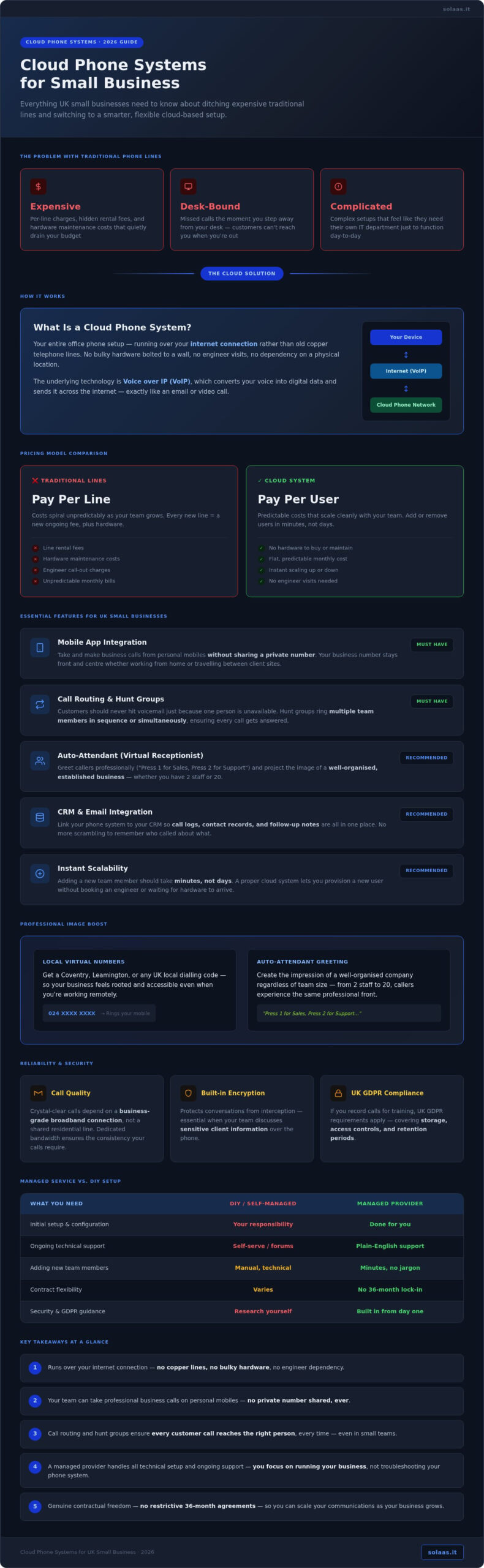
- A cloud phone system for small business runs over your internet connection, replacing costly traditional phone lines with a simpler, user-based pricing model that’s far easier to budget for.
- The right system gives your team the freedom to take professional business calls on their personal mobiles — without ever sharing a private number — so you’re no longer tied to a desk to stay reachable.
- Features like call routing and hunt groups mean that even the smallest teams can ensure every customer call reaches the right person, every time.
- Working with a managed provider like SolaaS means the technical setup and ongoing support is handled for you, so you can focus on running your business rather than troubleshooting your phone system.
- Unlike many providers, SolaaS offers genuine contractual freedom — no restrictive 36-month agreements — giving you the flexibility to scale your communication setup as your business grows.
Modernising Your Communication: Why Small Businesses Need a Cloud Phone System
Think of a cloud phone system as your entire office phone setup, but running over your internet connection rather than old copper telephone lines. There’s no bulky hardware bolted to a wall, no engineer visits every time something breaks, and no dependency on a physical location to stay connected. Your calls travel digitally, your team stays reachable, and your business keeps moving — whether that’s from a Coventry office, a home study, or a hotel room in Birmingham.
The shift this technology brings to small businesses is genuinely significant. Traditional landlines charge you per line, which means the moment your team grows or your needs change, costs spiral unpredictably. A cloud phone system flips that model entirely. You pay per user instead, making it straightforward to budget, scale up, or scale back without nasty surprises on your monthly invoice.
The Financial Benefits for Growing Teams
Physical phone systems come with hidden costs that quietly drain small business budgets: line rental fees, hardware maintenance, and the occasional call-out charge when something fails. A cloud-based approach eliminates most of that overhead. Your costs become predictable, your planning becomes easier, and your finance team will thank you for it. The underlying technology making this possible is Voice over IP (VoIP) technology, which converts your voice into digital data and sends it across the internet, just like an email or a video call.
Enhancing Your Professional Image
Here’s something that often surprises smaller teams: a cloud phone system for small business doesn’t just improve how you communicate internally, it transforms how customers perceive you from the very first ring. Features like Auto-Attendants greet callers professionally (“Press 1 for Sales, Press 2 for Support”) and create the impression of a well-organised, established company, regardless of whether you have two staff members or twenty.
Pair that with a local virtual landline number — a Coventry or Leamington dialling code, for instance — and your business feels rooted and accessible even when you’re working remotely. Customers trust what feels familiar, and a local number delivers exactly that.
Building a professional identity is a priority for any organisation; just as a sports club creates a unified look with custom kits from sUperstar, a small business uses its phone system to project a professional and reliable image to its customers.
Choosing the Right System: Essential Features for UK Small Businesses
Not all cloud phone systems are built the same, and for a small business, choosing the wrong one can be just as frustrating as sticking with the traditional setup you’re trying to escape. The features you prioritise now will shape how your team communicates, how your customers experience you, and how easily your system grows alongside your business.
Here are the features that genuinely matter for UK small businesses in 2026:
- Mobile app integration: Your team should be able to take and make business calls from their personal mobiles without ever handing out a private number. A good mobile app keeps your business number front and centre, whether someone’s working from home or travelling between client sites.
- Call routing and hunt groups: When a customer calls, they shouldn’t reach a voicemail because the one person they needed was unavailable. Hunt groups ring multiple team members in sequence or simultaneously, so calls get answered even in a small team with shifting schedules.
- CRM and email integration: Linking your cloud phone system for small business to tools like your CRM means call logs, contact records, and follow-up notes are all in one place. No more scrambling to remember who called about what.
- Instant scalability: Adding a new team member should take minutes, not days. A genuinely flexible system lets you provision a new user without booking an engineer or waiting for hardware to arrive.
If you’re weighing up your options, exploring a managed service means these features come configured for your business from day one, rather than leaving you to piece things together yourself.
Reliability and Call Quality
Crystal-clear calls aren’t just a nice-to-have; they’re a basic expectation for any professional business. The quality of your business broadband connection plays a significant role here. A dedicated business-grade connection, rather than a shared residential line, provides the consistency your calls need. Equally important is having support that speaks plain English when you need to adjust settings quickly, without wading through technical jargon at the worst possible moment.
Security and Compliance
If your business records calls for quality or training purposes, UK GDPR requirements mean you need to handle that data carefully, including how it’s stored, who can access it, and how long it’s retained. Built-in encryption protects your conversations from interception, which matters particularly if your team discusses sensitive client information over the phone. A reputable cloud phone system for small business should handle this as standard, not as an optional extra you have to request separately.
The SolaaS Approach: Local Expertise Without the Long-Term Contracts
There’s a fundamental difference between a provider that sells you a phone system and one that actually partners with you to make it work. SolaaS sits firmly in the second camp. Rooted in the Midlands and serving businesses across Coventry, Leicester, Warwick, and Leamington, the approach here is built on a straightforward principle: your communication setup should work for you, not the other way around.
That starts with something refreshingly rare in the telecoms industry. No restrictive 36-month agreements. No being locked into a contract that made sense on day one but becomes a frustration six months later when your business needs change. Contractual freedom isn’t a small print detail at SolaaS; it’s a core part of how the service is delivered.
Underpinning everything is a partnership with industry leaders Wildix and Xbees, whose platforms provide the technology backbone for bespoke, flexible solutions. Rather than fitting your business into an off-the-shelf package, SolaaS configures the right combination of tools for your specific situation, whether you’re a two-person professional services firm or a growing retail operation with multiple sites.
Why Managed Telephony Beats DIY
Self-service setup sounds appealing until you’re three hours deep into a configuration problem with customers unable to reach you. With SolaaS, the technical heavy lifting is handled from the start: number porting, system configuration, staff training, and ongoing proactive monitoring so that your cloud phone system for small business stays reliable without you ever having to think about it. That’s the value of managed IT support services done properly.
Tailored Solutions for Your Sector
A solicitor’s practice has different communication needs to a retail shop or a construction firm. SolaaS recognises that, which is why solutions are shaped around your specific sector rather than applied generically. Having a single partner managing your IT, internet, and telephony also removes the frustrating finger-pointing that happens when multiple providers are involved and something goes wrong.
If you have any questions about this article and how it affects your business, please contact us and a member of the SolaaS team will be happy to help.
Your Business Deserves Better Than an Outdated Phone System
The way small businesses communicate has changed, and the right cloud phone system for small business is no longer a luxury reserved for larger organisations. It’s a practical, affordable step that removes the frustration of missed calls, unpredictable costs, and being tied to a desk.
What makes the difference isn’t just the technology itself, it’s having a partner who configures it properly, supports you when you need it, and doesn’t lock you into a contract that stops working for you the moment your business evolves. That’s precisely what sets a bespoke, locally supported approach apart from a generic off-the-shelf solution.
With no long-term commitment, a Midlands-based support team who understand your business, and solutions built around your specific needs rather than a standard template, there’s genuinely no reason to keep putting this decision off.
If you have any questions about this article and how it affects your business, please contact us and a member of the SolaaS team will be happy to help you take the next step with confidence.
Frequently Asked Questions
Is a cloud phone system reliable enough for a small business?
Yes, and for most small businesses it’s actually more reliable than a traditional landline. Modern cloud phone systems are hosted across multiple data centres, which means if one location experiences a problem, your calls automatically route through another without any interruption on your end. The main variable is your internet connection, which is why pairing your system with a business-grade broadband connection rather than a residential line makes a genuine difference to call consistency.
Providers like SolaaS also carry out proactive monitoring, catching potential issues before they affect your team. That’s a level of oversight most small businesses simply don’t get with a traditional phone setup.
Can I keep my existing business phone number when I switch to the cloud?
In almost all cases, yes. The process is called number porting, and it allows your existing business number to be transferred across to your new cloud phone system for small business without any disruption to incoming calls. Your customers won’t notice a thing, and you won’t lose the number recognition you’ve built up over time. The porting process does take a little time to complete, so it’s worth factoring that into your switchover plan.
A managed provider handles this process on your behalf, which removes the administrative back-and-forth that can otherwise make number porting feel more complicated than it needs to be.
What happens to my phone system if the office internet goes down?
This is one of the most common concerns businesses raise, and it’s a fair one. The practical answer is that your mobile app keeps working regardless of what’s happening at the office. Because a cloud phone system for small business routes calls over the internet rather than a physical line, your team can continue taking and making calls from their mobiles using your business number, even if the office broadband goes down entirely. Customers reach the same number and get the same professional experience.
Call routing rules can also be configured in advance so that if the office is unreachable, calls automatically divert to a mobile or another location. You set the rules once, and the system handles the rest.
Do I need to buy special hardware or new handsets to use a cloud system?
Not necessarily. Many small businesses run their cloud phone system entirely through desktop apps and mobile applications, which means your existing computers and smartphones are all you need to get started. Physical handsets are available if your team prefers a traditional desk phone feel, but they’re optional rather than a requirement, and there’s no need to invest in expensive on-site hardware to make the system work.
This is one of the reasons the switch is often more straightforward than businesses expect. Without hardware installation to schedule, getting up and running is largely a matter of configuration rather than logistics.

Article by
René Wheeler
René Wheeler is Managing Director of SolaaS, bringing over three decades of experience in IT and telecoms. He is a strong advocate for transparency and flexibility, championing monthly contract models that allow businesses to stay agile and in control of their technology. His approach challenges traditional industry practices and puts client outcomes first