
Business Broadband: The Complete Guide for UK Companies in 2026
Frozen video calls. Frustratingly slow downloads. That constant, nagging feeling that your internet connection is a bottleneck, not a launchpad for success. If unreliable connectivity is killing your team’s productivity, you’re not alone. Choosing the right business broadband for your UK company can feel like navigating a minefield of confusing jargon-from FTTP and leased lines to SLAs and static IPs. How can you be sure you’re not getting locked into an expensive, unsuitable contract?
Welcome to your definitive guide for 2026. We’re here to cut through the noise and empower you to make a confident, informed decision. In this article, we’ll demystify the technology, help you calculate the exact speed your operations demand, and reveal the features that truly matter for your company’s growth. Discover how to secure a fast, reliable, and scalable connectivity solution, backed by the expert support you deserve. It’s time to turn your internet into your greatest competitive advantage.
Key Takeaways
- Business-grade connections prioritise reliability and performance over raw speed. Learn the key differences to ensure your company stays online when it matters most.
- The ‘best’ broadband technology and speed depend entirely on your daily operations. Assess your team’s needs to avoid overpaying for a connection you don’t need or choosing one that slows you down.
- Look beyond the connection itself to features that drive real business value, such as static IPs, enhanced security, and superior support that can boost productivity.
- Choosing the right business broadband is a strategic decision. This guide provides a clear framework for selecting a flexible solution that fuels your company’s growth and efficiency.
What is Business Broadband (And Why It’s Not the Same as Home Internet)
While most people are familiar with what broadband is from their home setup, a dedicated business broadband connection operates on a completely different level. It’s not just about faster download speeds for streaming; it’s a robust, commercial-grade service engineered for unparalleled reliability and consistent performance. Think of it as the central nervous system of your company-a tailored solution designed to support critical operations, from cloud applications and VoIP calls to secure data transfers.
In today’s digital-first economy, your internet connection is a direct driver of efficiency and revenue. Even minor disruptions can halt productivity, frustrate customers, and lead to tangible financial losses. Choosing a residential package for a commercial environment is a false economy, leaving your operations vulnerable when you can least afford it. A professional connectivity solution is an investment in your company’s stability and growth.
Key Differentiators: Beyond the Speed Test
The real value of a business connection lies in the services and guarantees that underpin the raw speed. These are the features that keep your company operational, secure, and supported.
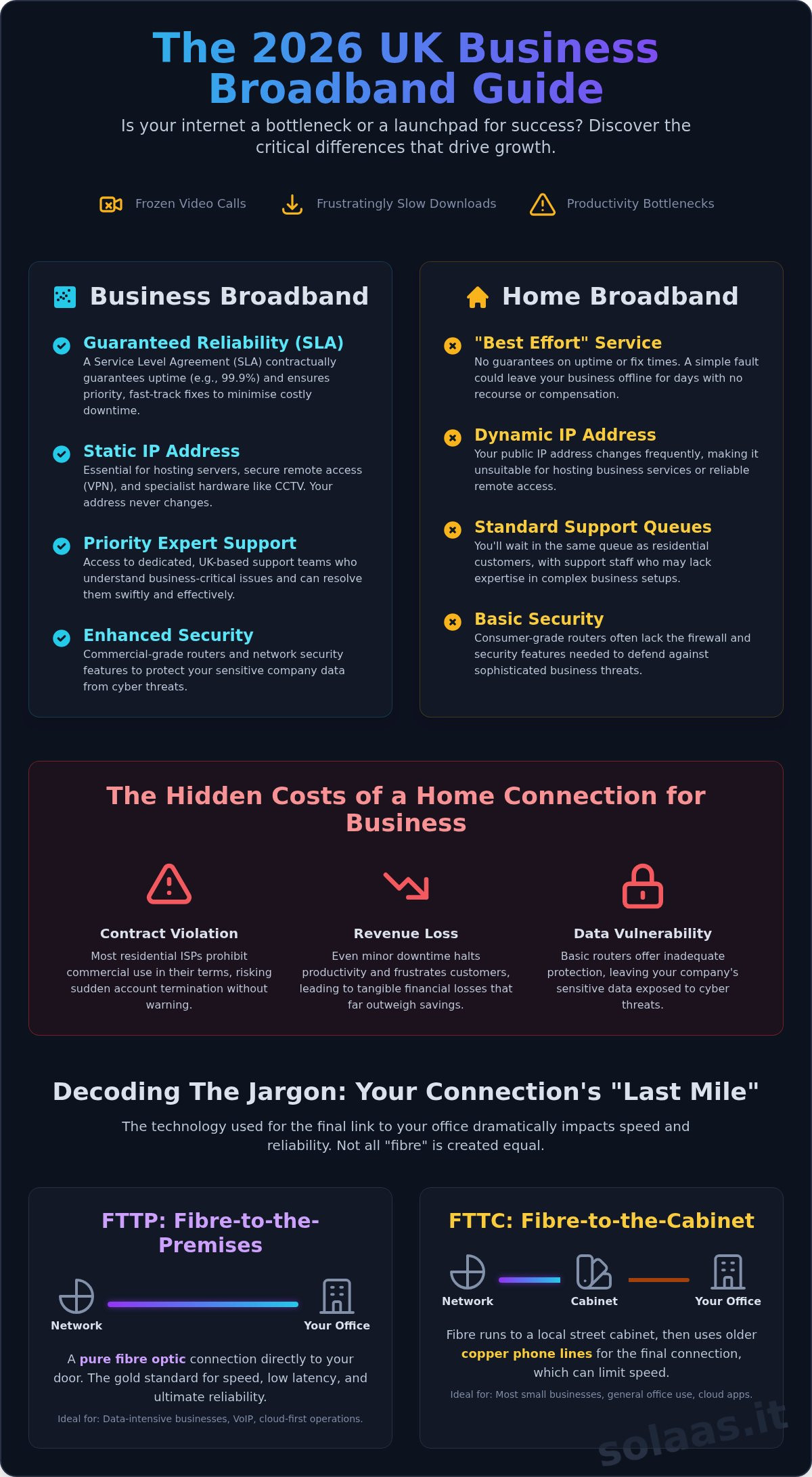
- Service Level Agreements (SLAs): Unlike residential ‘best effort’ services, business packages come with a contractually guaranteed level of uptime (e.g., 99.9%). If an issue occurs, the SLA ensures a much faster, prioritised fix time, minimising costly downtime.
- Static IP Addresses: A static IP is essential for hosting your own servers, running a secure Virtual Private Network (VPN) for remote staff, or using specialist equipment like CCTV systems. Residential connections typically use dynamic IPs, which change frequently and are unsuitable for these tasks.
- Priority Customer Support: When your connection is down, you can’t wait in a standard queue. Business providers offer dedicated UK-based support teams with the expertise to diagnose and resolve complex technical issues swiftly and effectively.
The Hidden Costs of Using a Residential Connection for Business
Attempting to run your company on a home internet plan can introduce significant risks and unexpected costs. Many businesses learn this lesson the hard way, when an outage costs them thousands of pounds in lost revenue. Key risks include violating your ISP’s terms of service, which can lead to termination of your account without warning, and the lack of an SLA, meaning a simple fault could leave you offline for days with no recourse or compensation. Furthermore, the basic routers supplied with residential packages often lack the advanced security features needed to protect your sensitive company data from cyber threats.
Decoding the Jargon: A Plain-English Guide to Broadband Technologies
Navigating the world of business broadband can feel like learning a new language. But finding the right solution is simpler than it seems-it’s about matching the technology to your specific operational needs, budget, and location. The “best” connection isn’t a one-size-fits-all product; it’s a tailored solution that empowers your team to work efficiently.
Think of it like choosing a transport route. A standard broadband connection is like a public road: it’s cost-effective and gets you there, but you share it with other traffic, which can cause slowdowns during peak hours. A dedicated leased line, however, is your own private motorway-clear, direct, and exclusively for your use.
This difference often comes down to the “last-mile” connectivity-the final physical link from the provider’s network to your premises. Whether that last mile is modern fibre optic cable or older copper wire dramatically impacts your speed and reliability.
Fibre Broadband (FTTP & FTTC)
Fibre broadband is the most common choice for UK businesses, but not all “fibre” is created equal. Fibre-to-the-Cabinet (FTTC) brings high-speed fibre to a street cabinet, but then uses existing copper phone lines for the “last mile” into your office. In contrast, Fibre-to-the-Premises (FTTP) is a pure fibre optic connection right to your door, offering superior speeds and reliability. The distinction is crucial, as performance varies significantly. To help businesses navigate these differences, Ofcom has published official guidance on broadband terms to tackle provider ambiguity.
- Ideal for: Most small to medium-sized businesses, companies reliant on cloud applications (like Office 365 or Salesforce), and general office internet use.
- Pros: Excellent speeds, wide availability across the UK, and highly cost-effective.
- Cons: It’s a “contended” service (shared with other users), and speeds are typically asymmetrical, meaning uploads are much slower than downloads.
Leased Lines (Dedicated Fibre)
A leased line is the gold standard for business connectivity. It’s a private, dedicated fibre optic line rented exclusively for your business, creating a direct, uncontended link to the internet. This is your private motorway, free from traffic jams. You get symmetrical speeds (uploads are as fast as downloads) and a robust Service Level Agreement (SLA) that guarantees uptime and rapid fault resolution, making it a cornerstone for mission-critical operations.
- Ideal for: Businesses that depend on VoIP phone systems, transfer large data files, host servers, or cannot afford any downtime.
- Pros: Unparalleled reliability, guaranteed symmetrical speeds, and robust SLAs.
- Cons: Significantly higher cost (often several hundred pounds per month) and a longer installation lead time.
Wireless & Satellite Solutions (5G & Starlink)
When fixed lines aren’t feasible, wireless technology provides a powerful and flexible alternative. 5G business broadband uses the mobile network to deliver fibre-like speeds without the need for physical cables, enabling rapid deployment for new sites or temporary locations. For businesses in rural or hard-to-reach areas, satellite solutions like Starlink have become a game-changer, offering high-speed connectivity where traditional options fail. These are also excellent as a secondary backup line to ensure seamless continuity.
- Ideal for: Remote or rural businesses, temporary sites, rapid deployment needs, or as a resilient backup connection.
- Pros: Extremely fast to set up and can provide connectivity anywhere with a clear signal.
- Cons: Performance can be affected by weather or physical obstructions, and latency can be higher than with fibre.
How to Choose the Right Speed and Package for Your Business
Selecting the right business broadband isn’t a race to the highest advertised speed. The optimal solution is a tailored one, balancing performance, reliability, and cost-effectiveness to match your unique operational demands. Choosing correctly ensures you aren’t paying for capacity you don’t use, while also preventing the productivity losses that come from an under-provisioned connection. A strategic approach puts the reins of your connectivity firmly back in your hands.
Step 1: Assess Your User Count and Usage Patterns
First, evaluate how your team uses the internet. Your needs will scale with your operations, so understanding your current profile is key to finding a flexible solution.
- Low Usage (1-5 staff): Core activities include email, web browsing, and occasional cloud file sharing. A standard fibre connection is often sufficient.
- Medium Usage (5-20 staff): Characterised by heavy use of cloud applications (e.g., Office 365, Salesforce), VoIP phone systems, and regular HD video calls. Here, strong upload speeds become critical.
- High Usage (20+ staff): Involves constant large file transfers, hosting servers, or simultaneous high-quality video streaming. This often requires a dedicated, high-capacity connection.
Step 2: Calculate Your Required Bandwidth
While not an exact science, you can estimate your needs. Consider the bandwidth requirements of your most common applications and plan for concurrent use. For example, a single HD video call can use 2-4 Mbps, while a VoIP call needs around 0.1 Mbps. Crucially, activities like video conferencing and uploading to the cloud depend on upload speed-a factor often overlooked in standard packages. We recommend planning for 30-50% extra capacity to accommodate peak times and future growth.
Step 3: Consider Reliability and Uptime Needs
For modern businesses, connectivity is mission-critical. Ask yourself: what would one hour of downtime cost your business in pounds? If the answer is significant, reliability becomes your top priority. A standard business broadband package with a basic Service Level Agreement (SLA) may not be enough. For operations where any interruption causes major disruption, a dedicated leased line with guaranteed uptime or a seamless 5G failover backup solution provides the resilience and peace of mind you need to operate with confidence.
Essential Features and Add-Ons That Drive Business Value
A high-speed connection is the price of entry, but the real competitive advantage lies in the features built on top of it. The right business broadband package moves beyond simple internet access, transforming your connectivity into a powerful, integrated solution. These value-added services are designed to enhance security, boost productivity, and provide the flexibility modern companies need to thrive. A forward-thinking provider bundles these elements to create a seamless and robust digital foundation for your operations.
Static vs. Dynamic IP Addresses
In simple terms, a dynamic IP address can change, while a static IP address is a permanent, fixed address for your business on the internet. While a dynamic IP is fine for casual browsing, a static IP is essential for many professional functions. Most genuine business broadband solutions will include at least one as standard.
A static IP is crucial if you need to:
- Host your own website or email server.
- Provide reliable remote access for staff via a Virtual Private Network (VPN).
- Access on-site equipment like servers or CCTV systems from an external location.
Managed Routers and Network Security
The router your provider supplies is your gateway to the internet, and a business-grade, managed device offers significant advantages. Unlike consumer hardware, these routers are built for higher traffic and offer advanced security features. When a provider manages the router, they handle all configuration, security updates, and troubleshooting. This proactive approach not only strengthens your network with add-ons like content filtering and threat management but also dramatically reduces the IT burden on your team, freeing you to focus on your core business. Ensuring your network is secure is just one part of a broader compliance picture; understanding your obligations under UK GDPR is equally important for protecting the sensitive data that flows across it.
Integrating with Cloud Services like VoIP
Your broadband connection is the bedrock for all modern cloud services. This is especially true for cloud-based phone systems (VoIP), which depend on a stable, high-quality connection for crystal-clear communication. The best providers use Quality of Service (QoS) technology, which intelligently prioritises voice traffic over other data. This prevents call jitter or dropouts, even during peak network usage, and is fundamental to creating a truly unified communications strategy for your business. Great connectivity is the engine that powers modern work.
See how our Cloud Phone Systems rely on great connectivity to deliver unparalleled performance.
Why Partner with SolaaS for Your Business Connectivity?
Choosing the right internet connection is more than a technical decision; it’s a strategic move for your company’s success. After exploring the different types of connections, speeds, and security considerations, the final step is selecting a provider who acts as a true partner. At SolaaS, we move beyond the transactional sale to become an extension of your team, delivering connectivity solutions that meet your needs and services that exceed your expectations.
We understand that the right business broadband isn’t just about speed-it’s about reliability, flexibility, and expert support. It’s about empowering your team to work efficiently without interruption. That’s why we’ve built our services around the real-world challenges UK businesses face every day.
Solutions Tailored to You, Not Off-the-Shelf Packages
Your business is unique, and your connectivity should be too. Instead of forcing you into a rigid, pre-defined package, we start by understanding your specific operational needs, from daily tasks to long-term growth ambitions. This allows us to recommend the perfect technology for you.
- A Comprehensive Technology Portfolio: We offer a full spectrum of connectivity options, including ultra-fast FTTP, uncontended dedicated Leased Lines, and innovative Starlink solutions for even the most remote locations.
- Unparalleled Flexibility: Break free from the constraints of long-term contracts. Our flexible, month-to-month options put the control back in your hands, allowing you to scale your services as your business evolves.
Expertise and Support You Can Rely On
Great technology is only half the solution. When you need help, you need it fast from someone who understands your setup. Our UK-based team of experts is dedicated to providing proactive and responsive support. We don’t just sell you a connection; we manage it for you, ensuring a seamless installation and switching process with minimal disruption. By providing a single point of contact for all your connectivity and IT needs, we simplify your operations and let you focus on what you do best: running your business.
Ready to experience a better way to manage your business broadband? Speak to a SolaaS expert today and discover how a true technology partner can make all the difference.
Your Next Step to Superior Business Connectivity
Choosing the right connection is one of the most critical decisions a modern UK company can make. As this guide has shown, understanding the difference between residential and professional services, decoding the technology, and identifying essential features are the first steps toward future-proofing your operations. Ultimately, the best business broadband isn’t just a utility; it’s a strategic asset that fuels your efficiency and competitive edge.
At SolaaS, we believe your connectivity partner should empower, not restrict you. That’s why we’ve replaced rigid, long-term commitments with flexible month-to-month contracts. Our expert UK-based IT and telecoms support team is dedicated to crafting tailored solutions that scale with your ambitions. And as an Authorised Starlink Reseller, we deliver high-speed connectivity to businesses everywhere, from bustling city centres to the most remote rural locations.
Welcome to a new era of IT. Take the next step towards seamless, reliable connectivity that puts you in control. Talk to an expert about your business connectivity needs today.
Frequently Asked Questions About Business Broadband
How much does business broadband cost in the UK?
Costs vary based on technology and required performance. A standard business fibre package typically starts from £25-£40 per month. For more robust full-fibre (FTTP) solutions with higher speeds, expect to pay between £40 and £100+. Dedicated leased lines, offering unparalleled, guaranteed speeds and reliability, are a premium investment, usually starting from £200 per month and increasing based on your specific bandwidth needs. It’s about tailoring the solution to your operational demands and budget.
What is a fair contention ratio for a business fibre connection?
A contention ratio shows how many users share bandwidth. For business connections, a ratio of 20:1 or lower is considered effective, providing a significant performance uplift compared to typical 50:1 home broadband ratios. This ensures more consistent speed, especially during peak hours. For mission-critical tasks, a dedicated leased line provides an uncontended 1:1 ratio, where all the bandwidth is exclusively yours, guaranteeing seamless connectivity and maximum efficiency for your operations.
Do I really need a static IP address for my small business?
While not every business needs one, a static IP is crucial for certain functions. If you host your own website, run an email server, or need reliable remote access for staff using a VPN, a static IP is essential. It provides a fixed, unchanging address for your network, enhancing security and accessibility for these key services. For general web browsing and cloud applications, a dynamic IP is often sufficient, but a static IP puts you in greater control.
How long does it take to get a new business broadband line installed?
Installation times depend on the connection type and existing infrastructure. A standard fibre (FTTC) line can often be activated within 10-15 working days, assuming a phone line is already in place. A new full-fibre (FTTP) installation may take several weeks. For a dedicated leased line, which is a fully tailored solution requiring engineering work, you should plan for a lead time of 45-90 working days. Proactive planning is key to a smooth transition.
Can I get fast business broadband in a rural area?
Absolutely. While connecting rural businesses has been a challenge, modern technology offers powerful solutions. The national full-fibre (FTTP) rollout is continually expanding, and high-speed 4G/5G mobile broadband can be an excellent alternative. Furthermore, innovative satellite services like Starlink now provide high-performance connectivity to even the most remote locations. A tailored strategy ensures you can get the fast business broadband your company needs to thrive, wherever you are.
What’s the difference between a business broadband router and a home one?
A business router is engineered for superior performance, security, and control. Unlike standard home routers, they feature advanced firewalls, robust VPN capabilities for secure remote work, and the ability to create separate guest Wi-Fi networks to protect your core systems. They are built with more powerful hardware to handle a higher volume of simultaneous connections without sacrificing speed or stability, providing a reliable foundation for your business operations.

Article by
René Wheeler
René Wheeler is Managing Director of SolaaS, bringing over three decades of experience in IT and telecoms. He is a strong advocate for transparency and flexibility, championing monthly contract models that allow businesses to stay agile and in control of their technology. His approach challenges traditional industry practices and puts client outcomes first