
Cloud Phone System: The Ultimate Guide for UK Businesses
Is your traditional office phone system feeling more like a liability than an asset? For many UK businesses, the reality of expensive maintenance, missed calls, and a system unable to support a flexible, hybrid workforce is a daily frustration. If you’re tired of being tethered to outdated technology that’s draining your budget and limiting your team’s potential, it’s time to put the reins of your communications firmly back in your hands.
Welcome to a new era of business connectivity. This ultimate guide is designed to demystify the cloud phone system-a powerful, scalable solution built for the dynamic demands of modern work. We will cut through the technical jargon and show you exactly how making the switch can revolutionise your operations, enhance productivity, and improve your bottom line. Discover how to connect your team from anywhere, project an unparalleled professional image with modern features, and finally adopt a telecoms solution that grows with your business, not against it.
Key Takeaways
- Discover how switching to the cloud delivers tangible cost savings and boosts team productivity, turning your telecoms from a cost centre into a strategic asset.
- Identify the essential features your business needs, from seamless call management to mobile app integration, to ensure you choose a future-proof solution.
- Develop a clear framework for selecting the right cloud phone system provider in the UK, ensuring you find a partner that aligns with your specific business goals.
- Demystify the migration process and gain the confidence to make the switch, with a clear understanding of the steps to a smooth, planned transition.
What is a Cloud Phone System? A Plain English Guide
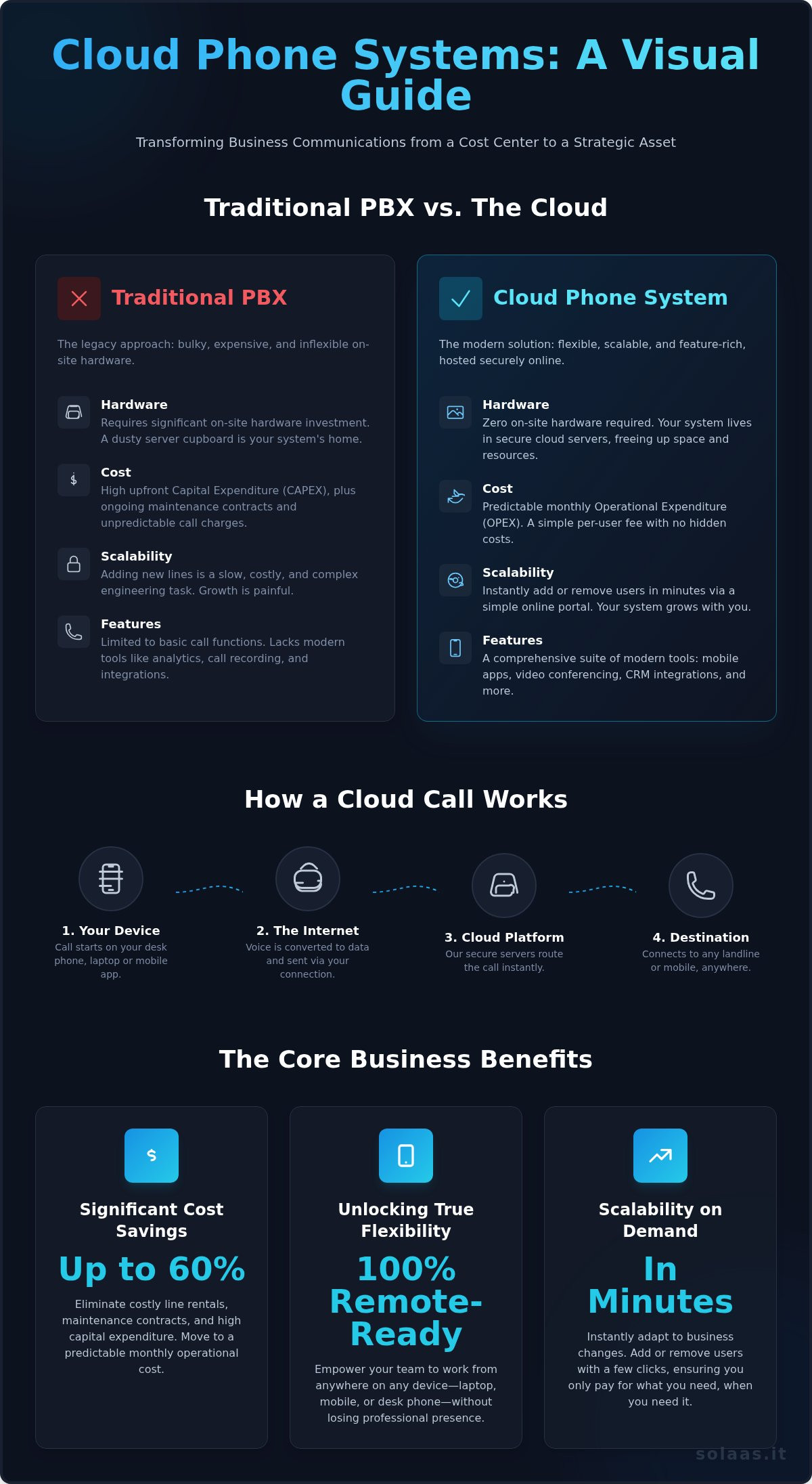
Think of a cloud phone system as your business’s entire phone service, hosted securely online rather than in a dusty server cupboard. It leverages Voice over IP (VoIP) technology to make and receive calls over your existing internet connection, breaking free from the constraints of traditional phone lines. This marks a significant shift from on-premise PBX systems, which rely on bulky, expensive hardware to function.
The core value is transformative: unparalleled flexibility, effortless scalability, and access to advanced features that drive efficiency. It’s a cornerstone of modern Cloud communications, often forming the central hub of a Unified Communications as a Service (UCaaS) solution that seamlessly integrates voice, video, and messaging into one powerful platform.
How Does a Cloud Phone System Actually Work?
The process is remarkably simple and elegant. When you make a call, your voice is instantly converted into tiny digital data packets. These packets travel securely and rapidly across your internet connection to our cloud servers. From there, the system intelligently routes the call to its destination-whether it’s a landline down the road or a mobile phone on another continent. This happens in milliseconds, ensuring crystal-clear, high-definition audio for every conversation.
Traditional PBX vs. Cloud Phone System: The Key Differences
Understanding the distinction highlights why so many UK businesses are making the switch. The contrast is clear across four key areas:
- Hardware: A traditional PBX demands a significant on-site hardware investment. A cloud solution requires no physical box, freeing up valuable space and resources.
- Cost: PBX systems involve high upfront capital expenditure (CAPEX) and ongoing maintenance fees. The cloud model uses a predictable monthly operational expenditure (OPEX), often saving businesses thousands of pounds per year.
- Scalability: Adding a new line to a PBX is a slow, often costly, engineering task. With a cloud system, you can add or remove users in minutes through a simple online portal.
- Features: While a PBX offers basic call functions, cloud systems provide a comprehensive suite of modern tools like auto-attendants, call recording, and analytics to boost productivity.
Is a Cloud Phone System the Same as VoIP?
Not quite, and it’s an important distinction. Think of it this way: VoIP is the underlying technology-the digital ‘road’ that carries your voice data from one point to another. The cloud phone system is the complete solution built on that road. It includes the user-friendly management portal, advanced features like video conferencing and CRM integration, and the expert support that ensures your business communications run seamlessly.
The Core Business Benefits of Switching to the Cloud
Moving your business communications to the cloud is more than a technical upgrade; it’s a strategic decision that delivers tangible, bottom-line results. A modern cloud phone system puts the reins of your communications firmly back in your hands, transforming a traditional cost centre into a powerful asset for growth, flexibility, and customer satisfaction.
Significant Cost Savings and Predictable Billing
Break free from the financial constraints of legacy phone systems. By switching to the cloud, you eliminate the significant upfront capital expenditure (CAPEX) on expensive on-site hardware. Businesses can see savings of up to 60% by removing costly line rental, maintenance contracts, and unpredictable call charges. Instead, you move to a simple, transparent operational expense (OPEX) with a predictable monthly fee per user, often including generous call packages to UK landlines and mobiles.
Unlocking True Flexibility for Hybrid and Remote Teams
Empower your team to work effectively from anywhere, at any time. A cloud-based solution allows staff to make and receive calls on their business number from any internet-enabled device, including laptops, desk phones, and mobile apps. The technology that makes this seamless connectivity possible is Voice over Internet Protocol (VoIP), which securely transmits calls over your broadband connection. This ensures your business remains fully operational and professional, whether your team is in the office, at home, or on the move.
Scalability on Demand: Grow (or Shrink) With Ease
Your communications should adapt to your business, not the other way around. A key advantage of a cloud phone system is its unparalleled scalability. Add or remove users instantly through a simple online portal, ensuring you only ever pay for the licences you need. This agility is perfect for seasonal businesses, project-based teams, or companies experiencing rapid growth, saving you the time and expense of installing new physical phone lines.
Access Enterprise-Grade Features for Any Size Business
Project a polished, professional image and enhance customer experience, regardless of your company’s size. Cloud solutions democratise access to powerful features once reserved for large corporations.
- Auto-Attendant: Greet callers professionally with a ‘Press 1 for Sales, Press 2 for Support’ menu.
- Intelligent Call Routing: Direct calls to the right person or department automatically, reducing wait times.
- Voicemail-to-Email: Receive voicemail transcriptions and audio files directly in your inbox so you never miss a message.
- Call Analytics: Gain valuable insights into call volumes, peak times, and staff performance to make data-driven decisions.
Essential Features to Look For in a Modern Cloud Phone System
Choosing the right cloud phone system means looking beyond a simple dial tone. The true power lies in features that streamline your operations, enhance customer interactions, and provide actionable insights. These modern capabilities are delivered over the internet using Voice over Internet Protocol (VoIP), a foundational technology explained well in this Federal Communications Commission guide to VoIP. To build your ideal ‘shopping list’, consider these essential features, grouped by the business challenges they solve.
Core Communication and Collaboration Tools
These are the foundational tools that ensure your team stays connected and your customers receive a seamless, professional experience every time they call.
- Auto-Attendant (IVR): Create a polished first impression. An auto-attendant greets callers with a professional menu and routes them to the correct department or individual, improving efficiency and customer satisfaction without needing a human receptionist.
- Call Forwarding & Routing: Never miss a crucial call again. Advanced routing rules ensure calls can be directed to mobile numbers, other team members, or specific departments based on time of day or caller ID, guaranteeing business continuity.
- Voicemail to Email: Boost productivity for your mobile workforce. This feature automatically transcribes voicemails and sends them as an audio file and text to a user’s email inbox, allowing them to respond faster from any device.
- Video Conferencing & Messaging: Unify your communications into a single platform. Integrated video and team messaging reduce reliance on multiple applications, fostering better collaboration and a more connected company culture.
Powerful Management and Analytics
A modern cloud phone system puts control and data firmly back in your hands, allowing you to manage your communications and make informed, data-driven decisions to improve performance.
- Admin Portal: Manage your entire phone system with ease. A user-friendly web portal allows you to add or remove users, change call routing, and configure settings in real-time from anywhere, without needing technical expertise.
- Call Recording: Enhance quality and ensure compliance. Record calls for staff training, quality assurance, dispute resolution, and to meet regulatory requirements in sectors like finance and law.
- Reporting Dashboards: Turn call data into business intelligence. Track key metrics like call volumes, peak times, wait times, and missed calls to optimise staffing levels and improve your overall service.
These tools provide the visibility you need to drive real business improvements. See the advanced features included with SolaaS solutions.
Crucial Business Integrations
Break down information silos and automate workflows by connecting your phone system to the other critical tools your business relies on every day.
- CRM Integration: Automatically log every call, note, and recording against the correct customer record in your CRM (like Salesforce or HubSpot). This saves time, eliminates manual entry, and gives your team a complete view of every customer interaction.
- Microsoft Teams Integration: Supercharge your collaboration hub by enabling external calling directly from the Teams interface. Your staff can make and receive calls using their business number within the application they use most, creating a truly unified workspace.
- Productivity Suite Integration: Connect with tools like Microsoft 365 and Google Workspace to sync contacts and schedule video meetings directly from your calendar, streamlining daily tasks and boosting efficiency.
How to Choose the Right Cloud Phone System Provider in the UK
Understanding the benefits of a cloud phone system is the first step. The next, more crucial stage is selecting the right provider to become your trusted partner. With a crowded UK market, making an informed decision is vital for your business’s productivity and growth. This practical framework will empower you to choose a solution that not only meets your needs today but also scales seamlessly with you tomorrow.
Step 1: Assess Your Business’s Unique Needs
A one-size-fits-all approach rarely delivers the best results. Before evaluating providers, look inward to define your specific requirements. A clear understanding of your operational needs ensures you invest in a tailored solution that drives efficiency, not just a list of features you won’t use. Ask yourself:
- Scalability: How many users do you have now, and what are your growth projections for the next 1-3 years?
- Call Volume: What is your typical daily volume of inbound and outbound calls during peak times?
- Essential Features: Which functions, like call recording, CRM integration, or an auto-attendant, will genuinely improve your workflow?
- Budget: What is your realistic monthly budget per user in pounds (£)?
Step 2: Evaluate Reliability, Security, and Uptime
Your phone system is a mission-critical tool where downtime means lost opportunities and frustrated customers. The technical foundation of your chosen provider is non-negotiable. Look for concrete proof of resilience and an unwavering commitment to protecting your data and conversations.
- Guaranteed Uptime: Seek a provider offering a Service Level Agreement (SLA) of 99.9% or higher.
- Robust Infrastructure: Ask about their data centre locations and network redundancy to ensure service continuity.
- Security Protocols: Ensure all calls are encrypted and that the platform is protected against threats.
- UK Compliance: Verify the provider is fully compliant with UK regulations, including UK GDPR.
Step 3: Prioritise UK-Based, Expert Support
When you need help, you need it fast and from someone who understands your context. Opting for a provider with a dedicated, UK-based support team can be the difference between a minor hiccup and a major business disruption. This is where a true partner proves their value.
- Availability: Is expert support available during your core UK business hours?
- Local Expertise: A UK team understands the local market, connectivity challenges, and regulatory landscape.
- Proven Track Record: Check independent reviews for feedback on support responsiveness and problem-solving skills.
- Personalised Service: Does the provider offer a dedicated account manager for a single, consistent point of contact?
By following this framework, you can cut through the noise and select a solution that truly empowers your team. At SolaaS, we believe this partnership approach is the only way to deliver services that exceed expectations.
The Migration Process: What to Expect When You Switch
The thought of changing your business phone system can seem daunting, filled with concerns about downtime and disruption. However, migrating to a modern cloud phone system is a structured, managed process designed for minimal impact. With a trusted partner guiding you, the transition is not just an upgrade in technology but a seamless step towards greater business agility and efficiency. Let’s demystify the key stages.
Discovery and System Design
Your journey begins with a comprehensive discovery phase. A dedicated specialist will audit your current telecoms setup, understand your team’s communication needs, and map out your business processes. This isn’t about a one-size-fits-all solution; it’s about designing a tailored call flow-from auto-attendants to call queues-that enhances your productivity and customer experience from day one.
Keeping Your Existing Business Numbers (Number Porting)
One of the most critical questions is: “Can I keep my number?” The answer is a definitive yes. We manage the entire number porting process on your behalf, coordinating directly with your previous carrier, whether it’s BT or another UK provider. This ensures complete continuity for your customers, who can continue to reach you on the numbers they already know and trust, with zero interruption.
Hardware Setup and Team Training
Whether you opt for new, feature-rich IP desk phones or prefer the flexibility of softphone applications on computers and mobiles, we ensure everything is ready to go. Any hardware arrives pre-configured and plug-and-play. Crucially, we provide comprehensive training for your team, ensuring everyone is comfortable and confident using the new system’s powerful features to their full potential.
Going Live and Ongoing Partnership
The final switch-over is meticulously planned and scheduled for a time that causes the least disruption to your operations, often outside of core business hours. Our team provides hands-on support during the go-live phase to ensure a smooth cutover. But our commitment doesn’t end there. We transition from migration managers to your ongoing strategic partner, providing continuous support and advice to help you get the most from your new communications solution.
Upgrading your business communications should be an empowering move, not a complex burden. Let us handle your seamless migration to the cloud.
Your Next Step Towards Smarter Communication
Moving to the cloud is no longer a future concept; it’s a strategic necessity for UK businesses seeking agility and efficiency. As this guide has shown, the benefits are clear: unparalleled scalability, significant cost-effectiveness, and the advanced features needed to thrive in a modern, hybrid work environment. The right system empowers your team to connect seamlessly, wherever they are.
The key to unlocking these advantages lies in choosing a partner that puts you in control. At SolaaS, we deliver a robust cloud phone system backed by our expert, UK-based support team and the freedom of flexible, month-to-month contracts. It’s why businesses across Coventry and the UK trust us as their partner in success. It’s time to invest in a communications solution that meets your needs and exceeds your expectations.
Discover a flexible, scalable cloud phone system for your business.
Frequently Asked Questions About Cloud Phone Systems
How much does a cloud phone system cost for a small business?
The cost is highly flexible and designed to scale with your business. Typically, you can expect to pay between £10 and £25 per user, per month. This price often includes a generous bundle of minutes, advanced features like call routing and voicemail-to-email, and ongoing support. Unlike traditional systems with high upfront costs, our solutions are tailored to your exact needs, ensuring you only pay for what you use and putting you in complete control of your budget.
Can I keep my existing business phone numbers when I switch?
Absolutely. Keeping your established business numbers is a seamless and standard part of the process, known as ‘number porting’. Our team of experts manages this transition for you, ensuring there is no disruption to your operations or loss of connectivity with your clients. This allows you to upgrade your technology while maintaining the brand consistency and contact details your customers already trust, making the switch completely hassle-free and professional from start to finish.
Do I need to buy special hardware or new phones?
Not at all. One of the greatest advantages of a cloud-based system is its flexibility. You can use your new service with existing VoIP-compatible desk phones, or you can forgo traditional hardware entirely. Your team can make and receive calls directly from their computers using a ‘softphone’ application or from their business mobiles via a dedicated app. This adaptability empowers your team to work from anywhere, breaking free from the constraints of office-based hardware.
How reliable is a cloud phone system compared to a landline?
Modern cloud phone systems offer unparalleled reliability, often exceeding that of a traditional landline. Hosted in secure, geographically redundant data centres, our systems are not vulnerable to local issues like line damage or power cuts at your office. With industry-leading uptime guarantees (often 99.999%), your business communications gain a new level of resilience. This robust infrastructure ensures business continuity and provides the dependable connectivity modern enterprises demand.
Is the call quality as good as a traditional phone line?
Yes, provided you have a stable business-grade internet connection, the call quality is exceptional-often clearer than a traditional analogue line. Our systems utilise HD Voice (High-Definition) technology, which captures a wider spectrum of audio frequencies for richer, more natural-sounding conversations. We can assess your existing connectivity to ensure it meets the requirements for a flawless audio experience, guaranteeing every call is crystal-clear and professional.
How long does it take to switch to a cloud phone system?
The switch is remarkably fast and efficient. For a new setup without number porting, you can be operational within a few business days. If you are porting existing numbers, the process is typically completed within 2 to 4 weeks, depending on your current provider. Our dedicated team manages the entire project to ensure a smooth, coordinated transition with minimal disruption, getting you connected to a more flexible communication solution as quickly as possible.
What happens if my internet connection goes down?
This is where the resilience of a cloud phone system truly shines. In the event of an internet outage at your office, your system’s intelligent call routing features automatically take over. Incoming calls can be seamlessly forwarded to designated mobile numbers, alternative landlines, or a voicemail service without your customers ever knowing there is an issue. This built-in disaster recovery ensures you never miss an important call and your business remains fully operational.

Article by
René Wheeler
René Wheeler is Managing Director of SolaaS, bringing over three decades of experience in IT and telecoms. He is a strong advocate for transparency and flexibility, championing monthly contract models that allow businesses to stay agile and in control of their technology. His approach challenges traditional industry practices and puts client outcomes first