
How to Prevent Ransomware Attacks: A 2026 Guide for UK Businesses
In 2024, the UK Government’s Cyber Security Breaches Survey reported that 50% of UK businesses suffered a cyber attack, making it critical to understand how to prevent ransomware attacks before they paralyse your operations. You likely feel the pressure of protecting your company from a total shutdown while navigating the fear of UK GDPR fines that can reach £17.5 million. It’s difficult to feel confident when you’re constantly second-guessing which security software actually provides the protection your team needs to stay productive.
We’re here to help you break free from that uncertainty with a comprehensive, multi-layered strategy designed for total data resilience. This guide provides a clear checklist of both technical and non-technical defences that will empower your business to stay ahead of 2026’s evolving threats. We’ll walk you through the essential steps to build a secure environment, giving you the peace of mind to focus on growth with a trusted partner by your side.
Key Takeaways
- Understand the shift toward “triple extortion” in the 2026 landscape and why UK SMEs must evolve their strategy to counter encryption, data theft, and DDoS threats.
- Master the “Defense-in-Depth” philosophy and the 3-2-1-1 backup rule to discover how to prevent ransomware attacks while ensuring total data immutability.
- Deploy AI-powered technical controls, such as EDR and advanced email scanning, to proactively detect malicious intent before it breaches your network perimeter.
- Transform your workforce into a resilient “Human Firewall” through continuous security awareness training that moves beyond traditional annual tick-box exercises.
- Explore how managed IT support provides UK businesses with the 24/7 proactive threat hunting and expert oversight required for total cyber resilience.
Understanding the 2026 Ransomware Landscape for UK Businesses
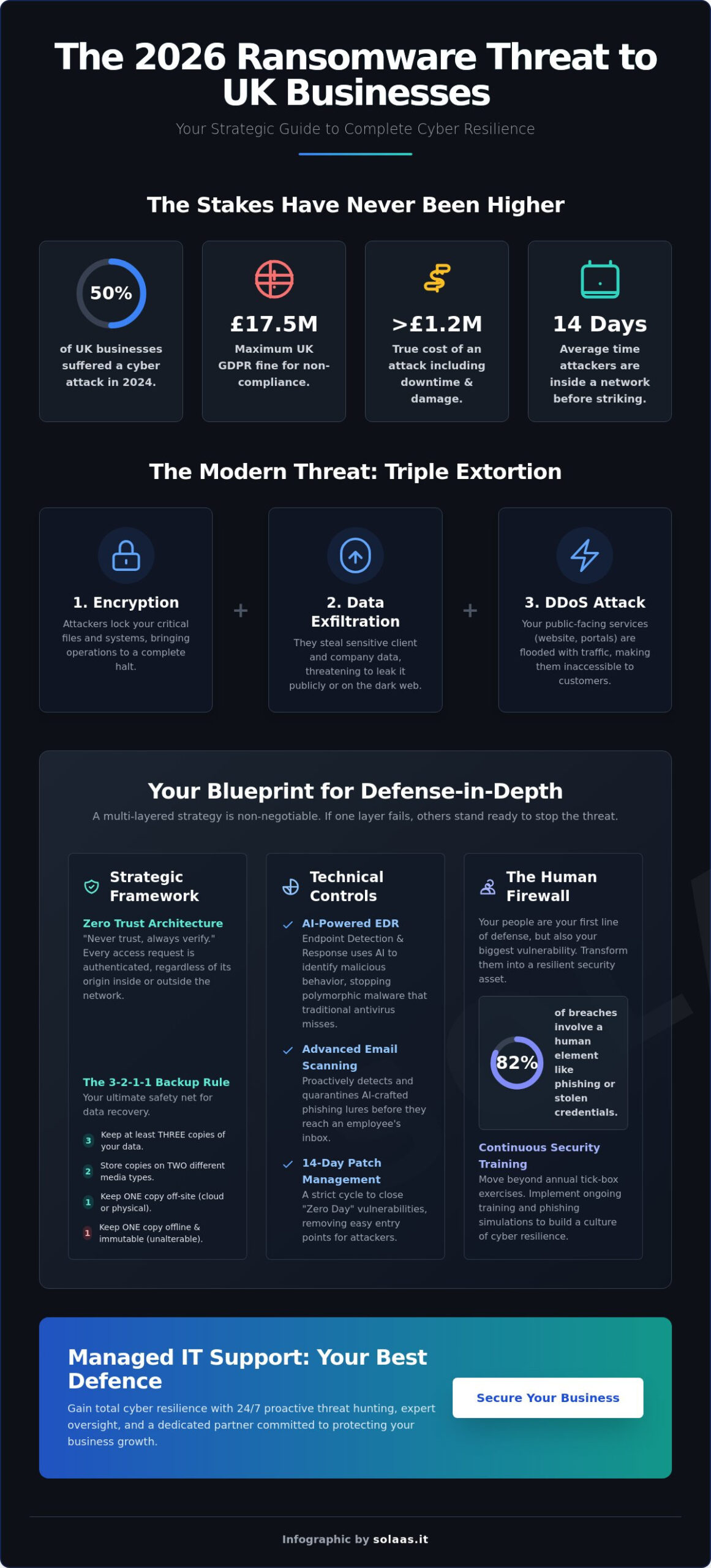
Ransomware has transitioned from a nuisance to a sophisticated, multi-stage extortion industry. In 2026, the threat isn’t just about locked files; cybercriminals now deploy “triple extortion” tactics. This strategy combines traditional encryption with massive data exfiltration and targeted Distributed Denial of Service (DDoS) attacks. If you don’t pay the ransom to unlock your data, the attackers threaten to leak sensitive client information or flood your servers with traffic to keep you offline. To grasp the severity, you should first understand the fundamentals of What is Ransomware? and how it has historically functioned.
UK SMEs are currently the primary targets for global syndicates because they often lack the enterprise-grade security of FTSE 100 firms but hold valuable data. Data from 2025 indicates that 53% of UK small businesses experienced at least one successful breach. The financial impact is staggering. While the average ransom demand might sit at £150,000, the true cost of an attack often exceeds £1.2 million when you factor in weeks of downtime, permanent reputational damage, and the loss of customer trust. Ransomware is a business-ending event rather than just an IT glitch.
Understanding how to prevent ransomware attacks is no longer an IT luxury; it’s a core survival strategy for any British firm. Relying on outdated recovery plans is a recipe for disaster in a landscape where attackers spend an average of 14 days inside your network before ever encrypting a single file.
The Evolution of ‘Ransomware-as-a-Service’ (RaaS)
UK Legal and Regulatory Implications
The legal fallout of a breach can be as damaging as the attack itself. Your responsibilities are clearly defined under UK GDPR explained: a complete guide for UK businesses, which mandates that you protect personal data with robust security. If a breach occurs, you must report it to the Information Commissioner’s Office (ICO) within 72 hours if there’s a risk to individuals. Failure to demonstrate “appropriate technical and organisational measures” can lead to fines of up to £17.5 million or 4% of your global turnover. The National Cyber Security Centre (NCSC) also strongly discourages ransom payments, as they don’t guarantee data recovery and may violate UK sanctions laws if the attackers are linked to prohibited regimes.
The Core Pillars of Ransomware Prevention: A Strategic Framework
Defense-in-Depth isn’t just a technical concept; it’s a non-negotiable necessity for any UK business operating in 2026. Think of your security like a medieval castle. You wouldn’t rely solely on a front gate. You need moats, high walls, and internal keeps. If one layer fails, others stand ready to stop the threat. Relying on a single firewall or antivirus tool is a recipe for disaster. A multi-layered strategy ensures that even if a spear-phishing email bypasses your initial filters, internal controls stop the lateral movement of malware. This holistic approach aligns perfectly with the UK government’s ransomware guidance, which stresses the importance of resilience over simple perimeter defense.
Zero Trust Architecture has shifted the security paradigm from “trust but verify” to “never trust, always verify.” It removes the assumption that anything inside your network is inherently safe. Every single request for access, whether from a remote worker in London or a server in your office, must be verified. This shift is vital because 82% of breaches now involve a human element or stolen credentials. Alongside this, you must implement a strict 14-day patch management cycle. Leaving “Zero Day” vulnerabilities open for weeks gives attackers an open door to your most sensitive data. Rapid patching is one of the most effective ways to solve the puzzle of how to prevent ransomware attacks before they even begin.
Immutable Backups: Your Last Line of Defence
Backups are your ultimate safety net, but modern ransomware specifically targets these files first to force a ransom payment. This is why the 3-2-1-1 rule is the new gold standard. You need three copies of your data on two different media types, with one copy off-site and one copy being “immutable.” An immutable backup is “write once, read many.” It cannot be changed, deleted, or encrypted by a hacker, even if they gain administrative credentials. Many businesses confuse cloud sync with a backup. Cloud sync is just a mirror; if your local files are encrypted, the cloud version is encrypted seconds later. True off-site, air-gapped storage keeps your data out of reach. Remember, a backup is useless if it hasn’t been verified. Statistics show that 60% of businesses fail to test their recovery plans annually, leaving them vulnerable when a crisis hits.
Identity and Access Management (IAM)
Controlling who has the keys to your digital kingdom is a critical component of how to prevent ransomware attacks. Multi-Factor Authentication (MFA) is the baseline, but you should move beyond SMS codes, which are vulnerable to SIM-swapping. Use hardware tokens or authenticator apps for better security. Implement the Principle of Least Privilege; your marketing team doesn’t need access to financial payroll folders. You should also automate your “Joiners, Movers, and Leavers” process. Dormant accounts from employees who left the company six months ago are prime targets for exploitation. If you want to ensure your business remains agile and secure, we can help you build a tailored security roadmap that puts the reins of your IT firmly back in your hands.
Technical Controls: Securing Your Network and Endpoints
Email remains the primary delivery mechanism for 91% of successful cyberattacks. Modern security solutions now utilize AI to analyze the linguistic intent of an email. These tools identify “social engineering” patterns that human eyes often miss, such as a subtle change in a CEO’s writing style or a spoofed domain that looks 99% identical to a trusted supplier. By stopping the threat at the inbox, you remove the reliance on employees making perfect decisions every time they click a link.
Network segmentation provides the final layer of internal defense. By dividing your network into isolated zones, you ensure that a breach in the marketing department cannot reach your financial records or core backups. This containment strategy is vital for stopping the lateral movement of malware. Your infrastructure should be designed so that every connection is verified, regardless of whether the user is in the office or working from a remote hub.
Securing Modern Connectivity: Starlink and Mobile Workforces
The rise of satellite-based internet has transformed remote operations. When deploying Starlink for business at rural sites or temporary UK projects, security must be integrated from day one. These connections require robust hardware-based encryption and centralized management to prevent them from becoming “blind spots” in your perimeter. Mobile devices are equally vulnerable; a 2024 report found that 85% of mobile attacks occur via “smishing” or malicious apps. Integrating these devices into your managed IT support services ensures that security patches are applied automatically across all hardware, keeping your distributed workforce resilient against evolving threats.
Next-Generation Firewalls (NGFW) and Web Filtering
Modern firewalls do far more than block unauthorized ports. Next-Generation Firewalls (NGFW) utilize Deep Packet Inspection to look inside encrypted traffic, identifying hidden malware that traditional filters ignore. This is a critical component of how to prevent ransomware attacks at the gateway. DNS filtering adds another layer by blocking access to known malicious domains and Command and Control (C2) servers. By preventing a device from “calling home” to the attacker’s infrastructure, you effectively neutralize the ransomware’s ability to receive encryption keys or exfiltrate sensitive data. This proactive approach ensures your team can browse the web safely while your network remains a hostile environment for intruders.
The Human Firewall: Building a Culture of Cyber Resilience
Your team is your first line of defence. While sophisticated software is vital, a 2024 report by the ICO found that human error accounted for over 60% of reported data breaches in the UK. This makes people the most frequent entry point for hackers. Understanding how to prevent ransomware attacks starts with shifting the mindset from viewing staff as a liability to empowering them as a “Human Firewall.”
Annual tick-box training sessions don’t work. By the time the next session rolls around, your team has forgotten the previous year’s lessons. Effective Security Awareness Training (SAT) must be continuous. Short, monthly modules keep threats top-of-mind. You should also run unannounced phishing simulations. These controlled tests help you identify which departments are most likely to click a malicious link. In 2025, firms that used monthly simulations saw a 40% reduction in successful phishing attempts compared to those doing annual reviews.
Encouraging a no-blame culture is equally critical. If an employee clicks a suspicious link, they must feel safe reporting it immediately. A delay of just 30 minutes can be the difference between an isolated incident and a company-wide lockout. When staff know they won’t be punished for an honest mistake, they become proactive partners in your security strategy.
Implementing Incident Response Plans
Having a structured response plan is a fundamental part of how to prevent ransomware attacks from escalating into total business failure. When the red light flashes, everyone needs to know their role. Your plan should define who shuts down the servers and who contacts the ICO. Communication is vital. You need templates ready to inform clients without triggering panic. Conduct tabletop exercises twice a year. Practicing a simulated ransomware event ensures your team reacts with calm precision rather than chaos.
Physical Security and Social Engineering
Cyber threats aren’t always digital. Social engineering tactics like “vishing” (voice phishing) are rising. Criminals often call UK reception desks pretending to be IT support to harvest credentials. Physical security matters too. Tailgating, where an unauthorised person follows a staff member through a secure door, remains a risk for 15% of London-based offices. Train your team to challenge strangers and never plug in “found” USB drives. These simple habits are essential components of securing your business future.
Why Managed IT is Your Best Defence Against Ransomware
For the average UK business, keeping pace with 2026’s cyber threat landscape is a full-time job your team likely isn’t equipped for. Research shows that over 80% of successful ransomware attacks occur outside of standard 9-to-5 office hours, often targeting the “quiet” periods when internal IT staff are offline. This gap is exactly why understanding managed IT support services is critical for survival. You need a partner that doesn’t just fix things when they break but actively hunts for vulnerabilities before they’re ever exploited.
SolaaS changes the game by offering flexible, month-by-month security solutions. We’ve removed the “contract trap” that keeps many UK SMEs locked into rigid, outdated service levels that no longer fit their needs. By aligning your security with your overall business strategy, we ensure your defence evolves as fast as the hackers do. It’s about giving you total control without the burden of constant technical oversight.
Proactive Monitoring vs. Reactive Break-Fix
The traditional “break-fix” model is obsolete in a world of instant encryption. If you’re waiting for an alert to tell you your files are locked, you’ve already lost the battle. Our Security Operations Centre (SOC) operates 24/7, providing the vigilance needed for how to prevent ransomware attacks in real-time. We use automated threat intelligence to share data across our entire managed network. If a new strain of malware hits a firm in London at 2 AM, your systems are shielded by 2:01 AM. Staying ahead of 2026 trends means using AI-driven predictive analysis to stop threats before they even reach your network perimeter.
Tailored Solutions for Your Business Needs
Generic security packages always leave “blind spots” in your infrastructure. Your business is unique; your security stack should reflect that. Whether you’re securing cloud phone systems for a remote workforce or protecting sensitive client data, we customise every layer of your armour. This bespoke approach ensures you aren’t paying for unnecessary features while leaving your most vulnerable assets exposed. We bridge the gap between complex technology and your daily operations, making high-level security accessible and manageable.
It’s time to put the reins of your business safety back in your hands. Book a security audit with SolaaS today and discover how a modern, flexible partner can secure your future and provide the peace of mind you deserve.
Take Control of Your Cyber Security Strategy
The 2026 threat landscape demands more than just basic antivirus software. UK businesses face sophisticated threats that bypass traditional filters. You’ve seen that mastering how to prevent ransomware attacks requires a dual approach: robust technical controls and a culture of cyber resilience. By 2025, industry reports suggested that human error accounted for over 70% of successful breaches; this makes your staff your most critical line of defence.
You don’t have to navigate these complexities alone. SolaaS provides the agility your business needs to thrive without the burden of restrictive commitments. Our expert UK-based support team delivers proactive monitoring and strategic guidance tailored to your needs. We leverage partnerships with industry leaders like Starlink and Wildix to ensure your connectivity and communications remain secure.
Secure your business with SolaaS Managed IT, no long-term contracts, just unparalleled protection.
Take back the reins of your IT infrastructure today. With month-by-month flexibility, you gain a partner dedicated to your long-term success and immediate security. Your business deserves a modern era of protection.
Frequently Asked Questions
Is it ever worth paying the ransom to get our data back?
Paying the ransom is rarely advisable because it offers no guarantee of data recovery. Recent data from the NCSC shows that 39% of UK businesses that paid a ransom in 2024 still didn’t retrieve all their files. It also marks your organisation as a soft target for future extortion. Focus on robust recovery strategies and immutable backups rather than rewarding criminals.
Can ransomware infect our cloud storage like OneDrive or Google Drive?
Yes, cloud storage services are highly susceptible to ransomware through automated synchronisation. If a local file becomes encrypted, the cloud client instantly mirrors that change and overwrites your clean cloud copies. This makes understanding how to prevent ransomware attacks essential for cloud-first businesses. You must use versioning and third-party backup tools to ensure you can roll back to a point before the infection occurred.
How often should we realistically back up our business data?
You should back up critical business data every 15 to 60 minutes using an automated system. For less sensitive files, a daily backup is the absolute minimum requirement for UK SMEs. Following the 3-2-1 rule ensures you have three copies of data on two different media types, with one copy stored entirely offsite and disconnected from your main network.
What is the very first thing I should do if I think we’ve been hacked?
Disconnect the infected device from your network immediately by unplugging the ethernet cable or turning off the Wi-Fi. This simple action prevents the ransomware from spreading to other servers or connected drives. Once isolated, don’t restart the machine. Restarting can often trigger further encryption routines or delete vital forensic evidence that your IT partner needs for recovery.
Do we really need a firewall if all our staff work from home?
Yes, a firewall is essential for remote workers because standard home routers lack the enterprise-grade security needed to block sophisticated threats. Since 20% of UK data breaches originate from remote access vulnerabilities, you need a managed software firewall on every laptop. This creates a secure perimeter for your business data regardless of where your team logs in from.
Can a standard antivirus software stop modern ransomware attacks?
Standard antivirus software often fails to stop modern ransomware because it relies on known signatures rather than suspicious behaviour. Modern threats use zero-day exploits that haven’t been catalogued by traditional databases. You need Endpoint Detection and Response (EDR) which uses AI to spot patterns, such as hundreds of files being renamed or encrypted simultaneously.
How does the UK’s Cyber Essentials certification help with ransomware prevention?
Cyber Essentials helps by enforcing five key technical controls that mitigate 80% of common cyber threats. This government-backed scheme ensures your business has foundational protections like patch management and secure configuration in place. It’s a vital component in your strategy for how to prevent ransomware attacks while proving your security credentials to your customers.
What are the tell-tale signs that a ransomware attack is currently underway?
Unexpected system slowdowns and files that won’t open are the most common early indicators. You might notice files have strange new extensions like .locked or .crypted appearing in your folders. If your security software suddenly turns itself off or you see a massive spike in disk activity, your system is likely under an active attack and needs immediate isolation.

Article by
René Wheeler
René Wheeler is Managing Director of SolaaS, bringing over three decades of experience in IT and telecoms. He is a strong advocate for transparency and flexibility, championing monthly contract models that allow businesses to stay agile and in control of their technology. His approach challenges traditional industry practices and puts client outcomes first