
What Is a Data Breach? A Plain-English Guide for UK Businesses
The threat of a data breach looms large for UK businesses. It’s a scenario that brings to mind crippling fines from the ICO, the loss of hard-won customer trust, and a sea of confusing technical jargon. The pressure to comply with UK GDPR can feel immense, especially when you’re unsure where to begin. But understanding what is a data breach is the first, most crucial step towards building a robust defence. It’s about moving from a position of uncertainty to one of confident control.
This plain-English guide is your tailored solution. We will demystify the terminology and break down the real-world risks to your operations and reputation. You will gain a clear understanding of your obligations under UK law and, most importantly, discover the essential, actionable steps you can take to secure your data. By the end, you’ll have the confidence and peace of mind that comes from knowing your business is protected, compliant, and ready for the future.
Key Takeaways
- Move beyond the jargon to understand what is a data breach: any unauthorised access to sensitive data, not just a sophisticated cyber attack.
- Discover the real-world costs to a UK business, from significant ICO fines to the long-term impact on customer trust and your reputation.
- Identify the most common causes of a breach, including simple human error and internal oversights, which are often more frequent than external attacks.
- Learn the essential, proactive steps to build a comprehensive defence strategy that protects your data, your customers, and your business’s future.
Defining a Data Breach: More Than Just a ‘Hack’
When business owners ask, “what is a data breach?”, they often picture a hooded figure from a movie. The reality is both simpler and broader. At its core, a data breach is any incident where sensitive, protected, or confidential information is accessed, stolen, or used by an individual unauthorised to do so. It’s not just about being “hacked”; it can result from employee error, physical theft, or a sophisticated cyberattack.
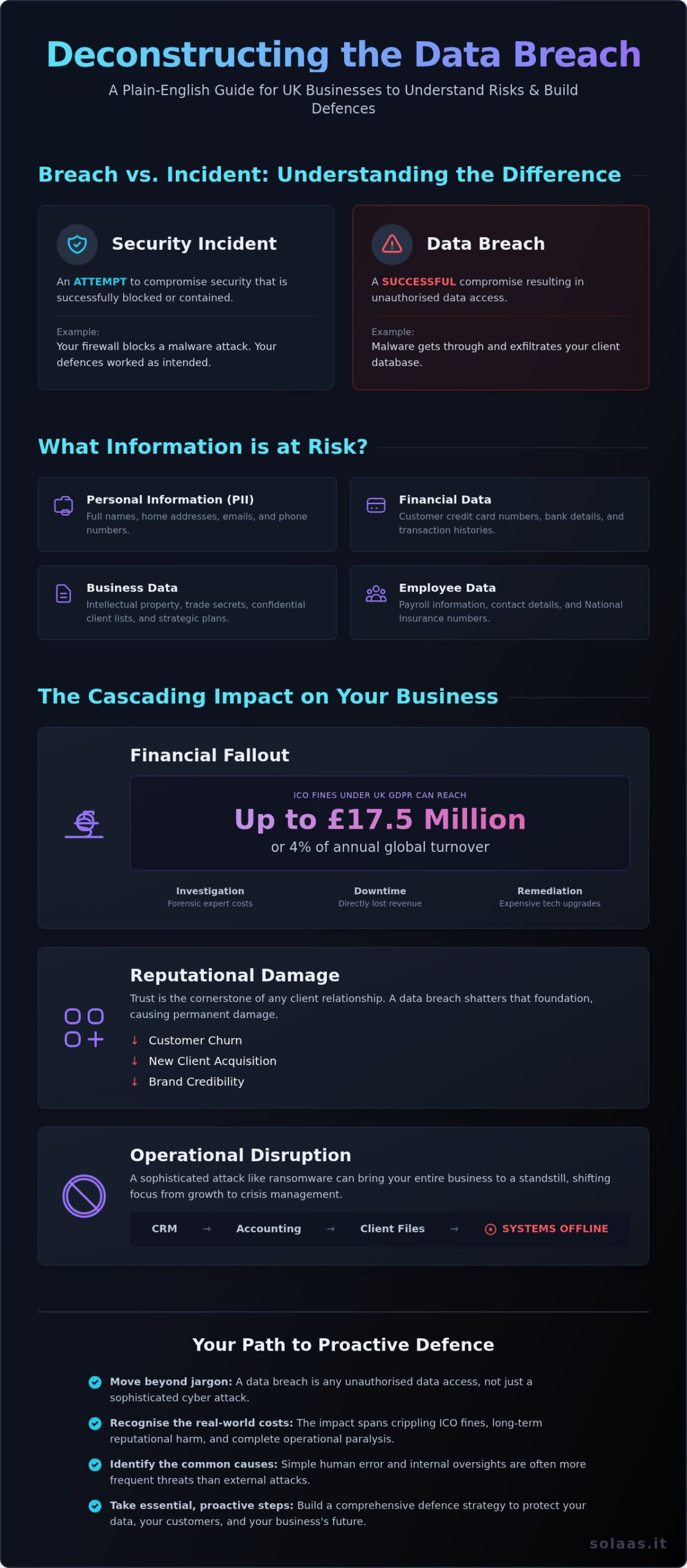
An effective analogy is a physical break-in. A would-be burglar rattling your office doorknob is a security incident-a threat that was thankfully prevented. However, a confirmed Data breach is when the burglar gets inside and successfully steals valuable files. One is an attempt; the other is a successful intrusion with tangible loss. Understanding this difference is the first step toward building a robust and tailored security solution.
What Information is at Risk?
Cybercriminals target any data that can be monetised, used for fraud, or leveraged for further attacks. Your business is a custodian of valuable information across several categories, including:
- Personal Identifiable Information (PII): Full names, home addresses, and contact details. For some businesses, this extends to highly sensitive data; for instance, a travel specialist like Sola Travel also handles passport details and detailed itineraries.
- Financial Data: Customer credit card numbers, bank account details, and transaction histories.
- Business Data: Your intellectual property, trade secrets, confidential client lists, and strategic plans.
- Employee Data: Payroll information, contact details, and National Insurance numbers.
Data Breach vs. Security Incident: Key Differences
Distinguishing between these two terms is critical for your response plan. A security incident is an attempt to compromise your systems, while a data breach is a successful compromise resulting in unauthorised data access. For example, your firewall blocking a malware attack is an incident; your defences worked. A breach only occurs if that malware gets through and exfiltrates your client database.
This distinction is vital because it directly impacts your legal obligations. A confirmed breach may require you to notify the Information Commissioner’s Office (ICO) and the individuals affected, whereas a contained incident may not.
The Real-World Impact on Your Business
Understanding what is a data breach is the first step; comprehending its cascading impact on your UK business is what drives decisive action. The consequences extend far beyond the initial loss of data, creating financial, reputational, and operational crises that can challenge the very survival of an organisation. Many business leaders believe their size grants them immunity, but the reality is that cybercriminals actively target small and medium-sized businesses (SMBs), viewing them as softer targets with fewer security resources.
The Financial Fallout: Fines, Ransom, and Recovery
The most immediate impact of a data breach is financial. Under UK GDPR, the Information Commissioner’s Office (ICO) has the authority to issue significant penalties-up to £17.5 million or 4% of your annual global turnover, whichever is higher. The ICO enforces strict rules on how organisations must handle and report Personal data breaches, making compliance critical. Beyond regulatory fines, the direct costs accumulate rapidly and include:
- Investigation and Remediation: The cost of hiring forensic experts to determine the scope of the breach and repair compromised systems.
- Downtime and Lost Revenue: Every hour your systems are offline translates directly into lost sales and productivity.
- Technology Upgrades: The essential, and often expensive, investment in new security solutions to prevent a recurrence.
Reputational Damage: Losing Customer Trust
While financial losses are painful, the damage to your reputation can be permanent. Trust is the cornerstone of any client relationship, and a data breach shatters that foundation. Customers whose data has been exposed are likely to take their business elsewhere, leading to significant churn. The negative publicity can deter potential new clients, making growth incredibly difficult. Rebuilding a tarnished reputation is a long, costly, and uncertain process that requires a sustained commitment to transparency and enhanced security.
Operational Disruption: When Business Grinds to a Halt
A sophisticated cyber-attack, such as ransomware, can bring your entire operation to a standstill. Imagine being locked out of your CRM, accounting software, and client files. This operational paralysis means sales stop, projects are delayed, and you are unable to deliver services to your customers. The leadership team’s focus is diverted from strategic growth to crisis management, consuming valuable time and resources for weeks or even months as you work to restore normal business functions.
How Do Data Breaches Happen? Common Causes and Attack Vectors
To effectively prevent a security incident, it’s crucial to understand its origins. A common misconception is that all breaches are the work of sophisticated external hackers. In reality, the answer to what is a data breach and how it occurs is far more nuanced, often stemming from a combination of external threats, internal human factors, and overlooked system weaknesses.
Understanding these vectors is the first step toward building a robust and resilient security posture for your business.
External Malicious Attacks
These are the deliberate, hostile actions taken by cybercriminals from outside your organisation to compromise your data. Common methods include:
- Phishing and Spear Phishing: Attackers send deceptive emails pretending to be a trusted entity, like a bank or a senior colleague. Their goal is to trick an employee into revealing sensitive information, such as passwords, or clicking a malicious link.
- Malware and Ransomware: This involves malicious software designed to disrupt operations or steal data. Ransomware is a particularly damaging form, encrypting your files and demanding a hefty payment for their release, effectively holding your business hostage.
- Brute Force Attacks: This is a less subtle method where attackers use automated software to guess login credentials by trying millions of password combinations on an account.
The Human Element: Accidental and Insider Threats
Often, your biggest security vulnerability isn’t a piece of technology, but a person. Breaches in this category can be both accidental and intentional.
- Employee Error: A simple mistake, like sending an email containing sensitive client data to the wrong recipient, is one of the most common causes of a data breach.
- Weak or Reused Passwords: Using easy-to-guess passwords or the same password across multiple services provides a simple entry point for attackers who have breached another service you use.
- Lost or Stolen Devices: An unencrypted company laptop, phone, or USB drive left in a taxi or coffee shop is an open invitation for data theft.
- Malicious Insiders: A disgruntled current or former employee might intentionally steal data or sabotage systems for personal gain or revenge.
System and Process Vulnerabilities
Sometimes, a breach occurs because the underlying systems and procedures have inherent weaknesses that attackers can exploit.
- Unpatched Software: Failing to apply regular security updates to your software and operating systems leaves known vulnerabilities exposed, like leaving a digital door unlocked for criminals.
- Poor Access Controls: Granting employees access to data they don’t need for their role increases risk. A junior team member, for example, should not have access to the entire company’s financial records.
- Insecure Third-Party Vendors: Your security is only as strong as your weakest link. A breach at one of your suppliers, like a payroll or cloud storage provider, can directly expose your company’s sensitive data. Building a resilient defence involves understanding these interconnected risks, a process outlined in guides like the FTC’s Data Breach Response: A Guide for Business.
Proactive Prevention: Building Your Business’s Defence Strategy
Understanding what is a data breach is a critical first step, but the ultimate goal is to prevent one from ever happening. Effective cybersecurity isn’t about a single product; it’s a comprehensive, ongoing strategy built on three core pillars: robust technology, clear processes, and empowered people. By integrating these elements, you transform your security from a reactive measure into a proactive defence that protects your assets, reputation, and customer trust. Building this resilience is the most powerful investment you can make in your business’s future.
Pillar 1: Implementing Essential Security Technology
Your technology stack is your first line of defence against external and internal threats. A multi-layered approach provides the strongest protection. Key components include:
- Firewalls & Antivirus: Foundational tools that monitor and control incoming and outgoing network traffic, blocking malicious software before it can execute.
- Multi-Factor Authentication (MFA): A simple yet powerful barrier that requires a second form of verification, drastically reducing the risk of unauthorised account access even if a password is stolen.
- Data Encryption: Renders sensitive data unreadable to unauthorised users, protecting it both when stored on your systems (at rest) and when being transmitted (in transit).
- Secure Data Backups: Regular, isolated backups ensure that even in a worst-case scenario like a ransomware attack, you can restore your operations with minimal disruption.
Pillar 2: Strengthening Your Processes and Policies
Technology is only as effective as the rules governing its use. Strong internal processes minimise human error and limit potential damage. Start by establishing a clear password policy that enforces complexity and regular updates. Implement the principle of ‘least privilege,’ ensuring employees can only access the data and systems absolutely essential for their roles. Most importantly, develop a formal incident response plan. Knowing precisely who to call and what to do before an incident occurs turns potential panic into a controlled, efficient response.
Pillar 3: Creating a ‘Human Firewall’ Through Training
Ultimately, your staff are your best and final line of defence. Cybercriminals frequently target employees with sophisticated phishing emails and social engineering tactics, knowing they can be the weakest link. Regular, engaging cybersecurity awareness training is essential to build a ‘human firewall’. This empowers your team to confidently identify suspicious emails, recognise social engineering attempts, and understand their critical role in protecting the business. Your team is your frontline. Let us help you fortify it.
Beyond the Breach: Take Control of Your Data Security
Understanding what is a data breach is the critical first step for any UK business. As we’ve explored, a breach is more than just a hack; it’s a significant business threat with severe financial and reputational consequences. The most crucial takeaway, however, is that effective defence is not reactive, but proactive. By implementing a robust prevention strategy, you can transform your organisation from a potential target into a resilient, secure operation.
You don’t have to build that defence alone. At SolaaS LTD, we provide expert cybersecurity solutions tailored for UK businesses. Our proactive monitoring and dedicated IT support ensure your critical data is protected around the clock, giving you the confidence to focus on growth. We act as your trusted partner, developing a flexible and scalable strategy that puts you firmly in control of your security posture.
Take the definitive step towards securing your operations. Don’t wait for a breach to happen. Secure your business with a trusted IT partner.
Frequently Asked Questions About Data Breaches
What is the very first thing I should do if I suspect a data breach?
The critical first step is to contain the threat. Immediately disconnect the affected devices from your network to prevent the breach from spreading to other systems. It is vital not to delete any data, as this is crucial evidence for a forensic investigation. Activate your incident response plan and contact your trusted IT security partner immediately. Swift, decisive action is the key to regaining control and minimising the impact on your business operations and reputation.
How common are data breaches for small businesses in the UK?
Data breaches are alarmingly common for UK small and medium-sized enterprises (SMEs). According to recent government reports, a significant percentage of small businesses experience a cyber attack each year, often because they are seen as softer targets. This stark reality underscores why understanding what is a data breach and implementing a robust, tailored security solution is no longer a luxury but a fundamental necessity for business survival and continued success in the modern landscape.
Is my business legally required to report a data breach to the ICO?
Yes, under UK GDPR, you must report a personal data breach to the Information Commissioner’s Office (ICO) if it is likely to pose a risk to people’s rights and freedoms. This report must be made without undue delay, and where feasible, within 72 hours of you becoming aware of it. Failure to comply can lead to significant fines, making a prompt and accurate response essential for protecting your business and meeting your legal obligations.
What’s the difference between a virus, malware, and ransomware?
Think of ‘malware’ (malicious software) as the overall category for any software designed to cause harm. A ‘virus’ is a specific type of malware that attaches itself to clean files and spreads through your systems to corrupt data. ‘Ransomware’ is another type of malware, but its primary goal is financial extortion; it encrypts your files and holds them hostage until a ransom is paid. Understanding these threats is key to building a comprehensive defence.
How can I protect my business from a phishing attack?
A multi-layered defence provides the most effective protection. Start with robust, ongoing staff training to help your team identify and report suspicious emails-they are your first line of defence. Implement advanced email filtering to block threats before they reach an inbox. Crucially, enforce Multi-Factor Authentication (MFA) across all accounts. This single step provides a powerful barrier, ensuring that even if credentials are stolen, unauthorised access is prevented, safeguarding your business data.
Can using cloud services help prevent a data breach?
Yes, reputable cloud platforms like Microsoft 365 and AWS can significantly enhance your security posture. They invest heavily in enterprise-grade, scalable security infrastructure that is often beyond the reach of an individual SME. However, security is a shared responsibility. While the provider secures the cloud itself, you are responsible for securing your data within it by managing user access, configuring settings correctly, and implementing strong security protocols for your team.

Article by
René Wheeler
René Wheeler is Managing Director of SolaaS, bringing over three decades of experience in IT and telecoms. He is a strong advocate for transparency and flexibility, championing monthly contract models that allow businesses to stay agile and in control of their technology. His approach challenges traditional industry practices and puts client outcomes first