
Business Phone Systems: The Complete Guide for UK SMBs (2026)
Is your current phone system struggling to keep pace with the demands of modern work? If you’re navigating a maze of confusing acronyms like VoIP and PBX, or worried about the high costs and disruption of an upgrade, you’re not alone. For many UK SMBs, the technology meant to connect you can feel like a barrier to growth. It’s time to take back control and find a solution that empowers your business, rather than limits it.
This is your complete 2026 guide to modern business phone systems. We’re here to demystify the options-from traditional setups to flexible, cloud-based solutions-in clear, straightforward language. Our goal is to equip you with the knowledge to choose a scalable, cost-effective system that enhances your professional image, supports your team wherever they work, and provides the seamless connectivity your business deserves. Welcome to a new era of communication.
Key Takeaways
- Learn why relying on personal mobiles can limit your growth and discover the professional features that set a true business system apart.
- Quickly compare the three core types of phone systems-on-premise, cloud, and hybrid-to identify the most scalable and cost-effective solution for your operations.
- Get a clear framework for choosing the right business phone systems, enabling you to assess your unique needs and invest with confidence.
- Understand the impact of the UK’s mandatory digital switch-over and why a modern cloud solution is essential for future-proofing your communications.
What is a Business Phone System? (And Why Your Smartphone Isn’t Enough)
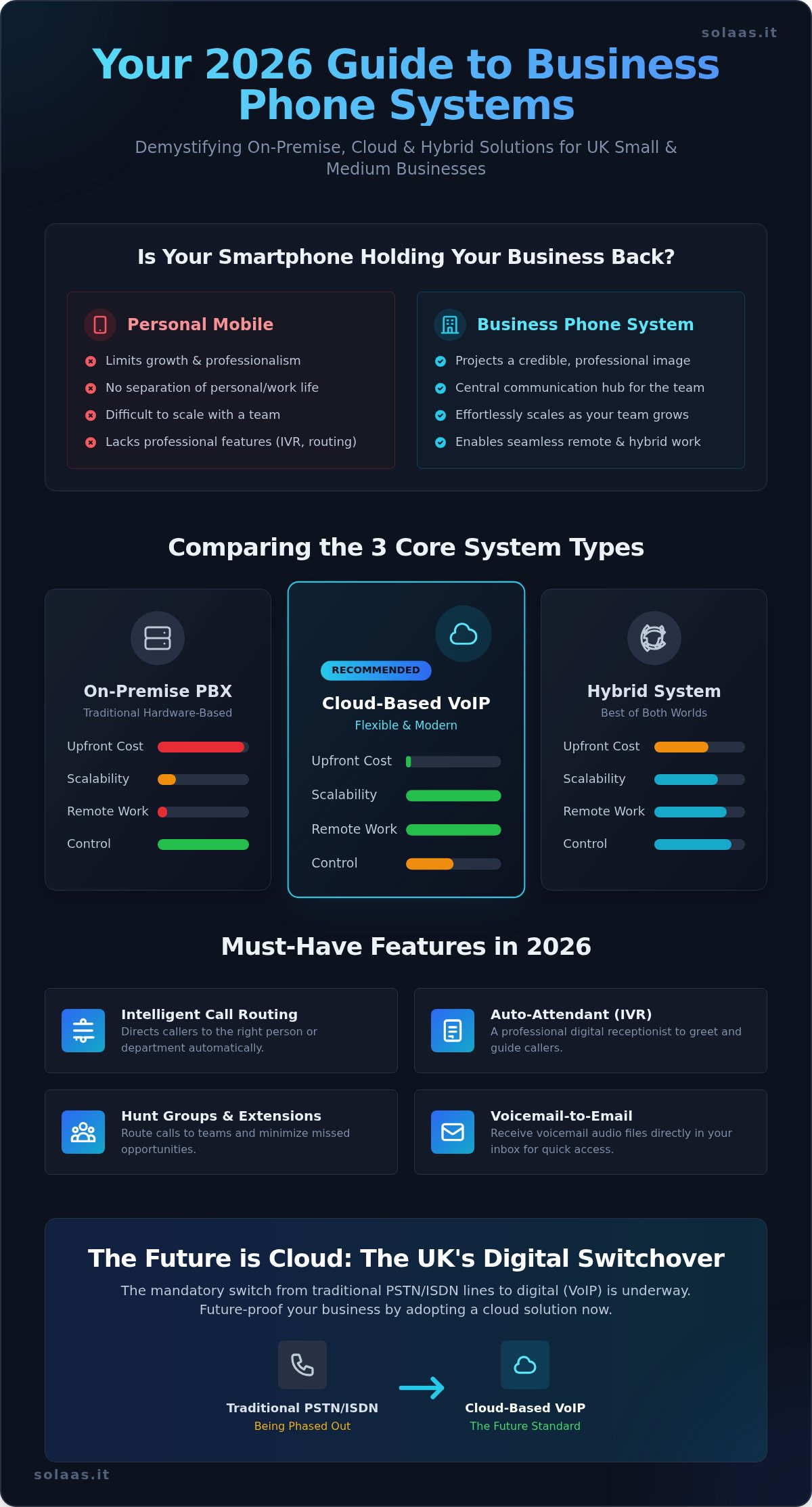
In today’s fast-paced market, relying on personal mobile phones for client communication can limit your growth and professionalism. A business phone system is a comprehensive, multi-line telecommunications network designed specifically for organisations. Unlike a single mobile number, a modern business telephone system acts as a central hub, engineered to manage all your inbound and outbound calls with unparalleled efficiency and control.
Its core purpose is to put the reins of your communication firmly back in your hands, ensuring every call is a professional interaction that builds trust. It’s the engine that powers seamless connectivity, scalability, and collaboration across your entire team, whether they’re in the office or working remotely.
Beyond a Single Line: Core Functions
Modern business phone systems move far beyond a simple dial tone. They provide a suite of intelligent features designed to streamline your operations and enhance the customer experience. Key functions include:
- Intelligent Call Routing: Automatically directs incoming calls to the most appropriate person or department based on pre-set rules, ensuring callers connect with the right expert, right away.
- Auto-Attendant (IVR): Acts as a professional digital receptionist, greeting callers with a custom message and guiding them with menu options (“Press 1 for Sales, Press 2 for Support”).
- Extensions & Hunt Groups: Assign unique extensions to each team member and group multiple lines together (a ‘hunt group’) so that an incoming call can ring several phones simultaneously or in sequence, minimising missed opportunities.
- Voicemail-to-Email: Delivers voicemail messages as audio files directly to your email inbox, allowing for quick, convenient responses from any device.
Key Benefits for Modern Businesses
Adopting a dedicated phone system is a strategic investment in your company’s future. It delivers tangible benefits that directly impact your bottom line and brand reputation, empowering you to:
- Project a Professional Image: A dedicated business number and a professional greeting establish immediate credibility and distinguish you from sole traders using a personal mobile.
- Improve Customer Service: Efficient call handling means fewer missed calls, shorter wait times, and a seamless experience for your clients, boosting satisfaction and loyalty.
- Enable Effortless Scalability: As your team grows, you can add new users, lines, and features in minutes, not days. The system scales with your success, flexibly and cost-effectively.
- Support Hybrid & Remote Work: Connect your entire team under one unified system, regardless of their physical location. Empower productivity and collaboration from anywhere.
The 3 Main Types of Business Phone Systems Explained
Choosing the right communication infrastructure is a strategic decision that directly impacts your budget, flexibility, and future growth. Understanding the core differences between the available business phone systems empowers you to select a solution tailored to your operational needs. The landscape is primarily divided into three categories: on-premise, cloud-based, and hybrid.
Traditional On-Premise PBX Systems
An on-premise system involves housing all the physical hardware-the Private Branch Exchange (PBX)-at your business location. This server connects to the traditional Public Switched Telephone Network (PSTN) via ISDN lines. While this model offers complete control over your system, it comes with a significant upfront investment, often running into thousands of pounds for hardware and installation. It is also rigid, making scaling or adapting for remote work difficult and costly.
Modern Cloud-Based (VoIP) Phone Systems
Welcome to the future of business communication. Cloud-based systems, powered by Voice over Internet Protocol (VoIP), are hosted entirely by a third-party provider and delivered to you as a service over the internet. This subscription-based model eliminates hefty initial costs, converting them into a predictable operational expense. At its core, this technology uses your internet connection to make and receive calls; for a detailed breakdown, this excellent Forbes article explains how VoIP works. The result is unparalleled flexibility, seamless scalability, and robust support for remote and hybrid teams.
Hybrid Phone Systems
A hybrid system offers a bridge between the old and the new, combining on-premise PBX hardware with the power of cloud-based VoIP services. This approach is ideal for businesses that have a significant investment in existing on-site equipment but want to add modern features like video conferencing or integrate a new office without a complete overhaul. While it provides reliability and enhanced capabilities, managing two interconnected systems can introduce complexity.
At-a-Glance Comparison
- On-Premise PBX
- Pros: Full control over hardware; not dependent on internet for internal calls.
- Cons: High upfront cost (£££); rigid and difficult to scale; requires in-house maintenance.
- Ideal For: Large enterprises with dedicated IT teams and a need for total system control.
- Cloud-Based VoIP
- Pros: Low initial cost; highly scalable and flexible; supports remote work; rich with modern features.
- Cons: Dependent on a stable internet connection for call quality.
- Ideal For: Businesses of all sizes, especially SMEs, startups, and companies with remote or hybrid teams seeking agility and cost-effectiveness.
- Hybrid Systems
- Pros: Leverages existing hardware; blends landline reliability with VoIP features.
- Cons: Can be complex to manage and integrate; a temporary step rather than a long-term solution.
- Ideal For: Companies transitioning to the cloud gradually or needing to connect legacy systems to modern applications.
Must-Have Features to Look For in 2026
Choosing a new communications platform is about future-proofing your operations. Think of this as a shopping list for success-a checklist of features that modern business phone systems must offer to drive efficiency and support growth. The right combination of tools empowers your team, enhances customer experience, and delivers a tangible return on investment. Let’s break down the non-negotiables into three core categories.
Essential Call Management Features
These foundational tools are the engine of your daily communications, ensuring every call is handled professionally and efficiently, creating a seamless experience for your customers from the very first ring.
- Auto-Attendant (IVR): Acts as a digital receptionist, professionally greeting callers and routing them to the correct department or individual 24/7. This ensures no lead is ever lost.
- Call Forwarding & Transferring: Empowers your team to connect customers with the right expert instantly, whether they are in the office, working from home, or on the move.
- Voicemail-to-Email: Delivers voicemails as audio files directly to your inbox, allowing you to listen and respond from any device, anywhere.
- Call Queues & Hunt Groups: Intelligently distribute high volumes of incoming calls across your team, minimising wait times and improving customer satisfaction.
Unified Communications (UCaaS) Features
Today’s business challenges demand more than just voice calls. A truly modern system unifies all your communication channels into one powerful, integrated solution that supports hybrid work and dynamic collaboration.
- Video Conferencing: Integrated high-definition video meetings allow for seamless face-to-face collaboration with colleagues and clients, regardless of location.
- Business Texting (SMS/MMS): Communicate with customers on their preferred channel for appointment reminders, quick updates, and marketing messages.
- Mobile & Desktop Apps (Softphones): Turn any smartphone, laptop, or tablet into a full-featured business phone, giving your team unparalleled flexibility.
- Team Messaging: A dedicated internal chat platform for instant messaging, file sharing, and project collaboration that reduces email clutter and boosts productivity.
Key Administrative & Analytics Features
The best business phone systems provide the data and control you need to make smarter decisions. These administrative features streamline workflows, ensure quality, and turn raw call data into actionable business intelligence.
- Call Recording: An invaluable tool for staff training, quality assurance, and dispute resolution. It is also crucial for maintaining compliance with industry standards, such as those outlined in the Ofcom industry guidance.
- Reporting & Analytics: Gain powerful insights into call volumes, wait times, call duration, and team performance to optimise staffing and strategy.
- CRM Integrations: Connect your phone system with platforms like Salesforce or HubSpot to automatically log calls, provide instant customer context, and streamline workflows.
How to Choose the Right Phone System for Your Business
Selecting the right communication platform is a strategic decision that impacts productivity, customer experience, and your bottom line. Moving beyond features, the goal is to find a solution tailored to your unique operational needs. This four-step framework will empower you to confidently choose the best business phone system for your team.
Step 1: Assess Your Needs and Future Growth
Begin by auditing your current and future requirements. A clear understanding of your needs prevents overspending on unnecessary features or choosing a system you’ll quickly outgrow. Ask your team:
- Scalability: How many users do we have now, and what is our projected headcount in two years?
- Pain Points: What are our biggest communication frustrations, such as missed calls, poor call quality, or lack of integration?
- Features: What is a ‘must-have’ (like call recording or CRM integration) versus a ‘nice-to-have’ (like advanced analytics)?
Step 2: Compare Costs (Upfront vs. Subscription)
Understanding the financial model is crucial. Traditional on-premise systems involve significant capital expenditure (CapEx) for hardware, installation, and ongoing maintenance. In contrast, modern cloud-based business phone systems operate on an operational expenditure (OpEx) model, with a predictable monthly per-user fee (typically £15-£30) and minimal to no hardware costs. Always consider the Total Cost of Ownership (TCO) over 3-5 years for a true comparison.
Step 3: Consider Your Team’s Work Style
The modern workplace is no longer confined to a single office. Your phone system must support your team wherever they work-in the office, at home, or on the move. A flexible, cloud-based solution ensures seamless connectivity, allowing employees to make and receive business calls on their mobiles, laptops, or desk phones with a consistent, professional identity.
Step 4: Evaluate Security and Reliability
Your business conversations are sensitive. Prioritise providers who can demonstrate robust security and exceptional reliability. Ask potential vendors about their uptime Service Level Agreement (SLA)-anything less than 99.9% should be a red flag. Inquire about security measures like end-to-end encryption and compliance with UK standards such as GDPR to ensure your data and communications are always protected.
Feeling overwhelmed by the options? Don’t be. Let our experts build a tailored solution for you.
The Future is Cloud: Why UK Businesses are Making the Switch
The conversation around business communications has fundamentally changed. It’s no longer a question of if your business should move to the cloud, but when. Cloud-based telephony is the new standard, offering unparalleled flexibility, advanced features, and the power to future-proof your operations against inevitable technological shifts. For UK businesses, this transition is now becoming a necessity.
The Big UK Switch-Off: The 2025 PSTN Shutdown
For decades, UK businesses have relied on the Public Switched Telephone Network (PSTN)-the traditional copper wire network that powers landline calls. This legacy infrastructure is now being retired, with a complete shutdown scheduled for 2025. This means any organisation still using analogue lines for phones, alarms, or even card machines must migrate to a digital, IP-based solution to maintain service. The clock is ticking, making the transition a matter of operational urgency.
Unlocking True Flexibility for a Modern Workforce
Beyond the mandatory switch, modern business phone systems are designed to empower the agile, hybrid workforce. They break down the barriers of a physical office, providing a consistent and professional communication experience whether your team is at their desk, working from home, or on the move. Key advantages that put you in control include:
- Seamless Mobility: Use your business number on any internet-connected device, from a desk phone to a laptop or mobile app.
- Effortless Scalability: Add or remove users in minutes to match your business demands, without waiting for an engineer or investing in costly hardware.
- Unified Communications: Integrate voice, video conferencing, and instant messaging into one cohesive and efficient platform for enhanced productivity.
Partnering with a Managed Provider like SolaaS LTD
Migrating your core communications can feel like a complex task, but you don’t have to navigate it alone. A managed service provider acts as your expert guide, ensuring a smooth, tailored transition with minimal disruption. At SolaaS LTD, we specialise in designing and implementing cloud solutions that fit your unique operational goals. As your trusted partner, we provide ongoing management and expert support, all on flexible, month-by-month terms that break free from restrictive long-term contracts.
Future-Proof Your Communications: The Final Word on Your Next Phone System
As we’ve explored, navigating the world of business phone systems is no longer just about making and receiving calls. For UK SMBs aiming for success in 2026, the shift to a modern, cloud-based solution is a strategic imperative, offering the scalability and advanced features that a standard mobile phone simply cannot match. The right choice is a system tailored to your unique operational needs-one that grows with you and enhances your professional image.
Finding that perfect fit shouldn’t mean being locked into a rigid, long-term contract. At SolaaS, we believe in empowering your business with flexibility. We provide tailored solutions backed by expert, UK-based support and management, all on simple month-to-month terms. We put the control back in your hands, ensuring your communications technology is an asset, not an obstacle.
Ready to modernise your communications? Book a free consultation with our experts. Let’s build a communication solution that fuels your success.
Frequently Asked Questions About Business Phone Systems
What is the difference between VoIP and a cloud phone system?
While closely related, they aren’t the same. VoIP (Voice over Internet Protocol) is the core technology that converts your voice into a digital signal to travel over the internet. A cloud phone system is the complete, hosted solution that uses VoIP to deliver a comprehensive suite of communication features, such as call routing, voicemail-to-email, and video conferencing. Think of VoIP as the engine and the cloud system as the entire high-performance vehicle.
Can I keep my existing business phone number if I switch providers?
Absolutely. In the UK, you have the right to keep your existing phone numbers when you switch providers. This process is called ‘number porting,’ and it is a standard, regulated procedure. As your trusted partner, we manage this entire process for you, ensuring a seamless transition with no disruption to your business operations. You maintain your established identity while upgrading your communications technology and capabilities.
Do I need to buy special desk phones for a cloud-based system?
Not necessarily. The flexibility of a cloud system is one of its key advantages. While dedicated VoIP desk phones provide a familiar, feature-rich experience, your team can also use ‘softphones’-applications on their computers, laptops, or smartphones. This allows for seamless communication whether your team is in the office, at home, or on the move, providing a truly tailored solution that fits how your business works today.
How much does a small business phone system typically cost per month?
The cost for modern business phone systems is highly scalable and designed for cost-effectiveness. For a small business in the UK, you can typically expect to pay between £10 and £25 per user, per month. This pricing model allows you to pay only for what you need and easily add or remove users as your business evolves. The monthly fee usually includes a generous call allowance, advanced features, and ongoing technical support.
How secure are business communications over the internet?
Security is paramount. Reputable cloud communication providers employ multi-layered security protocols that often exceed those of traditional on-premise systems. This includes end-to-end encryption for call data (using technologies like SRTP and TLS) and hosting services in highly secure, ISO-certified UK data centres. These facilities feature 24/7 monitoring, redundant power, and disaster recovery plans to ensure your communications are both private and resilient.
What is the process for switching from an old PBX to a new cloud system?
The migration to a cloud system is a structured, seamless process designed to minimise disruption. It begins with a consultation to tailor a solution to your specific needs. Next, we manage the porting of your numbers and configure your new system in the cloud. We then coordinate the deployment of any new handsets or software and provide comprehensive training for your team. Our experts guide you at every step, ensuring a smooth and successful transition.

Article by
René Wheeler
René Wheeler is Managing Director of SolaaS, bringing over three decades of experience in IT and telecoms. He is a strong advocate for transparency and flexibility, championing monthly contract models that allow businesses to stay agile and in control of their technology. His approach challenges traditional industry practices and puts client outcomes first