
Starlink Speeds UK: Real-World Performance Data & Analysis
For businesses and residents in the UK’s connectivity blackspots, the promise of high-speed satellite internet sounds revolutionary. But when you’re tired of buffering video calls and unreliable downloads, it’s natural to be sceptical. How do the real-world starlink speeds uk users experience stack up against the marketing hype, and is the investment of over £400 for hardware truly justified for your needs? Forget theoretical maximums and vague promises; it’s time for a transparent, data-driven look at actual performance.
This comprehensive analysis provides the impartial insights you’ve been searching for. We will break down real-world download speeds, upload capabilities, and the crucial latency figures that determine success on video calls. You will understand the key factors affecting your connection and see how Starlink compares against traditional fibre and 4G/5G alternatives. By the end, you’ll have the confidence to decide if Starlink is the right high-performance connectivity solution to drive your business forward.
Key Takeaways
- Understand the crucial difference between Starlink’s advertised performance and the actual speeds UK users experience, based on independent data.
- Identify the key network and environmental factors that can impact your connection, allowing you to better predict and manage your Starlink performance.
- Directly compare real-world starlink speeds uk against traditional fibre and 5G to determine the optimal connectivity solution for your specific location and needs.
- Translate raw speed data into practical business capability to assess if Starlink can reliably support critical operations like cloud access, VoIP, and video conferencing.
Starlink’s Advertised Speeds vs. Real-World UK Performance
Understanding the true performance of Starlink in the United Kingdom requires looking beyond the headline figures. While SpaceX provides expected speed ranges, real-world performance is influenced by network load, satellite coverage, and even local conditions. To build a complete picture of the starlink speeds uk businesses and residents can expect, we must compare official specifications with objective, third-party data.
This analysis reveals a crucial insight: while advertised ‘up to’ speeds represent the network’s potential, the median, everyday performance is the metric that truly matters for consistent connectivity and productivity.
Official Speed Tiers (Standard vs. Priority)
Starlink offers several service plans in the UK, each with different performance targets designed for specific use cases. Understanding these tiers is the first step in setting realistic expectations:
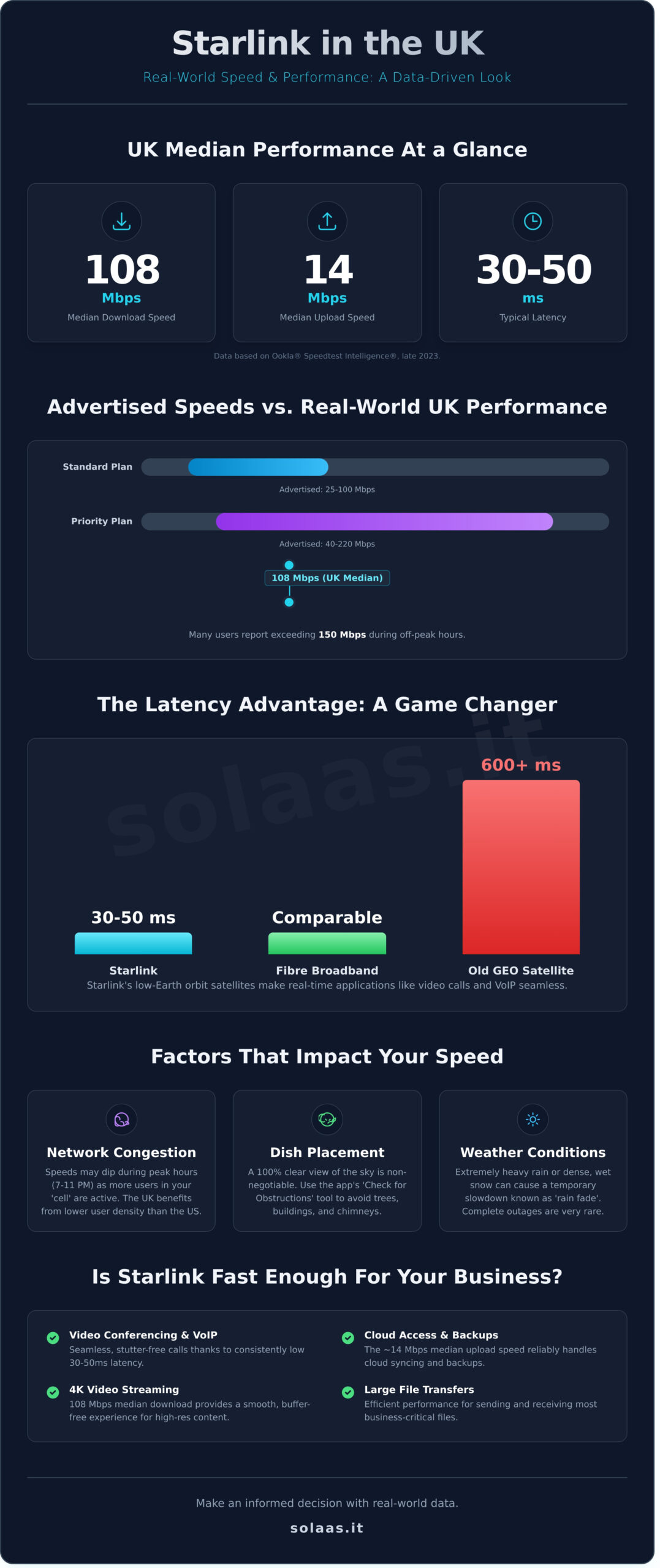
- Standard: Aimed at residential and small business users, this plan advertises expected download speeds of 25-100 Mbps. It’s designed for everyday activities like streaming, web browsing, and video calls.
- Priority: For businesses and high-demand users, this tier offers superior performance with expected download speeds of 40-220 Mbps and higher upload speeds. Priority data is also given network preference during peak hours.
- Mobile: Designed for users on the move (e.g., in vehicles or between locations), these plans offer de-prioritised, “best effort” service, meaning speeds may be slower during times of network congestion.
Real-World UK Download Speeds
Independent analysis from sources like Ookla’s Speedtest Intelligence® provides a clear view of on-the-ground performance. In late 2023, Starlink delivered a median download speed in the UK of approximately 108 Mbps. This figure comfortably surpasses the minimum expectations for the Standard plan and demonstrates a robust and capable network. While speeds can dip during evening peak times, many users report exceeding 150 Mbps during off-peak hours. This places the UK’s Starlink performance favourably among other European nations.
Upload Speeds and Latency in the UK
Modern connectivity is a two-way street. Starlink’s median upload speed in the UK hovers around 14 Mbps, a crucial metric for businesses relying on video conferencing, cloud backups, and transferring large files. However, its most significant advantage over traditional satellite internet is its low latency. Thanks to its vast constellation of low-Earth orbit satellites-a core component of the Starlink technology-users in the UK typically experience latency between 30-50 milliseconds (ms). This near-instantaneous response time is comparable to fibre broadband and makes real-time applications like online gaming and VoIP calls seamless, a feat impossible on older satellite systems with latencies of 600+ ms.
Key Factors That Influence Your Starlink Speed
Understanding your Starlink connection begins with a crucial concept: it’s a dynamic, shared resource, not a dedicated fibre line. This means your real-world performance is a blend of network-wide conditions and your specific local environment. As your trusted partner, SolaaS LTD helps you navigate these variables to ensure you get the most from your investment. A deep dive into the technical factors influencing Starlink speed reveals that with the right setup and knowledge, you can achieve a truly seamless connectivity experience.
Network Congestion and Time of Day
Starlink divides the world into service areas, or ‘cells’. Your speed is influenced by how many other users are active in your cell at any given moment. During peak residential hours, typically 7 PM to 11 PM, you might notice a dip in performance as more people stream, game, and browse. However, SpaceX is continuously expanding its satellite constellation to add capacity and mitigate this effect. Fortunately, the Starlink speeds UK businesses and residents experience are often more stable than in the US, due to a lower overall user density across the country.
Dish Placement and Obstructions
For optimal performance, your Starlink dish requires a completely clear, 360-degree view of the sky. This is non-negotiable. Obstructions like trees, chimneys, or neighbouring buildings can block the signal, causing micro-outages. While these last only milliseconds, they are enough to freeze a video call or interrupt a file transfer. To prevent this, always use the ‘Check for Obstructions’ tool in the Starlink app during setup. It uses your phone’s camera to scan the sky and guarantee a perfect line of sight to the satellites.
Weather Conditions
A common concern is how British weather affects performance. While Starlink is engineered to be robust, extremely heavy rain or dense, wet snow can cause a temporary slowdown-a phenomenon known as ‘rain fade’. However, complete outages are very rare. The dish is equipped with a brilliant feature for UK winters: a built-in heater that automatically melts snow and ice, ensuring your connection remains stable and efficient even in the harshest conditions.
To maximise your connection, focus on what you can control:
- Prioritise Placement: Use the app’s obstruction tool to find the absolute best location for your dish before final installation.
- Secure Your Installation: Ensure the dish is mounted securely so it cannot be moved by high winds, which would alter its alignment.
- Manage Heavy Traffic: If possible, schedule large downloads or system updates for off-peak hours to take advantage of higher available bandwidth.
Starlink Speed vs. Traditional UK Broadband (Fibre, 4G/5G)
Choosing the right connectivity solution is critical for business efficiency and home productivity. While the UK’s broadband landscape is diverse, performance varies dramatically by postcode. Starlink enters this market not as a universal replacement, but as a powerful, high-performance alternative for locations underserved by traditional infrastructure. Understanding how its performance stacks up against established options is key to making an informed decision.
| Metric | Starlink | Full Fibre (FTTP) | FTTC | 4G/5G Home Broadband |
|---|---|---|---|---|
| Typical Download | 100 – 200 Mbps | 100 – 1000+ Mbps | 30 – 70 Mbps | 20 – 500+ Mbps (highly variable) |
| Typical Upload | 10 – 20 Mbps | 20 – 115 Mbps | 5 – 15 Mbps | 5 – 50 Mbps (highly variable) |
| Typical Latency | 25 – 50ms | <20ms | 20 – 40ms | 30 – 70ms |
| Best For | Rural & underserved areas, business continuity | Urban areas, data-intensive tasks | Most UK premises with a phone line | Mobile use, areas with strong signal |
Starlink vs. Full Fibre (FTTP)
Let’s be clear: if you have access to a gigabit-capable Full Fibre to the Premises (FTTP) connection, it remains the gold standard for raw speed and ultra-low latency. However, for the millions of UK premises without this option, Starlink delivers a premium, next-generation experience. Its typical upload speeds of 10-20 Mbps often provide more symmetrical performance than many entry-level FTTP plans, a crucial benefit for cloud-based businesses and content creators.
Starlink vs. Fibre-to-the-Cabinet (FTTC)
Fibre-to-the-Cabinet (FTTC) is the UK’s most common ‘fibre’ service, but it’s a hybrid solution reliant on ageing copper wires for the final connection. This is where starlink speeds uk demonstrate a clear advantage. Starlink consistently outperforms typical FTTC services on both downloads and uploads. Crucially, its performance isn’t degraded by your distance from a street cabinet-a common bottleneck that throttles FTTC speeds in rural and suburban areas.
Starlink vs. 4G/5G Home Broadband
Mobile broadband can offer impressive headline speeds, but it often lacks the consistency required for business-critical operations. Performance can fluctuate wildly due to network congestion, signal strength, and even weather. Starlink provides a far more stable and reliable connection, free from the typical data caps and traffic deprioritisation found on mobile networks. This makes it a superior solution for seamless video calls, large file transfers, and dependable daily productivity. For businesses that cannot afford downtime, it represents a leap forward in reliability.
Is Starlink Fast Enough for Your Business? A Performance Breakdown
Raw download numbers are only part of the story. For a UK business, the critical question is how satellite broadband translates into seamless daily operations and sustained productivity. The answer depends not just on speed, but on the reliability, latency, and consistency of the connection. Let’s break down what Starlink’s performance means for your key business applications.
Performance for Daily Operations
Starlink’s low-latency connection is a significant leap forward, making it a viable solution for the real-time needs of a modern business-tasks that were previously impossible on traditional satellite internet.
- Video Conferencing (Zoom, Teams): With latency often below 40ms, Starlink provides the foundation for clear, stable video calls without the frustrating lag and interruptions that hinder collaboration.
- Cloud Applications (Office 365, CRMs): The connection is more than capable of handling the constant data synchronisation required by cloud-based platforms, ensuring your team stays productive and your data is always current.
- VoIP Phone Systems: While the speed is sufficient, consistent uptime is absolutely crucial for professional voice communication. A stable Starlink connection can support reliable voice calls, but this is where professional management becomes vital to guarantee quality.
Performance for High-Demand Tasks
Beyond the daily essentials, the impressive starlink speeds uk businesses can access also support more demanding workloads, unlocking new potential for rural and remote operations.
- Large File Transfers: For sectors like architecture, media, or engineering, the ability to quickly upload and download large project files is a genuine game-changer.
- Guest Wi-Fi Networks: Businesses in hospitality or events can offer reliable, high-speed internet access to dozens of customers simultaneously, enhancing the visitor experience.
- Site-to-Site VPN: The stability and throughput are robust enough to maintain a secure and reliable VPN connection between your main office and remote commercial locations.
Why Managed Starlink for Business Matters
Achieving enterprise-grade reliability from any connection requires more than a plug-and-play approach. This is where the distinction between a DIY setup and a professionally managed solution becomes critical. A managed service provider ensures your Starlink installation is optimised for maximum performance, uptime, and security.
Our expert team handles everything from a professional site survey and installation-avoiding obstructions that degrade signal-to proactive network monitoring and ongoing support. We transform a powerful technology into a resilient, business-critical asset, guaranteeing the connectivity your operations depend on.
Need guaranteed performance and unparalleled support for your business? Explore our managed Starlink business solutions.
Harnessing Starlink’s Potential for Your UK Business
The data is clear: Starlink is a transformative force in UK connectivity. Our analysis shows that the real-world starlink speeds uk businesses can achieve often surpass traditional broadband, especially in rural and underserved locations. While factors like hardware placement and network conditions play a role, the performance consistently opens up new possibilities for operational resilience and growth, moving high-speed, reliable internet from a goal to a reality.
Maximising this potential requires professional expertise. As an Official Starlink Solutions Provider, SolaaS delivers more than just hardware. We provide tailored, managed solutions with expert UK-based installation and ongoing support, all backed by flexible contracts that put your business needs first. Break free from connectivity constraints and empower your operations. Get a tailored quote for your managed Starlink business installation today.
Frequently Asked Questions
What is the fastest recorded Starlink speed in the UK?
While individual results vary based on location and network congestion, users across the UK have reported download speeds exceeding 200-250 Mbps in optimal conditions. These peak speeds demonstrate the powerful potential of the satellite constellation. However, it’s important to focus on the consistent, reliable speeds Starlink delivers day-to-day, which typically provide a seamless experience for streaming, video calls, and business operations, far surpassing traditional rural broadband solutions.
Does Starlink’s speed in the UK slow down at night?
Like any shared internet service, Starlink can experience fluctuations in speed during peak usage times, which are typically in the evening. This is due to more users in your area being online simultaneously. While some users may notice a slight dip in performance, the service is engineered to manage this load effectively. For most, the connectivity remains robust and more than sufficient for high-demand activities like 4K streaming, even during these busier periods.
Is the latency of Starlink in the UK good enough for online gaming?
Absolutely. Starlink’s Low Earth Orbit (LEO) satellite network provides significantly lower latency (or ‘ping’) than traditional satellite internet, typically ranging from 25-50ms. This is well within the acceptable range for most competitive online gaming, including first-person shooters and real-time strategy games. While not yet matching the absolute stability of fibre, it offers a transformative gaming experience for users in rural and underserved areas, making disruptive lag a thing of the past.
Will Starlink speeds in the UK get faster in the future?
Yes, a key part of Starlink’s strategy is continuous improvement. As SpaceX launches more advanced V2 satellites and expands its constellation, network capacity and efficiency will increase. This ongoing expansion is designed to deliver a significant boost to starlink speeds uk-wide. By 2026, we anticipate not only higher peak speeds but also greater consistency and lower latency for all users as the network matures, further solidifying its position as a leading connectivity solution.
How can I test my own Starlink speed accurately?
For the most accurate results, use the integrated speed test within the official Starlink app. This tool performs two tests: one measuring the speed from the satellite to your Starlink dish, and another from the dish to your device (e.g., phone or laptop). This helps diagnose if a slowdown is caused by the network or your local Wi-Fi. For a broader perspective on your end-to-end connection, you can also use reputable third-party sites like Speedtest.net or Fast.com.
Is the Starlink ‘Priority’ plan worth the extra cost for faster speeds?
The Starlink ‘Priority’ plan is a tailored solution designed for businesses and high-demand users who require unparalleled performance and reliability. For the additional monthly cost (starting from around £203 per month for 1TB of Priority data), your traffic is given precedence on the network. This ensures consistently higher speeds and lower latency, even during peak congestion. If your operations depend on stable, high-speed connectivity for video conferencing or large data transfers, the investment is a strategic advantage.

Article by
René Wheeler
René Wheeler is Managing Director of SolaaS, bringing over three decades of experience in IT and telecoms. He is a strong advocate for transparency and flexibility, championing monthly contract models that allow businesses to stay agile and in control of their technology. His approach challenges traditional industry practices and puts client outcomes first