
Mbps to Gbps: A Practical Guide to Business Internet Speeds
Is your business internet a source of daily frustration? When video calls drop and large files crawl, the technical jargon of internet speeds-Mbps, Gbps, bits, and bytes-only adds to the complexity. Making the simple conversion from mbps to gbps is the first step towards taking control, but what does that number actually mean for your team’s day-to-day productivity?
This practical guide is designed to cut through the noise and empower you with clarity. We will provide a straightforward conversion and, more importantly, translate these abstract numbers into tangible business outcomes. You’ll learn exactly what level of connectivity your operations require, enabling you to confidently choose a scalable internet solution that fuels efficiency without wasting a single pound on unnecessary bandwidth. It’s time to move from confusion to clarity and equip your business with the internet speed it truly deserves to succeed.
Key Takeaways
- Instantly convert mbps to gbps with a simple formula and a handy conversion chart to quickly assess your current internet speed.
- Understand the real-world difference between Megabits and Gigabits and how each impacts your day-to-day business operations.
- Discover why a Gigabit connection is more than just a speed boost-it’s a strategic asset that unlocks new levels of productivity and collaboration.
- Learn how to assess your company’s unique needs, looking beyond raw speed to factors like reliability and support to find the perfect connectivity solution.
How to Convert Mbps to Gbps: The Simple Formula & Chart
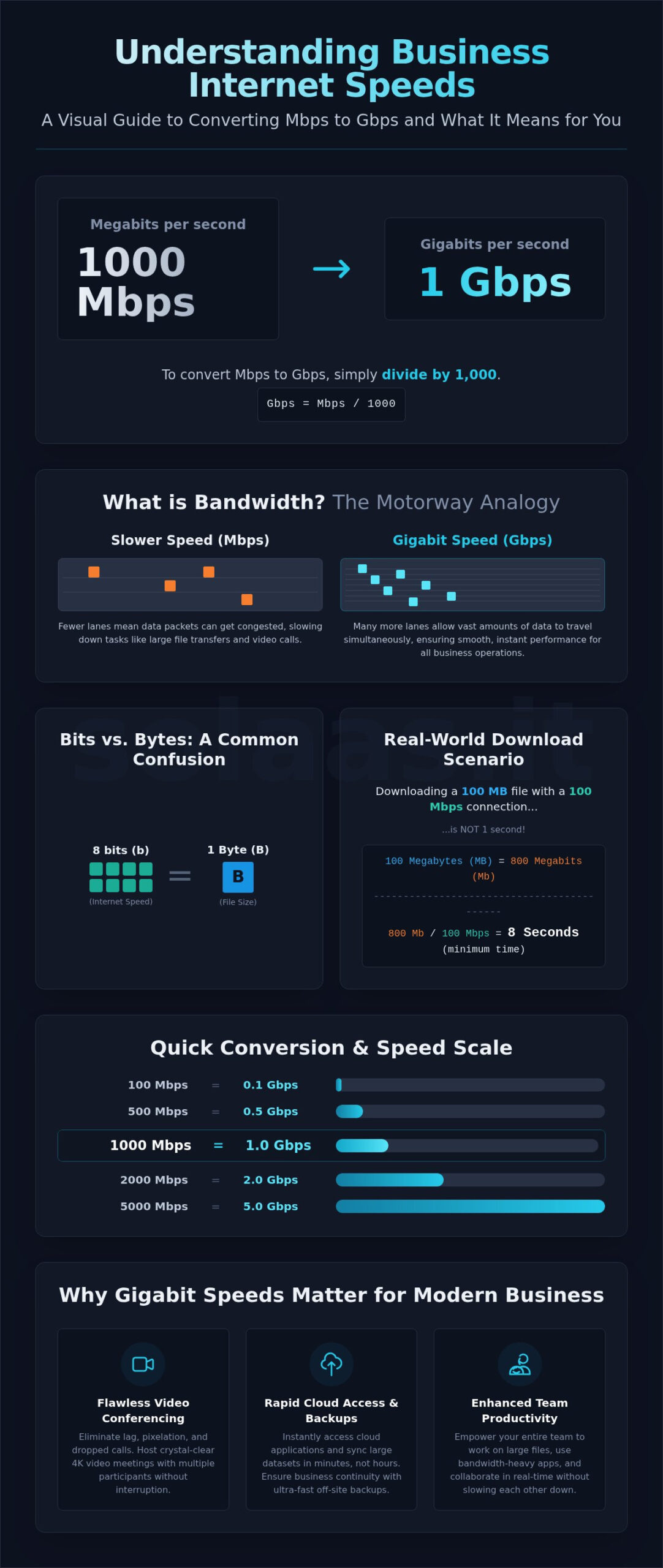
Let’s get straight to the point: there are 1,000 Megabits per second (Mbps) in 1 Gigabit per second (Gbps). This is the fundamental rule for converting between these two common measures of internet speed.
To convert from Mbps to Gbps, you simply divide the Mbps value by 1,000. Conversely, to convert from Gbps to Mbps, you multiply the Gbps value by 1,000. This straightforward calculation is crucial for accurately comparing internet plans and understanding the true performance of your business connectivity. These measurements are part of a standardised system of data-rate units used globally to define network performance and ensure clarity across providers. Mastering this simple conversion empowers you to choose a solution that genuinely meets your operational demands for efficiency and growth.
The Conversion Formula in Action
Putting this principle into practice is easy. Use the clear formula below to see how common internet speeds translate from one unit to the other.
Formula: Gbps = Mbps / 1,000
- Example 1: A common business fibre plan of 500 Mbps is equal to 0.5 Gbps (500 / 1,000).
- Example 2: A high-performance leased line offering 2500 Mbps is equal to 2.5 Gbps (2500 / 1,000).
Quick Conversion Reference Table
For even faster reference, use this chart to see the direct mbps to gbps conversion for typical business internet plans you’ll encounter in the UK. This table helps you quickly assess and compare different service tiers.
| Megabits per second (Mbps) | Gigabits per second (Gbps) |
|---|---|
| 100 Mbps | 0.1 Gbps |
| 250 Mbps | 0.25 Gbps |
| 500 Mbps | 0.5 Gbps |
| 1000 Mbps | 1 Gbps |
| 2000 Mbps | 2 Gbps |
| 5000 Mbps | 5 Gbps |
What Are Mbps and Gbps? Decoding Bandwidth and Speed
When discussing internet connectivity, the terms Mbps and Gbps are fundamental. Both are units of measurement for data transfer speed, more commonly known as bandwidth. Think of your internet connection as a motorway: if the data packets are the cars, bandwidth is the number of lanes available. More lanes mean more cars can travel at once, resulting in a faster, more efficient journey.
At the heart of this measurement is the ‘bit’-the smallest possible unit of digital data. From there, we scale up:
- A Megabit (Mb) is one million bits.
- A Gigabit (Gb) is one billion bits, or precisely 1,000 Megabits.
Understanding the simple conversion from mbps to gbps (1,000 Mbps = 1 Gbps) is the first step in appreciating the monumental leap in performance that gigabit connectivity offers. This speed determines how quickly you can perform online tasks, from sending an email to streaming high-definition video. Authoritative sources like the FCC Broadband Speed Guide provide detailed benchmarks on the speeds required for various activities, establishing Mbps as the baseline for modern digital life.
Bits vs. Bytes: A Common Point of Confusion
One of the most frequent sources of confusion is the difference between bits (b) and bytes (B). Internet speeds from providers are advertised in bits per second (Mbps, Gbps), while file sizes on your computer are measured in bytes (MB, GB). The critical relationship is: 1 Byte = 8 bits. This 8-to-1 ratio explains why a 100 Mbps connection doesn’t download a 100 MB file in one second. In reality, it would take at least eight seconds, as you’re downloading 800 megabits of data.
Understanding the Scale: From Kilobits to Gigabits
The evolution of internet connectivity can be seen in its units. We’ve progressed from Kbps (Kilobits per second), the standard of the dial-up era, to Mbps (Megabits per second), which powers today’s standard broadband. Now, Gbps (Gigabits per second) represents the new frontier of high-performance, fibre-optic connectivity. Making the leap from Mbps to Gbps empowers businesses with the seamless, scalable, and future-proof solution needed for modern demands like cloud computing and 4K video conferencing.
Why Gigabit (Gbps) Speeds Matter for Modern Businesses
In today’s competitive landscape, business connectivity is no longer just about being online; it’s about empowering your team to operate at peak efficiency. Making the leap from mbps to gbps is more than a simple upgrade; it’s a strategic investment that unlocks new levels of productivity and innovation. While many businesses still operate on Mbps connections, the demands of the modern digital workplace are rapidly making them obsolete. A comprehensive GAO report on business broadband needs even suggests that traditional speed benchmarks often fall short of what companies truly require to thrive.
A 1 Gbps connection removes the digital bottleneck that slows down ambitious teams. It transforms your internet from a utility into a powerful asset, future-proofing your operations for the ever-increasing data demands of tomorrow’s technology and ensuring you stay ahead of the curve.
If you’re ready to explore how a dedicated fibre connection can benefit your company, you can visit Lazer Telecom to see examples of business-grade internet packages.
Seamless Cloud Application and VoIP Performance
Modern businesses run on the cloud. Critical applications like Microsoft 365, Salesforce, and Adobe Creative Cloud demand constant, stable connectivity to function correctly. Likewise, a crystal-clear VoIP (Voice over Internet Protocol) telephone system relies on high bandwidth and low latency. Gigabit speeds provide the robust foundation these essential services need, eliminating frustrating lag, dropped calls, and interruptions that can damage both productivity and client perception.
Effortless Video Conferencing and Collaboration
For hybrid and remote teams, video conferencing is the new boardroom. A single 4K video call can consume significant bandwidth, and multiple simultaneous calls can quickly overwhelm a standard Mbps connection. This results in stuttering video, frozen screens, and poor audio quality. A Gbps connection ensures your team can collaborate seamlessly, presenting a polished, professional image on every call and maintaining the momentum of your projects without technical difficulties.
Accelerating Large Data Transfers and Backups
Does your business work with large files? For architects, creative agencies, video production houses, and data analysts, time is money. A gigabit connection can reduce the time it takes to upload or download massive files from hours to mere minutes. This has a direct impact on your bottom line:
- Faster Project Turnarounds: Deliver work to clients more quickly.
- Enhanced Data Security: Complete cloud backups in a fraction of the time, reducing downtime risk.
- Improved Efficiency: Your team spends less time waiting and more time creating value.
Speed Is Not Everything: Other Factors in Business Connectivity
Focusing solely on headline speeds can be misleading. While the jump from mbps to gbps promises a significant boost in performance, raw download speed is only one piece of the puzzle. A truly effective business connection is a carefully balanced solution of speed, quality, and reliability. A 1 Gbps plan is only as powerful as the infrastructure and support that underpins it, which is where dedicated business services demonstrate their unparalleled value over standard residential offerings.
As your trusted partner in connectivity, we believe in empowering businesses with the full picture. Here are the critical factors that transform a fast connection into a high-performance business asset:
Symmetrical Speeds: The Importance of Uploads
Most residential plans are asymmetrical, meaning your download speed is much faster than your upload speed. Business fibre, however, often provides symmetrical speeds (e.g., 1 Gbps download and 1 Gbps upload). This is vital for modern operations, ensuring seamless video conferencing, rapid cloud backups, and the swift transfer of large files to clients without bottlenecks.
Latency and Jitter: The Quality of Your Connection
Latency, or ping, measures the response time of your connection. High latency causes noticeable lag, which can be disruptive for real-time applications like VoIP calls and video meetings. Jitter refers to the variation in that latency. A quality business connection delivers consistently low latency and minimal jitter, ensuring a smooth, professional, and frustration-free experience for your team and customers.
Reliability and Service Level Agreements (SLAs)
Unlike residential broadband, a professional internet solution is backed by a Service Level Agreement (SLA). This is a contract that guarantees a minimum level of service, including uptime promises (e.g., 99.9% availability) and defined timescales for fault resolution. An SLA provides the ultimate peace of mind, ensuring that any potential downtime is minimised and your business remains productive.
Don’t let a consumer-grade connection hold your business back. A tailored solution considers all these factors to deliver the performance you truly need. Need a reliable connection built for business success? Explore our business internet solutions.
How to Choose the Right Internet Speed for Your Business
Selecting the right internet speed isn’t just about avoiding buffering; it’s a strategic decision that directly impacts your team’s productivity, efficiency, and capacity for growth. A connection that is too slow creates bottlenecks, while overpaying for unnecessary bandwidth affects your bottom line. The key is to find a tailored solution that aligns perfectly with your operational demands.
To help you make an informed choice, use this simple checklist to audit your current and future connectivity needs:
- User Count: How many employees use the internet simultaneously?
- Primary Activities: What are your most bandwidth-intensive tasks (e.g., video conferencing, large file transfers, cloud software)?
- Current Pain Points: Where do you currently experience slowdowns or interruptions?
- Growth Plans: How do you expect your team size and reliance on digital tools to change in the next 12-24 months?
Assess Your Team Size and Usage Patterns
Start by evaluating your daily operations. Consider not just the number of employees, but how they work. A small team that primarily uses email and web browsing has vastly different needs than a team of the same size that relies on constant video calls, VoIP, and transferring large design files. Don’t forget to account for remote staff connecting via VPN, as this also places demands on your central office connection.
Speed Recommendations for Different Business Sizes
While every business is unique, these tiers provide a strong starting point. The transition from mbps to gbps is a critical step for scaling businesses that depend on seamless cloud collaboration.
- 1-5 Users: A 100-300 Mbps connection is often sufficient for basic tasks like email, web browsing, and standard-definition video calls.
- 5-20 Users: With more collaboration, cloud app usage, and HD video, a 500 Mbps to 1 Gbps plan is ideal for maintaining smooth performance.
- 20+ Users: For larger teams, 1 Gbps and above is essential. This ensures your operations remain productive and free from frustrating lag, even during peak usage.
Planning for Future Growth
Your internet connection should be an asset that facilitates growth, not a constraint that holds you back. When choosing a plan, think about your hiring pipeline and the adoption of new, data-hungry technologies. The best approach is to partner with a flexible provider that allows you to scale your bandwidth easily as your business evolves. This agility ensures you are always equipped for what’s next, without being locked into a rigid, long-term contract.
Not sure what you need? Talk to one of our connectivity experts today.
Unlock Your Business Potential with the Right Connectivity
Understanding your internet speed is the first step towards unlocking greater efficiency and productivity. As we’ve explored, the leap from mbps to gbps represents more than just a number-it signifies a fundamental upgrade in your business’s capacity to handle data-intensive tasks, from seamless cloud collaboration to high-definition video conferencing. However, true high-performance connectivity goes beyond raw speed; it’s a combination of high bandwidth, low latency, and unwavering reliability.
Choosing the right solution can feel complex, but you don’t have to navigate it alone. As your expert UK-based IT and telecoms partner, SolaaS specialises in delivering flexible, scalable connectivity solutions tailored to your unique business needs. Whether you require the unparalleled performance of business-grade fibre or the innovative reach of Starlink satellite internet, our team is here to design a service that grows with you.
Ready to empower your team and future-proof your operations? Find the perfect high-speed internet solution for your business.
Frequently Asked Questions: Mbps to Gbps
What is the difference between Mbps and MBps?
The key difference lies in the unit of measurement: bits versus bytes. Mbps stands for megabits per second and is used to measure internet connection speed. MBps stands for megabytes per second and measures file size. Since there are 8 bits in every byte, a 100 Mbps connection will download a 100 MB file in approximately 8 seconds, not one. Understanding this distinction is crucial for managing expectations around your business connectivity performance.
How many Mbps is considered a good internet speed for a business?
A “good” speed is entirely dependent on your operational needs. For a small team with basic cloud usage, 50-100 Mbps may suffice. However, for businesses relying on video conferencing, large file transfers, and multiple cloud applications, a speed of 300 Mbps to 1 Gbps (1,000 Mbps) is a more effective solution. The right scalable solution ensures your connectivity never hinders productivity, even as your team grows and your digital demands increase.
How can I test my current business internet speed accurately?
For the most accurate reading, connect a computer directly to your router using an Ethernet cable, as Wi-Fi speeds can fluctuate. Close all other applications and browser tabs that might be using the connection. Use a reputable online speed testing tool and run the test multiple times throughout the day. This process provides a clear and reliable benchmark of the performance your business is actually receiving, removing variables like wireless interference.
Can my office hardware (router, cables) limit my Gigabit internet speed?
Yes, absolutely. Your internal hardware is a critical link in your connectivity chain. To achieve true Gigabit speeds, your router must have Gigabit Ethernet ports, and your network cables should be Cat 5e or, ideally, Cat 6. When you upgrade from Mbps to Gbps, using older, incompatible hardware will create a bottleneck, preventing you from realising the full speed and efficiency you are paying for. A full infrastructure audit is a vital step in any upgrade.
Is 1 Gbps internet the same as 5G?
No, they are different concepts. 1 Gbps is a specific measurement of data speed (1,000 megabits per second). 5G is the fifth-generation technology standard for cellular networks. While 5G networks can theoretically deliver 1 Gbps speeds, it is a wireless, shared technology where performance can vary based on signal strength and network congestion. A 1 Gbps fibre broadband connection provides a dedicated, physical line for more stable and reliable business performance.
Why is business broadband more expensive than residential plans?
Business broadband costs more because it is a fundamentally superior service designed for commercial reliability. The higher price, often just a few pounds more per day, typically includes a Service Level Agreement (SLA) with guaranteed uptime and faster fault-fix times. It also provides essential features like static IP addresses, enhanced security, and dedicated business support teams, all of which are vital for protecting a company’s productivity and revenue.

Article by
René Wheeler
René Wheeler is Managing Director of SolaaS, bringing over three decades of experience in IT and telecoms. He is a strong advocate for transparency and flexibility, championing monthly contract models that allow businesses to stay agile and in control of their technology. His approach challenges traditional industry practices and puts client outcomes first