
Cybersecurity for Manufacturing Plants: Threats and Defenses
A cyber incident on a factory floor can quickly become an operational problem, not just a data problem. Effective cybersecurity for manufacturing plants helps protect the connected systems behind production, from business networks to equipment that monitors and controls processes. The goal is to reduce the risk of disruption and protect sensitive information.
Manufacturing depends on systems working together, so a weakness in one area can affect others. Protecting production does not mean treating every device alike. It means understanding how systems connect and identifying where disruption would have the greatest impact.
This article outlines key cyber threats to manufacturers, how threat intelligence and ongoing monitoring can help flag suspicious activity, and why ransomware can halt production. It also explains how a considered security approach can build resilience and support informed decisions about protecting operations.
Key Takeaways
- Understand how connected production systems can create security weaknesses, including those exploited by EKANS ransomware.
- Learn how threat intelligence and continuous monitoring can help surface unusual activity before it escalates.
- See why ransomware can affect production, not just files, and what makes operational disruption especially challenging.
- Explore how tailored IT support can help strengthen security around the systems your business depends on.
What is Cybersecurity in Manufacturing?
Cybersecurity for manufacturing plants helps protect production systems, business networks and connected devices from attacks that could expose information or cause downtime. It focuses on how security risks affect operations, not only office computers.
ICS vulnerabilities and industrial threats
Industrial control systems (ICS) manage equipment and production processes, so vulnerabilities can affect both software and physical operations. A ransomware attack affecting industrial control systems can disrupt operations as well as compromise data. Industrial espionage and nation-state threats may also target valuable production knowledge.
Cyber Essentials is a UK government-backed scheme that assesses basic cyber protections. It can help manufacturers address common IT risks, but it does not cover every operational technology risk.
Visibility, asset classification and risk assessment
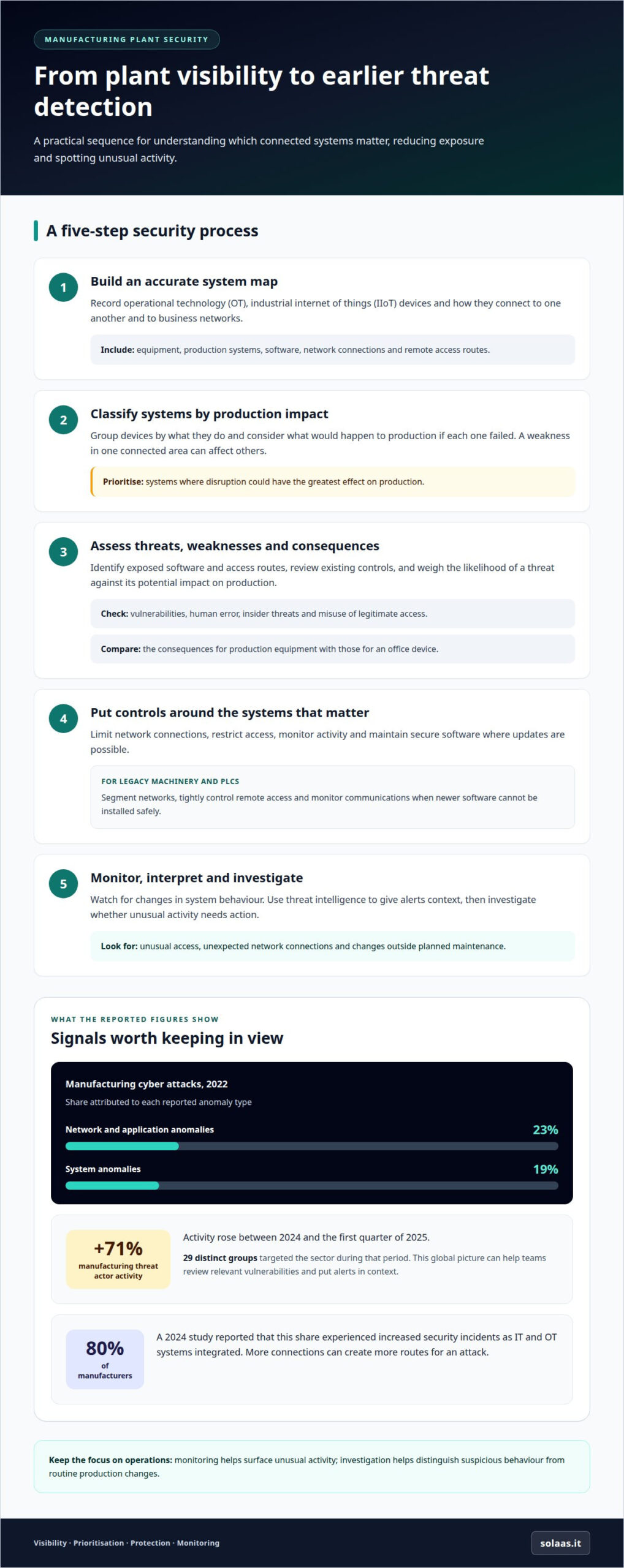
Start with an accurate, up-to-date record of operational technology (OT), industrial internet of things (IIoT) systems and their connections. Classify devices by function and by the production impact if they fail. A risk assessment can then identify threats and vulnerabilities, review existing controls, and weigh likelihood against impact to set priorities. Effective cybersecurity for manufacturing plants begins with knowing which systems matter most to production.
UK legal duties depend on the organisation’s activities and the information or services it handles; there is no single manufacturing-specific cybersecurity law. Standards include ISA/IEC 62443 for industrial automation security and ISO 27001 for information security management.
Industry 4.0 and expanding attack surfaces
Industry 4.0 connects machinery with sensors, software, cloud services and business networks. Each connection can create another route for an attack, particularly when devices share systems or remote access. A 2024 study reported that 80% of manufacturers experienced increased security incidents as IT and OT systems integrated.
Plant cybersecurity costs in the UK depend on the systems assessed, the risks identified and the controls needed. A quote request establishes the cost.
OT controls and legacy machinery
Protect OT by limiting network connections, restricting access, monitoring activity and maintaining secure software where updates are possible. For legacy machinery and PLCs, segment networks, tightly control remote access and monitor communications when newer software cannot be installed safely. These measures help contain a compromise without treating every machine alike.
UK government grants and support depend on current programmes and eligibility. Manufacturers should assess any available support against their project and business circumstances.
Threat intelligence and continuous monitoring
Threat intelligence gives security alerts context, while monitoring tracks activity across connected networks. For cybersecurity for manufacturing plants, this helps teams relate unusual activity to production systems. In 2022, network and application anomalies accounted for 23% of manufacturing cyber attacks; system anomalies accounted for 19%.
Threat and vulnerability assessment
A threat and vulnerability assessment compares likely attacks with weaknesses in a plant’s systems and existing controls. It matters because a flaw affecting production equipment can carry different consequences from one affecting an office device. Map connected systems, identify exposed software and access routes, then assess potential effects on production. Include human error and insider threats, such as misuse of legitimate access or an employee responding to a deceptive message.
OT and IIoT threat intelligence
OT and IIoT threat intelligence focuses on risks to equipment and connected industrial devices, rather than business networks alone. It helps teams interpret whether a new cyber threat could affect their particular systems. Manufacturing threat actor activity rose by 71% between 2024 and the first quarter of 2025, with 29 distinct groups targeting the sector during that period. This global picture gives security teams context for reviewing relevant vulnerabilities and refining cybersecurity for manufacturing plants.
Threat detection and continuous monitoring
Continuous monitoring looks for changes in system behaviour, while threat detection and analysis determine whether an alert needs action. IBM’s 2020 X-Force Threat Intelligence Index reported a 2000% year-on-year increase in attackers targeting OT environments. Monitoring can help discover unusual access, unexpected network connections or changes outside planned maintenance, while Cyber Essentials support can provide a practical baseline against common cyber risks. Reviewing access and investigating unusual actions can help distinguish routine production changes from suspicious behaviour.
Manufacturing ransomware and operational disruption
Major cyber threats to UK manufacturers include ransomware, phishing, stolen credentials and attacks on connected systems. These can affect production, data integrity and supply chain operations.
Ransomware can block access to systems or data, turning a cyber incident into an operational disruption. The impact depends on which production platforms and connected processes are affected.
Phishing and social engineering
Phishing uses deceptive messages to trick people into sharing credentials or opening harmful files, giving attackers a route into an organisation’s networks. Social engineering can also involve impersonation, such as a message that appears to come from a supplier and requests urgent payment or access. A compromised account may give attackers a way beyond email, so clear reporting routes and staff awareness can support earlier detection.
Ransomware risks in manufacturing
Ransomware blocks access to files or systems, often disrupting the tools that support production and business operations. In the Sophos State of Ransomware in Manufacturing and Production 2024 report, 65% of manufacturers were found to have been hit by ransomware. For an increasingly connected sector, the risk can extend beyond one site: suppliers and customers may also feel the effects when shared workflows or information become unavailable.
Operational disruption from ransomware
A ransomware attack can halt production if staff lose access to scheduling, technical records or systems needed to run equipment safely. After the 2019 LockerGoga attack, most of Norsk Hydro’s 160 manufacturing locations operated manually for more than a month. Manual workarounds can preserve some activity, but they may slow output and complicate quality checks. Protecting operational continuity means planning how the organisation will respond, restore access and maintain data integrity, with managed cybersecurity support helping shape those priorities.
SolaaS Limited: Cybersecurity
SolaaS helps businesses manage the IT systems behind day-to-day operations through Managed IT Services. For manufacturers, understanding how those systems connect to production can bring IT priorities and operational needs into the same conversation.
Review your business’s IT environment when setting security priorities, planning changes or seeking to reduce disruption. A clear view of the systems your teams rely on can help shape practical next steps. The right support depends on your organisation’s needs.
If you have questions about this article and how it affects your business, contact SolaaS Limited.
Build a stronger path to resilient production
Build security into operational planning so technology decisions reflect the needs of your workforce and production processes. A focused review can help identify which priorities need attention first and where specialist support could help.
SolaaS provides Managed IT Services, Cloud Telephony Solutions and a Contact Centre Platform. Discuss how these services fit your wider technology environment and business needs. A practical conversation can help you plan next steps for cybersecurity for manufacturing plants while keeping day-to-day operations in view.
If you have questions about this article and how it affects your business, contact SolaaS Limited. Take the next step towards a security approach that supports your business as it evolves.
Frequently Asked Questions
Why is manufacturing such a hot target?
Manufacturers attract attackers because production relies on connected systems, and disruption can affect orders, income and supply chain commitments. Plants may also hold valuable designs, process knowledge and supplier information. Attackers might exploit an office account or external connection to reach operational systems, making the sector a target for financially motivated criminals and espionage groups.
How can manufacturers securely connect IT and OT networks?
Connect IT and OT through controlled points, allowing only traffic needed for defined tasks. For example, limit a maintenance connection to approved systems and authorised accounts, then disable it when work ends. Require strong authentication for remote access, record sessions where practical, and review connection rules after engineering changes so temporary access does not become an unnoticed permanent route.
What steps should a manufacturing plant take to assess its cybersecurity risks?
Identify systems, their operational roles and the equipment or processes that depend on them. Map how information and access move between plant equipment, business systems and external parties. Review weaknesses, existing safeguards and the consequences of compromise. Assign owners to priority actions, and repeat the assessment when equipment, suppliers or production processes change.
How should manufacturers prepare for ransomware and operational disruption?
Prepare a response plan that names decision-makers, technical contacts and the people responsible for communicating with staff and suppliers. Set out how teams can isolate affected systems without unnecessarily interrupting unaffected work. Document recovery priorities, maintain protected backups, and test that data can be restored and checked before systems return to production. Practise the plan with realistic scenarios.
Which UK cybersecurity laws and regulations apply to manufacturing plants?
UK legal duties depend on the organisation’s activities and the information or services it handles; there is no single manufacturing-specific cybersecurity law. ISA/IEC 62443 and ISO 27001 are relevant standards.

Article by
René Wheeler
René Wheeler is Managing Director of SolaaS, bringing over three decades of experience in IT and telecoms. He is a strong advocate for transparency and flexibility, championing monthly contract models that allow businesses to stay agile and in control of their technology. His approach challenges traditional industry practices and puts client outcomes first