
Cyber Security Solutions for Enterprises and What They Include
No single security tool can protect an enterprise on its own. Effective cyber security solutions for enterprises combine measures that protect networks, devices, accounts and data, while helping teams detect and respond to threats. The right mix depends on how the organisation operates and which systems it relies on.
Cyber security is not just a technical issue. A breach can disrupt everyday operations, expose sensitive information and damage the trust of customers and partners. A coordinated approach gives businesses greater visibility and control over these risks.
This article explains what enterprise cyber security involves, how its core protections work and when they matter. It also outlines how security can connect with wider IT needs, helping your organisation make informed decisions about next steps.
Key Takeaways
- Understand how a coordinated security approach protects business systems, information and day-to-day operations.
- Learn how identity and access controls can limit who reaches sensitive accounts and data.
- See why security support works best when it reflects your organisation’s needs and priorities.
- Explore when managed IT services can help bring your business technology needs together.
What is a Cyber Security Solution?
Well-designed cyber security solutions for enterprises protect networks, devices, accounts and information. The right combination should reflect how the organisation works and which systems support its operations.
Insider threat risks
An insider threat involves someone with legitimate access causing harm through malicious actions, mistakes or compromised credentials. For example, a staff member might expose shared files by responding to a phishing message. UK GDPR and the Data Protection Act 2018 shape how organisations protect personal information. According to the Information Commissioner’s Office, serious data breaches can attract fines of up to £17.5 million or 4% of global annual turnover, whichever is higher.
Detection analytics and threat intelligence
Automated detection analyses network activity for signs of threats, while real-time analytics help teams investigate unusual changes. A sudden login followed by bulk file access, for instance, may warrant attention. Threat intelligence provides context about known attacks, and behavioural analytics can flag activity that differs from a user’s usual pattern. Together, these measures help teams distinguish routine events from possible ransomware or phishing activity.
Monitoring and managed protection
Continuous monitoring reviews activity across systems, helping teams investigate alerts and respond to incidents. A response may include isolating an affected device and preserving records for investigation. The National Cyber Security Centre’s 12 Principles of Supply Chain Security provide a framework for managing supply-chain cyber security, including supplier access and related risks.
Managed and in-house security teams
In-house teams know the organisation’s systems, while managed security services can provide additional specialist monitoring capacity. The trade-off is between internal control and business knowledge, and reliance on an external team’s processes and communication. When selecting cyber security solutions for enterprises, consider available skills, risk priorities and reporting needs. Organisations looking to build capability or supplement their teams often collaborate with specialist providers like Insoft Services for technical consultancy and training. Cyber Essentials sets baseline controls, while Cyber Essentials Plus adds technical assessment. Certification costs vary by scheme and assessment scope; enterprise security costs depend on the systems covered and the services required.
Identity and access management
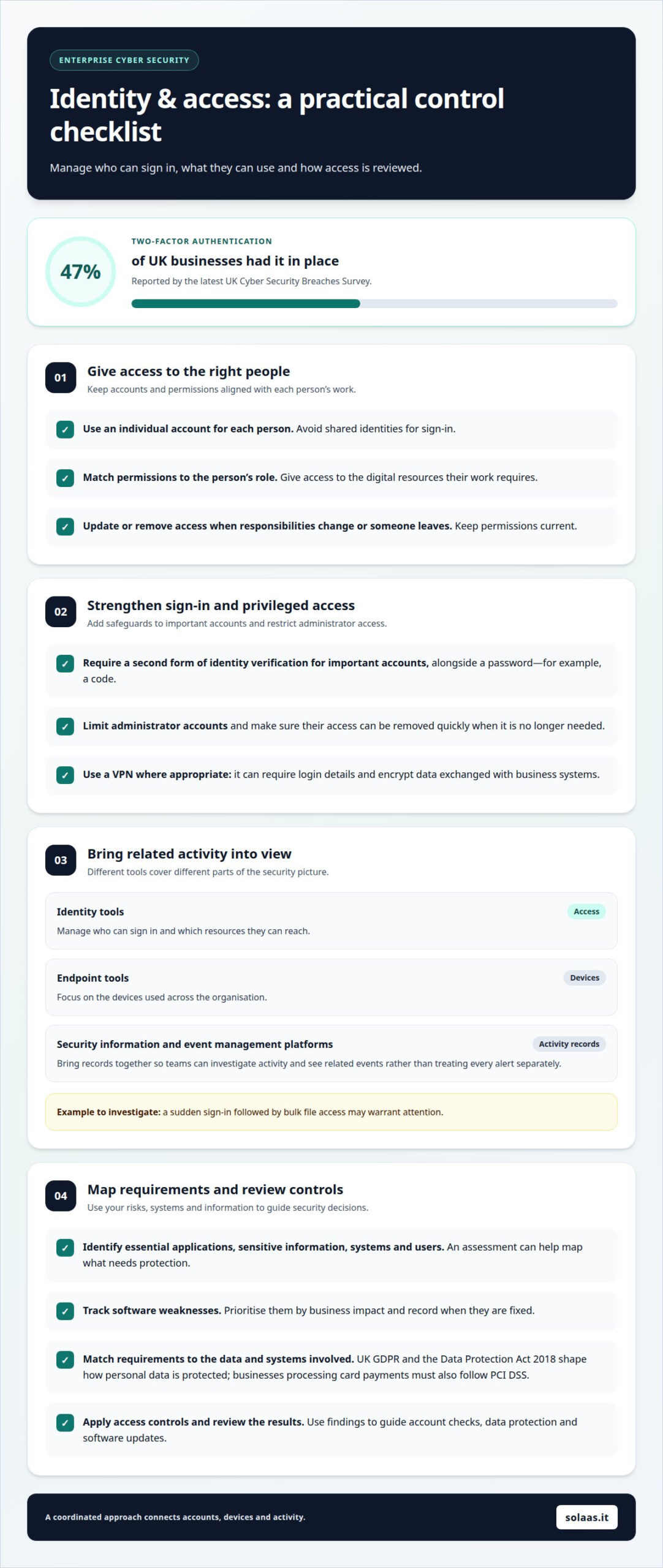
Identity and access management determines who can sign in, which devices they can use and what digital resources they can access. Give each person an individual account and match permissions to their role. Remove access when someone changes responsibilities or leaves, so permissions stay aligned with current work needs.
For important accounts, require a second form of identity verification alongside a password, such as a code. A virtual private network (VPN) can require login details and encrypt data exchanged with business systems. Limit administrator accounts and ensure their access can be removed quickly when it is no longer needed.
The latest UK Cyber Security Breaches Survey reported that 47% of UK businesses had two-factor authentication in place. Identity tools manage access; endpoint tools focus on devices; security information and event management platforms bring activity records together for investigation. For cyber security solutions for enterprises, connecting these tools can help teams see related activity rather than treating every alert separately.
UK GDPR and the Data Protection Act 2018 shape how organisations protect personal data. Businesses processing card payments must also follow PCI DSS, a security standard for payment card information. The relevant requirements depend on the data handled and the organisation’s activities, so map them against the systems and records they affect.
Build a cybersecurity programme by assessing business risks, identifying systems and users, applying access controls and reviewing the results. An assessment can map essential applications and sensitive information. Track software weaknesses, prioritise them by business impact and record when they are fixed. Effective cyber security solutions for enterprises use these findings to guide decisions on account checks, data protection and software updates.
Cyber security expertise and customer-led support
Expert support connects security decisions to business priorities, not just platform alerts. A retailer, for example, may prioritise payment systems and customer records, while a professional services firm may focus on confidential client files. This context helps teams identify critical assets, assess where threats could disrupt operations and decide which safeguards need attention first.
Customer-led support starts with understanding the organisation’s environment, including cloud services, office networks, remote access and suppliers. Specialists can use this picture to shape monitoring, interpret intelligence and explain which alerts need action. An unusual sign-in to a finance account, for example, may need immediate investigation, while a known software update could explain routine activity.
During an incident, clear responsibilities and communication help staff respond quickly. The response team needs to identify affected systems, limit further access, preserve useful records and keep business leaders informed. Afterwards, a review can establish how the breach happened and which changes could reduce similar exposure. This turns detection into practical learning, rather than leaving it as a closed alert.
For a multi-site organisation, central visibility can bring activity from different locations and cloud services together. Effective support also makes reporting clear: what was detected, what action followed and which risks remain. Many organisations turn to providers such as Gradius IT Solutions to ensure hands-on technical assistance and dependable day-to-day system management across workplace environments. Choose a partner that explains its approach in plain English and adapts it as your systems change. Explore security support options to see how they could fit your business.
SolaaS Limited: Managed IT Services
SolaaS provides Managed IT Services to help businesses manage their technology and support day-to-day operations. This can be a useful next step when security priorities involve workplace systems, user support and business operations, rather than a single isolated tool.
A clearer view of how IT supports daily work helps identify where specialist security measures fit within the wider technology environment. SolaaS also provides Cloud Telephony, a Contact Centre Platform and Internet Connectivity, helping businesses consider core technology needs together.
If you’d like to discuss how these services relate to your business, contact SolaaS Limited.
Build security into future decisions
Security decisions are most effective when they evolve with your organisation. As teams adopt systems, change working practices or engage suppliers, review which assets matter most and whether safeguards still match those priorities. This keeps cyber security solutions for enterprises aligned with business goals, rather than treating protection as a one-off technical project. Include security in change planning, responsibility assignments and reviews of how new technology will affect daily operations.
SolaaS Limited offers Managed IT Services, Cloud Telephony Solutions and a Contact Centre Platform, helping businesses consider technology needs together. If you’re planning your next steps or want to discuss how this affects your business, contact SolaaS Limited. A practical conversation can help you clarify priorities and move forward with confidence.
Frequently Asked Questions
Why is enterprise cybersecurity important?
Enterprise cybersecurity helps protect business operations, confidential information and customer relationships from disruption. In a Coventry organisation, for example, a compromised shared account could expose files used across teams. Clear access rules, incident responsibilities and recovery arrangements help limit the impact and give staff a more organised response when something goes wrong.
What Defines Top Cybersecurity Companies?
A strong cybersecurity provider explains how its work fits an organisation’s risks, systems and priorities. Look for clear reporting that distinguishes urgent issues from routine alerts, alongside an agreed process for raising incidents. For a business with several sites or suppliers, useful support should explain how risks across those connections are assessed and who is responsible for each response.
What are the Five Main Types of Cybersecurity?
A practical five-part framework covers network security, application security, information security, operational security, and disaster recovery and business continuity. Network security focuses on connections; application security addresses software weaknesses; information security protects data. Operational security covers access and working practices, while recovery planning helps restore essential services after disruption. These areas work together rather than in separate silos.
What are the Technical Approaches to Cybersecurity?
Effective technical security combines safeguards across systems instead of relying on one tool. Network segmentation, for example, can separate finance systems from general office devices, limiting how far an intruder can move. Secure configuration reduces unnecessary access, while application testing can reveal weaknesses before launch. Recovery exercises help teams practise restoring critical services and identify gaps in their plans.
What are the benefits of robust enterprise security?
Robust security gives organisations clearer oversight and defined responsibilities when making changes. Before launching a customer portal, a business can review who needs access, how information will be handled and how services could be restored after disruption. This planning supports confident decisions, protects working relationships and gives managers a clearer basis for prioritising future technology improvements.
For support connecting IT priorities with your wider business needs, contact SolaaS.

Article by
René Wheeler
René Wheeler is Managing Director of SolaaS, bringing over three decades of experience in IT and telecoms. He is a strong advocate for transparency and flexibility, championing monthly contract models that allow businesses to stay agile and in control of their technology. His approach challenges traditional industry practices and puts client outcomes first