
The Ultimate Guide to Phone Systems for Business (2026 UK Edition)
Is your outdated, unreliable phone system causing you to miss crucial customer calls and frustrating your team? For many UK businesses, the thought of upgrading brings worries of high costs, complex installation, and a sea of technical jargon. In today’s hybrid work environment, a clunky communication setup isn’t just an inconvenience-it’s a barrier to growth. The good news is that selecting the perfect phone system for business has never been more accessible or more powerful.
Welcome to your definitive 2026 guide, designed to cut through the complexity and empower you to make a confident choice. In this article, you will discover everything you need to know about modern solutions, from flexible cloud-based VoIP to the essential features that support remote work and enhance your professional image. Prepare to find a scalable, cost-effective system that not only meets your needs today but is ready to drive your company’s success tomorrow.
Key Takeaways
- With the UK’s traditional phone network switch-off approaching, learn why transitioning to VoIP is an essential move that unlocks superior flexibility and cost-efficiency.
- Your most critical decision is between a cloud-hosted or on-premise system; understanding the key differences in scalability and cost is crucial for future-proofing your business.
- A modern phone system for business is a productivity powerhouse. Discover the must-have features that go beyond calls to streamline workflows and enhance customer experience.
- Choosing the right provider is vital for success. Follow our 5-step checklist to confidently evaluate partners on reliability, support, and overall value for your company.
What is a Modern Business Phone System? (And Why Your Landline is Obsolete)
In today’s dynamic business environment, your phone system is far more than a way to make and receive calls-it’s the central hub of your professional communication. While traditional landlines once served this purpose, they are now being replaced by more powerful, flexible, and cost-effective technology. At its core, a modern Business telephone system operates over the internet, a technology known as VoIP, transforming how you connect with clients and colleagues.
This fundamental shift isn’t just a trend; it’s a critical infrastructure upgrade. For companies in the UK, the clock is ticking on the old way of doing things, making the transition to a modern solution an immediate priority.
The End of the Line: The UK’s 2025 PSTN Switch-Off
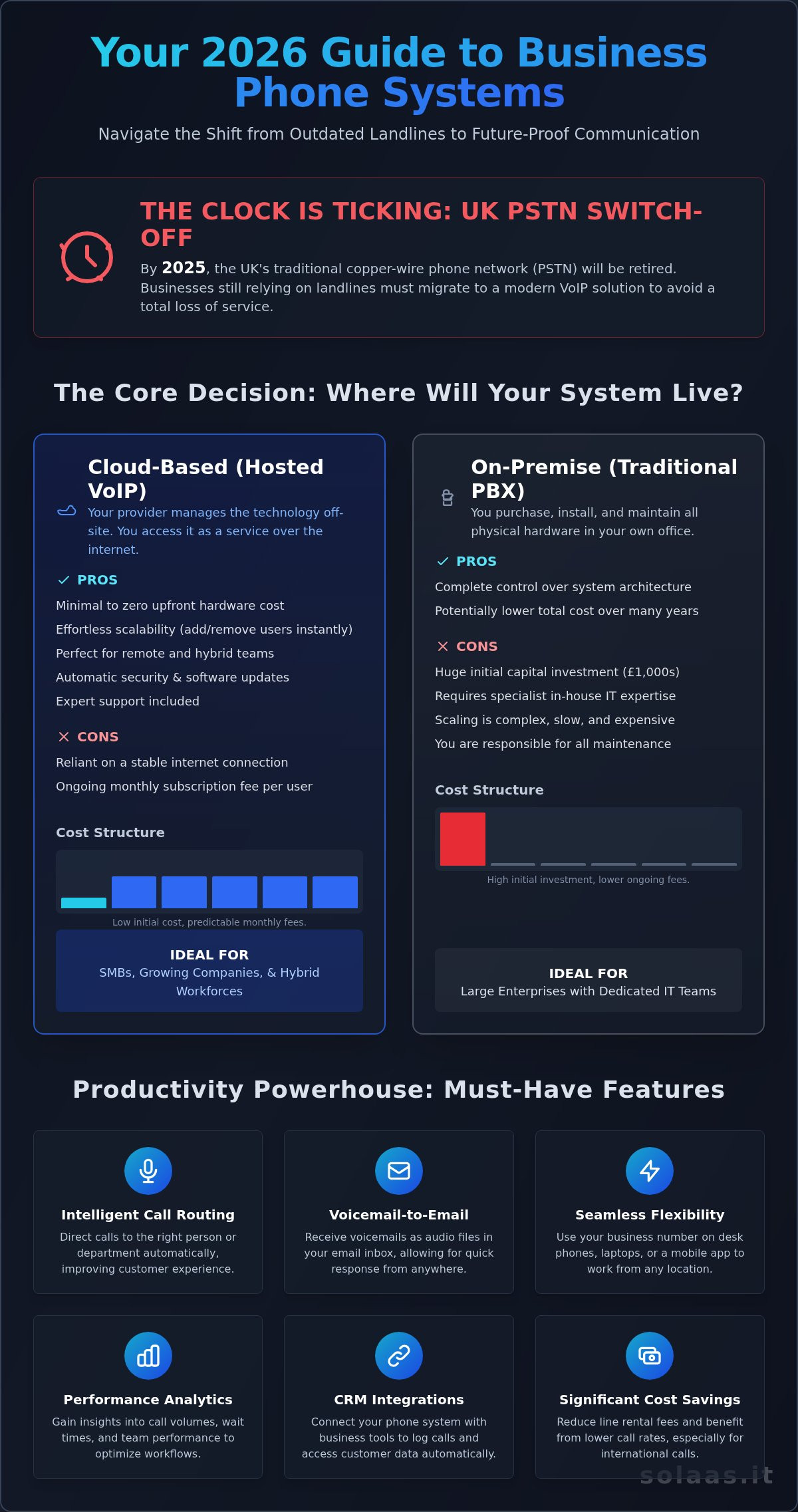
The Public Switched Telephone Network (PSTN) is the traditional copper-wire network that has powered UK landlines for decades. This ageing infrastructure is expensive to maintain and lacks the capabilities of modern digital networks. As a result, it is being officially retired, with a complete switch-off scheduled for 2025. Businesses still relying on these lines must act now to migrate to a new solution to avoid a total loss of service.
VoIP Explained: How Your Business Calls Use the Internet
VoIP, or Voice over Internet Protocol, is the foundational technology for every modern phone system for business. Think of it like sending an email or streaming a video, but for your voice. Instead of using a physical copper line, VoIP converts your voice into digital data and sends it securely over your internet connection. This simple change unlocks incredible potential, allowing you to make and receive crystal-clear calls from any device-a desk phone, a laptop, or a mobile app-wherever you have internet access.
Switching to a VoIP-based system puts the reins of your communication services firmly back in your hands, offering a suite of benefits that legacy systems cannot match:
- Significant Cost Savings: Drastically reduce line rental fees and benefit from lower call rates, especially for international calls.
- Unparalleled Flexibility: Empower your team to work seamlessly from any location-the office, home, or on the move-using the same business number.
- Advanced Features: Gain access to powerful tools like intelligent call routing, voicemail-to-email, performance analytics, and CRM integrations to boost efficiency.
Types of Business Phone Systems: Cloud vs. On-Premise
Choosing how your communications infrastructure is hosted is one of the most significant decisions you will make. This choice fundamentally dictates your system’s flexibility, cost structure, and maintenance requirements. The decision boils down to a simple question: do you want to own and manage physical hardware on-site, or do you prefer to leverage a provider’s expertise and infrastructure as a flexible service? This is the core difference between an on-premise PBX and a modern, cloud-based phone system for business.
Let’s break down the two primary models to help you find the right solution.
Cloud-Based Phone Systems (Hosted VoIP)
A cloud-based system, often called Hosted VoIP or Hosted PBX, means an expert provider (like SolaaS) owns, manages, and maintains all the technology in secure, off-site data centres. You access the service over the internet, freeing you from the complexity of hardware management. This model puts the focus on functionality, not infrastructure, delivering a suite of essential VoIP features like call routing and CRM integration as a service.
- Pros: Minimal upfront cost, unparalleled scalability to grow with your business, seamless support for remote and hybrid teams, and automatic software updates and security patches.
- Cons: Performance is dependent on a stable internet connection, and it involves a predictable, ongoing monthly subscription fee per user.
On-Premise PBX Systems
The traditional alternative is an on-premise Private Branch Exchange (PBX) system. This involves purchasing and installing all the physical server hardware and telecommunications equipment within your own office. Your internal IT team is then responsible for its configuration, maintenance, updates, and security.
- Pros: Gives you total control over your system’s architecture and data. For very large enterprises with static workforces, the total cost of ownership could potentially be lower over many years.
- Cons: Requires a huge initial capital investment (£1,000s-£10,000s), demands specialist in-house IT expertise for ongoing management, and scaling the system is both complex and expensive.
| Factor | Cloud-Based System | On-Premise System |
|---|---|---|
| Initial Cost | Low (minimal hardware) | Very High (servers, installation) |
| Maintenance | Handled by the provider | Requires in-house IT team |
| Scalability | Easy & Instant | Complex & Costly |
Which is Right for Your Business?
For the vast majority of UK SMEs, startups, and companies embracing agile, hybrid working models, a cloud-based solution is the clear winner. It offers the flexibility, cost-effectiveness, and advanced features needed to compete in the modern marketplace. An on-premise system may still be a viable option for large corporations with dedicated IT departments and specific, complex security requirements. The right phone system for business should empower your operations, not constrain them. Our experts can help you assess the best fit for your needs.
Must-Have Features of a Modern Business Phone System
A modern phone system is far more than a tool for making and receiving calls. It’s a strategic asset designed to enhance customer experience, boost productivity, and provide unparalleled flexibility. When selecting the right phone system for business, it’s crucial to look beyond basic dial tone and build a checklist of features that solve genuine operational challenges.
For Professionalism & Customer Experience
- Auto-Attendant (Digital Receptionist): Make a powerful first impression. An auto-attendant greets callers with a professional, custom message and routes them to the correct department or individual, ensuring every customer connects with the right person, fast.
- Call Queues: Never let a busy signal cost you a customer. Call queues efficiently manage high call volumes by placing callers in an orderly line with custom music or announcements until an agent is free, transforming potential frustration into a seamless service experience.
- Voicemail-to-Email: Stay responsive without being tied to a handset. This feature sends voicemail audio files directly to your email inbox, allowing you to listen, forward, or archive messages from any device and streamlining your workflow.
For Mobility & Flexibility
- Mobile & Desktop Apps (Softphones): Empower your team to work from anywhere. Softphone apps turn laptops and smartphones into fully-featured business extensions, allowing your team to use their business number whether they’re in the office, at home, or on the move.
- Call Forwarding: Ensure business continuity and never miss a critical call. Advanced rules can redirect calls to a mobile, a colleague, or a group of numbers based on availability. This is a cornerstone of a resilient communications strategy, aligning with official UK guidance on telecoms resilience to keep your business connected.
- Virtual Phone Numbers: Establish a local presence across the UK without the cost of a physical office. Acquire virtual numbers for any city, from London (020) to Manchester (0161), making your company more accessible to regional customers.
For Productivity & Collaboration
- Video Conferencing & Team Messaging: Unify your communications. Integrating video and messaging into your phone platform creates a single, powerful hub for collaboration, reducing reliance on multiple apps and simplifying workflows.
- CRM Integrations: Turn call data into business intelligence. Connecting your phone system for business with CRMs like HubSpot or Salesforce provides your team with instant caller context, enabling more personal and efficient conversations.
- Call Recording: A vital tool for training, quality, and compliance. Automatically or manually record calls for quality assurance, to support staff development, or to maintain a verifiable record for dispute resolution.
How to Choose the Right Provider: A 5-Step Checklist
Selecting the right contact centre platform is a strategic decision that impacts your customer experience and operational efficiency. To make a confident choice, you need a framework that goes beyond the price tag. This five-step checklist empowers you to evaluate providers and find the perfect phone system for business communications, putting the reins of control firmly back in your hands.
Step 1: Assess Your Business Needs
Before looking at any software, look inward. A clear understanding of your requirements is the foundation for a successful choice. Start by asking critical questions:
- Scalability: How many users do you have now, and what is your projected growth over the next two years? Your chosen platform must scale with you.
- Flexibility: Do you have remote or hybrid employees? Ensure the system offers seamless connectivity and a consistent user experience, regardless of location.
- Challenges: What are your biggest communication pain points? Are you missing calls, struggling with call routing, or lacking performance data?
Step 2: Check Your Internet & Network
A modern VoIP-based platform is only as strong as the network it runs on. Poor call quality is almost always linked to an unstable internet connection, not the provider. Before you commit, perform a speed test to check your bandwidth and latency. More importantly, a trustworthy provider can help you perform a network readiness assessment to guarantee a seamless transition.
Step 3: Compare Pricing and Contracts
Look beyond the headline monthly fee. Scrutinise what is included in each pricing tier. A cheaper plan may lack essential features like call recording or analytics, costing you more in the long run. Beware of providers that lock you into long-term contracts. The most adaptable solutions offer flexible, month-to-month options. Always ask about potential extra costs, such as charges for additional phone numbers or international calls.
Step 4: Evaluate Reliability and Support
Downtime is not an option. Look for providers that offer a high uptime guarantee, often detailed in a Service Level Agreement (SLA) of 99.9% or higher. When issues arise, you need fast, effective help. Check if they offer UK-based support during your business hours. Finally, read recent reviews and case studies from businesses of a similar size and sector to gauge real-world performance and customer satisfaction.
Step 5: Arrange a Demo and Trial
The final step is to experience the platform firsthand. A demonstration will walk you through the key features, but a free trial allows your team to test the system in a real-world environment. Evaluate the user interface for intuitiveness and test the call quality for yourself. This hands-on approach is the best way to ensure the new phone system for business is a perfect fit for your team. Ready to see a modern solution in action? Explore our tailored platform today.
Why SolaaS is Your Trusted Partner for Business Communications
Understanding the features of a modern contact centre is the first step. The next is choosing a partner who can deliver a solution that not only meets your technical needs but also aligns with your business goals. At SolaaS, we go beyond being a simple vendor; we become an extension of your team, providing the technology and expertise to drive your success. We deliver a comprehensive phone system for business communications that is built for the demands of today and the ambitions of tomorrow.
Flexibility First: No Restrictive Long-Term Contracts
We believe technology should empower your business, not constrain it. That’s why we’ve broken free from the industry standard of rigid, long-term contracts. Our flexible, month-to-month options put the control firmly back in your hands. As your needs evolve, your services can adapt instantly. This approach eliminates risk and ensures your investment always aligns with your current operational requirements.
A Truly Unified Solution
Your communication platform doesn’t exist in a vacuum. SolaaS offers a genuinely unified technology ecosystem by integrating your communications with our other core services, including business internet, mobile solutions, and comprehensive IT support. Imagine having one expert partner, one point of contact, and one clear strategy for all your critical technology. This seamless integration eliminates inter-vendor conflicts and maximises efficiency across your entire organisation.
UK-Based Expertise and Support
When you need assistance, the last thing you want is an anonymous call centre on the other side of the world. Our entire support team is based in Coventry, UK. You get direct access to local experts who understand the nuances of the UK market. We pride ourselves on providing responsive, accessible, and practical support, ensuring that help is always available right when you need it most.
Scalable Systems Designed for Growth
Your business is dynamic, and your communications system should be too. Our solutions are designed for seamless scalability. Whether you’re hiring a new department, adapting to seasonal demand, or streamlining your team, adding or removing users is simple and immediate. We provide a future-proof platform that grows with you, ensuring you only ever pay for what you need. See how our solutions can meet your needs and exceed your expectations.
Empower Your Business with a Future-Ready Phone System
As we’ve explored, the landscape of business communications has transformed. The shift from outdated landlines to dynamic, feature-rich cloud solutions is no longer an option-it’s a necessity for growth and efficiency in 2026. Selecting the ideal phone system for business comes down to identifying your unique needs, prioritising scalability, and choosing a partner truly committed to your success.
At SolaaS, we believe in empowering UK businesses, not locking them into rigid contracts. As your trusted UK-based IT & telecoms partner, we provide scalable solutions that grow with you, all on flexible month-to-month options. We put the reins of your communication services firmly back in your hands, delivering a tailored solution that meets your needs and a service that exceeds your expectations.
Ready to modernise your communications? Book a free, no-obligation demo with our experts. Take the next step towards seamless, efficient, and future-proof connectivity today.
Frequently Asked Questions
What’s the difference between VoIP and a cloud phone system?
Think of VoIP (Voice over Internet Protocol) as the core technology-it’s the method of transmitting voice calls over the internet. A cloud phone system is the complete, hosted service that uses VoIP to deliver a comprehensive communications solution. This service includes all the business features, management portals, and support you need, turning the underlying technology into a powerful, ready-to-use tool for your business.
Can I keep my existing business phone number if I switch providers?
Absolutely. In the UK, moving your existing phone number to a new provider is a standard, regulated process known as ‘porting’. Your number is a valuable business asset, and we ensure a seamless transition with no disruption to your services. As your trusted partner, we manage the entire porting process for you, ensuring you maintain continuity and brand recognition when you upgrade your communications.
Do I need to buy special desk phones for a VoIP system?
Not necessarily. One of the greatest advantages is flexibility. You can use ‘softphones’-applications on your computer or smartphone-to make and receive calls, which is ideal for remote and hybrid teams. While modern IP handsets offer excellent quality and features, they are not mandatory. This choice puts control firmly in your hands, allowing you to tailor the hardware to your specific needs and budget.
How much does a typical business phone system cost per user in the UK?
The cost is scalable and depends on the features you require. For a small to medium-sized business in the UK, you can typically expect to pay between £12 and £25 per user, per month. Basic packages cover standard call features, while more comprehensive plans include advanced contact centre capabilities like call recording and analytics. This flexible model ensures you only pay for the functionality that drives your business forward.
Is a business phone system that uses the internet secure?
Yes, security is a core component of any modern communications platform. Reputable providers employ robust security measures, including end-to-end encryption (like TLS and SRTP) to protect call data during transit. Calls are routed through secure, enterprise-grade data centres with built-in redundancy and monitoring. A professionally managed internet-based phone system for business is often more secure than a traditional, on-premise setup.
What happens to my phone system if the internet goes down?
This is where a modern system excels. Built-in business continuity features ensure you never miss a critical call. In the event of an office internet outage, calls can be automatically and seamlessly rerouted to alternative destinations, such as mobile phones or another office location. Furthermore, with a mobile app, your team can continue operating over 4G or 5G data, making a flexible phone system for business a truly resilient solution.

Article by
René Wheeler
René Wheeler is Managing Director of SolaaS, bringing over three decades of experience in IT and telecoms. He is a strong advocate for transparency and flexibility, championing monthly contract models that allow businesses to stay agile and in control of their technology. His approach challenges traditional industry practices and puts client outcomes first