
The BT Landline Switch Off 2027: A Complete Guide for UK Businesses
The clock is ticking on one of the biggest changes to UK telecommunications in decades: the national landline network switchover by 2027. By this deadline, the traditional copper phone network that powers everything from your office phones to your card machines and security alarms will be switched off permanently. For many business owners, this news brings a wave of uncertainty and legitimate concerns about potential disruption, confusing technical jargon, and the cost of making the change.
Consider this your complete roadmap to a seamless transition. This guide is designed to be your trusted partner, cutting through the complexity to give you a clear, actionable plan. You will understand exactly how the switch-off impacts every part of your business and follow our step-by-step checklist to ensure nothing is missed. Our goal is to empower you to confidently choose the right modern, digital solution and migrate your services with zero downtime. Welcome to a new era of business connectivity.
Key Takeaways
- Understand why BT is retiring its analogue phone network (PSTN & ISDN) and what the move to a fully digital UK means for your business operations.
- Discover which often-overlooked systems rely on a traditional phone line-from alarms to payment terminals-and how to audit them for a risk-free transition.
- Follow our 5-step migration roadmap to navigate the bt landline switchover 2027 proactively, ensuring a seamless and efficient upgrade with zero disruption.
- Learn how to transform this mandatory change into a strategic advantage by upgrading to a flexible, scalable, and more cost-effective cloud phone system.
What is the BT Landline Switch Off? (And Why is it Happening?)
The UK’s communications landscape is undergoing its most significant transformation in a generation. BT is officially retiring its traditional analogue phone network, the Public Switched Telephone Network (PSTN), a move that will impact millions of homes and businesses. This nationwide upgrade, often referred to as the UK PSTN switch-off, means all calls will soon be made over modern broadband connections.
The core reason for this shift is simple: the existing copper wire network is ageing, becoming increasingly difficult and expensive to maintain. The bt landline switchover 2027 is not just about replacing old technology; it’s about paving the way for a more reliable, flexible, and feature-rich digital future for UK businesses.
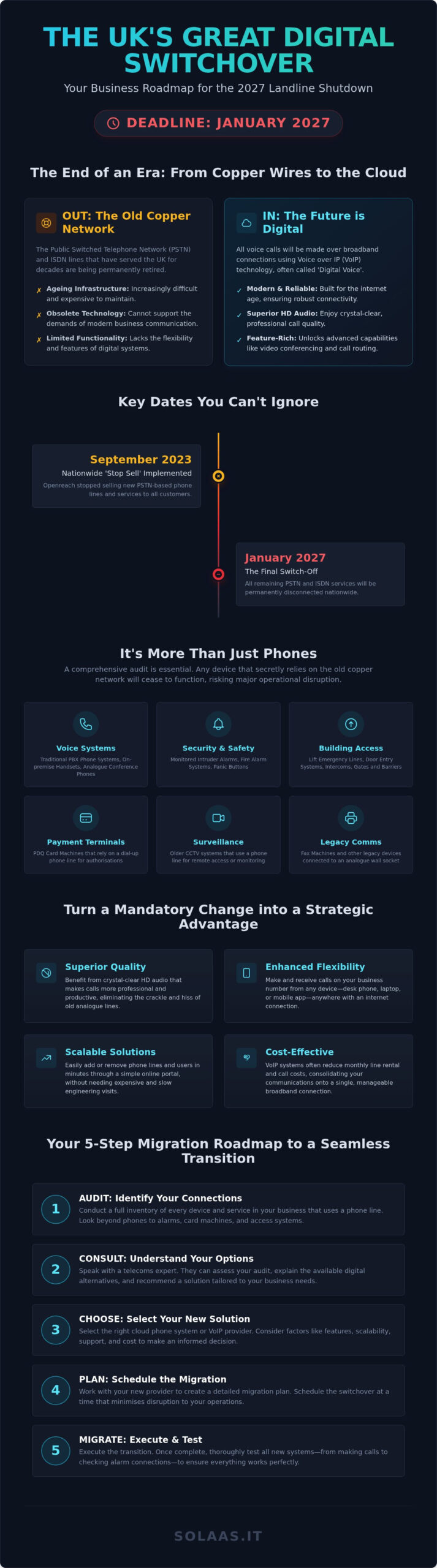
This transition is already well underway. Openreach implemented a nationwide ‘stop sell’ in September 2023, preventing the sale of new PSTN-based services. The final deadline for the complete switch-off is set for January 2027, by which point all businesses must have migrated to a digital solution.
Goodbye PSTN & ISDN: The Old Copper Network Explained
For decades, the PSTN has been the backbone of our telephone calls, using traditional copper wires. Businesses often relied on a slightly more advanced version called ISDN for better quality and multiple lines. The simplest analogy is the switch from analogue TV to digital streaming; the old system did its job for its time, but it’s now obsolete and cannot support the dynamic demands of modern business communication.
Hello Digital Voice & VoIP: The Future of Business Calls
The future is Voice over Internet Protocol (VoIP), a technology that transmits calls as data over your broadband connection. You may have heard BT mention ‘Digital Voice’-this is simply their brand name for their VoIP service. For businesses, this transition unlocks a new era of communication with unparalleled benefits:
- Superior Quality: Enjoy crystal-clear HD audio for more professional and productive conversations.
- Enhanced Flexibility: Make and receive calls on any device, from your desk phone to a laptop or mobile, anywhere with an internet connection.
- Scalable Solutions: Easily add or remove phone lines and features as your business grows, without the need for complex and costly engineering work.
This evolution is a global trend, ensuring the UK’s infrastructure remains competitive and ready for the future. The bt landline switchover 2027 is a critical step towards a fully digital Britain, and a major opportunity for businesses to upgrade their capabilities.
How the 2027 Switch Off Impacts Your Business (It’s More Than Just Phones)
Many businesses mistakenly believe the upcoming PSTN switch-off is merely a telephony issue. This is a critical underestimation. The reality is that the bt landline switchover 2027 represents a fundamental upgrade to the UK’s digital infrastructure, impacting any device or service that secretly relies on the old copper network. A comprehensive audit is not just recommended; it’s essential for seamless business continuity. This transition is overseen by the regulator, and reviewing Ofcom’s guidance for consumers provides valuable context on the nationwide scale of this change. Inaction risks significant operational disruption across seemingly unrelated parts of your business.
Voice Communications
While your office phone system is the most obvious area of impact, the dependencies run deeper. Migrating to a modern VoIP solution is the first step, but you must also account for peripheral devices that will lose connectivity. These often-overlooked tools will cease to function without a digital upgrade.
- Traditional PBX Systems: Any on-premise phone system connected via ISDN lines will stop working.
- Fax Machines: Legacy machines that rely on an analogue phone line will become obsolete.
- Analogue Conference Phones: Any device plugged directly into a traditional wall socket will need replacing.
Security and Safety Systems
This is where inaction poses the most significant risk. Many critical safety and security systems use a PSTN line for their ‘always-on’ emergency connection. This hidden dependency creates a serious point of failure that could compromise the safety of your staff and premises, as well as your compliance with safety regulations.
- Intruder & Fire Alarms: A significant number of monitored alarm systems use a phone line to alert the monitoring centre.
- Lift Emergency Lines: These essential safety features often rely on a dedicated PSTN connection for communication.
- CCTV Systems: Older surveillance setups may use analogue lines for remote access or alert transmission.
Ensuring these life-safety systems remain fully operational after the switch is critical. For businesses needing to audit or upgrade their fire and security alarms for digital compatibility, specialist providers such as quartzempire.co.uk offer expert installation and maintenance services.
Payments and Other Services
The switch-off’s reach extends into daily administrative and customer-facing operations. Many back-office devices that you take for granted use a dial-up connection to function. When the line goes dead, so do they, potentially affecting everything from payment processing to building access.
- PDQ Card Machines: Older credit and debit card terminals using a dial-up connection will fail to process transactions.
- Door Entry Systems: Intercoms and access control systems connected to the phone network will be cut off.
- Franking Machines: Many models require a phone line to download the latest postal rates and essential software updates.
Identifying and migrating these services ahead of the bt landline switchover 2027 is crucial to prevent disruptions that could impact your revenue, security, and overall efficiency.
Your Migration Roadmap: A 5-Step Plan for a Smooth Transition
The bt landline switchover 2027 deadline is not a future problem; it’s a current opportunity to modernise your business communications. A proactive strategy ensures a seamless transition, prevents operational disruption, and unlocks new efficiencies. This five-step roadmap puts the reins of your migration firmly back in your hands, transforming a mandatory change into a strategic upgrade.
Step 1: Audit Your Current Systems
Begin by creating a comprehensive inventory of every device and service connected to your analogue phone lines. Don’t leave anything to chance. Your audit should include:
- A full review of your latest telecoms bill to identify all active PSTN and ISDN lines.
- A physical check of all connected hardware, including alarms, EPOS systems, PDQ machines, door entry systems, and lift lines.
- An assessment of which services are business-critical and cannot afford any downtime during the switch.
Step 2: Talk to Your Suppliers
Once you know what you have, contact the providers of your connected hardware. Ask them directly about their readiness for the digital switchover. Key questions include confirming if your existing equipment is IP-compatible or requires an upgrade, and understanding their timelines and migration support options. This step is crucial for specialist systems like security alarms and payment terminals.
Step 3: Choose Your Digital Voice Solution
Now is the time to explore the powerful alternatives to traditional landlines. Research modern Cloud Phone Systems (VoIP) and evaluate the features that will drive your business forward, such as advanced call routing, mobile integration, and video conferencing. A vital part of this step is assessing your internet connectivity-a robust connection is the foundation of a reliable VoIP service.
Step 4: Plan and Schedule Your Migration
A detailed project plan is essential for a flawless execution. Define clear timelines, assign responsibilities, and schedule the final switchover during a period of low business activity to minimise impact. As you build your plan, it’s helpful to reference the official government guidance on the digital landline transition. Remember to communicate the upcoming changes clearly to your staff and customers to manage expectations.
Step 5: Implement, Test, and Review
With a solid plan in place, you can proceed with the implementation. This includes porting your existing business numbers to the new service and installing any new hardware. After the switch, rigorously test all functions-from making and receiving calls to ensuring your alarm and payment systems are fully operational on the new network. A successful migration is a tested one.
Feeling overwhelmed? The bt landline switchover 2027 is a significant project, but you don’t have to manage it alone. Let our experts build your migration plan for you.
Upgrading to a Cloud Phone System: The Smart Choice for Your Business
The upcoming bt landline switchover 2027 is not a hurdle to overcome; it’s a strategic opportunity to transform your business communications. By moving away from the rigid, ageing PSTN network, you can embrace a more flexible, powerful, and cost-effective solution: Cloud Telephony, also known as Voice over IP (VoIP). This modern technology runs your phone system over your internet connection, leaving behind the limitations of copper wires and unlocking a new era of business efficiency.
Unlocking Flexibility and Remote Working
A cloud phone system liberates your team from their desks. Staff can make and receive calls on their business number from anywhere with an internet connection, using a desktop softphone app, a mobile app, or a traditional handset. This seamless connectivity is essential for supporting today’s dynamic hybrid and remote working models, ensuring your business remains productive and professional, no matter where your employees are located.
Gaining Advanced Features and Integrations
Traditional landlines offered little more than a dial tone. A cloud-based solution provides a suite of powerful features designed to improve customer service and operational workflow. These enterprise-grade tools, once reserved for large corporations, are now accessible to all businesses:
- Auto-Attendant (IVR): Professionally greet and direct callers to the right department.
- Call Recording: Essential for training, compliance, and quality assurance.
- Advanced Analytics: Gain insights into call volumes, wait times, and team performance.
- CRM Integration: Connect your phone system with platforms like Salesforce or HubSpot for a unified customer view.
Scalability and Cost-Effectiveness
Forget waiting for engineers to install new lines. With a cloud system, you can add or remove users in minutes through a simple online portal, allowing your communications to scale perfectly with your business needs. Financially, the benefits are clear. Monthly costs are often significantly lower than traditional ISDN line rentals, and many providers offer inclusive call packages that drastically reduce your call charges, saving your business hundreds of pounds a year. The bt landline switchover 2027 provides the perfect moment to reassess these costs and upgrade to a superior, more affordable solution.
Ready to put these advantages to work for your business? See how a SolaaS Cloud Phone System can transform your communications.
Secure Your Business’s Future Beyond the 2027 Switch Off
The end of the traditional PSTN network is not a distant possibility-it’s a firm deadline. As we’ve explored, this transition impacts everything from your voice calls to critical systems like alarms and card machines. Procrastination isn’t an option; a strategic migration is essential for business continuity and presents a powerful opportunity to upgrade your communications infrastructure for the modern era.
Navigating the bt landline switchover 2027 can seem complex, but it doesn’t have to be a challenge. With the right partner, you can transform this mandatory change into a catalyst for growth, unlocking greater flexibility, scalability, and efficiency for your entire operation.
Let SolaaS be your trusted partner for IT and telecoms. We provide expert guidance on migrating from PSTN to Cloud Telephony with flexible, scalable solutions tailored to your business needs. Book a free, no-obligation consultation today to discuss your business’s migration plan and step confidently into the future of connectivity.
Frequently Asked Questions
What happens if I do nothing before the 2027 deadline?
Failing to act before the BT landline switchover 2027 means your traditional phone services will cease to function. This disruption extends beyond voice calls, potentially affecting any system reliant on the old copper network, such as alarm systems, EPOS terminals, and fax machines. Proactively migrating ensures business continuity and prevents a last-minute scramble, allowing for a seamless transition to a more modern, flexible, and feature-rich communications solution that supports your business goals.
Can I keep my existing business phone number after I switch?
Yes, absolutely. Keeping your established business number is a straightforward and standard part of the migration process. This procedure, known as ‘porting’, allows you to move your existing number from the old analogue network to a new digital VoIP service seamlessly. As your trusted partner, we manage this entire process for you, ensuring there is no disruption to your client communications and your business identity remains consistent throughout the transition to a modern system.
What happens to my phone line during a power cut or internet outage?
Since digital phone systems rely on your internet connection, they will be affected by power or internet outages. However, modern VoIP solutions are designed with resilience in mind. We can implement an Uninterruptible Power Supply (UPS) to keep your router and phones running temporarily. Furthermore, cloud-based systems offer unparalleled flexibility, automatically rerouting calls to designated mobile numbers or other locations, ensuring you never miss an important call and your business stays connected.
Do I need a new, faster broadband connection to use a VoIP phone system?
Not necessarily. Modern VoIP technology is highly efficient and does not require huge amounts of bandwidth. A standard business-grade fibre broadband connection is typically more than sufficient for high-quality calls. The stability and reliability of your connection are more critical than raw speed. Our team of experts will assess your current connectivity to ensure it can support a seamless and crystal-clear communication experience, recommending tailored solutions only if necessary for optimal performance.
Will my old telephone handsets work with a new digital system?
In most cases, traditional analogue handsets are not directly compatible with a purely digital VoIP system. However, they can often be connected using an Analogue Telephone Adapter (ATA), which converts the signal. While this is a workable solution, we recommend upgrading to modern IP handsets to take full advantage of the advanced features, superior call quality, and enhanced productivity that a fully digital, cloud-based phone system offers your business.
How much does it cost to migrate from a landline to a cloud phone system?
The cost of migration is an investment in future-proofing your business and varies based on your specific needs, such as the number of users and required hardware. However, many businesses find that a cloud phone system delivers significant long-term savings. With flexible monthly plans, often starting from as little as £10 per user, and reduced call charges, the total cost of ownership is frequently lower than a traditional landline, providing a far greater return on investment.
Is a VoIP system secure for business communications?
Yes, a professionally managed VoIP system is highly secure. At SolaaS, we prioritise the security of your communications with robust, multi-layered protection. Our solutions utilise advanced encryption protocols like Transport Layer Security (TLS) and Secure Real-time Transport Protocol (SRTP) to safeguard your calls from interception. Combined with secure network configurations and proactive monitoring, we provide a comprehensive security framework that ensures your business conversations remain private and protected.

Article by
René Wheeler
René Wheeler is Managing Director of SolaaS, bringing over three decades of experience in IT and telecoms. He is a strong advocate for transparency and flexibility, championing monthly contract models that allow businesses to stay agile and in control of their technology. His approach challenges traditional industry practices and puts client outcomes first