
What is the Dark Web? A Practical Guide for UK Business Owners
The very mention of the dark web can conjure images from spy films-a shadowy digital underworld far removed from your day-to-day operations. But for many UK business owners, a nagging concern remains: what if my company’s sensitive data ended up there? This fear of the unknown, coupled with overwhelming technical jargon, can leave you feeling exposed and unsure how to protect the business you’ve worked so hard to build.
As your trusted partner in technology, we believe in empowering you with clarity, not confusion. This practical guide is designed to cut through the noise. We will provide a straightforward explanation of what the dark web is, identify the real-world risks that could impact your business, and deliver a clear, actionable plan to safeguard your valuable data and reputation. It’s time to move from uncertainty to confidence and put the reins of your digital security firmly back in your hands.
Key Takeaways
- Understand the crucial difference between the surface, deep, and dark web to accurately assess your business’s true online exposure.
- Clarify the legality of accessing these hidden networks for UK citizens and learn the core technologies that enable their anonymity.
- Discover what specific types of company data, from client lists to login credentials, are actively bought and sold on dark web marketplaces.
- Implement a multi-layered defence strategy with practical, actionable steps to protect your company’s data, reputation, and bottom line.
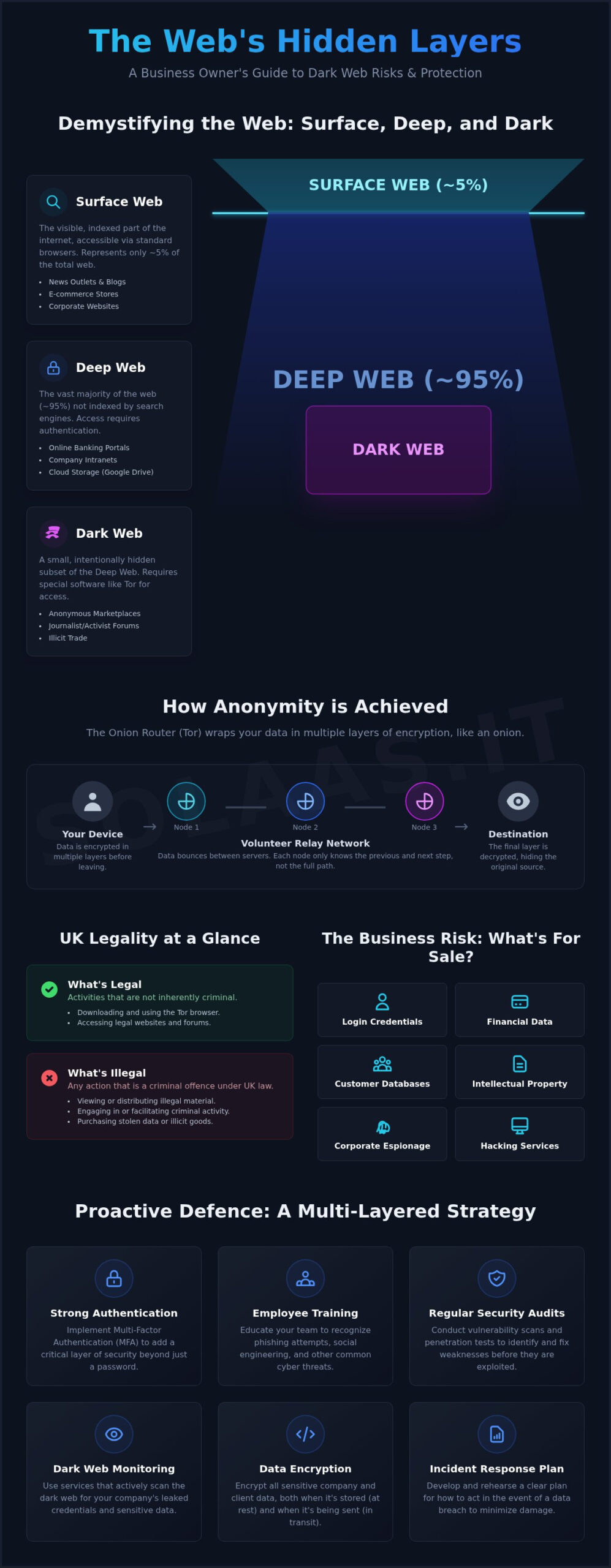
Demystifying the Web: Surface, Deep, and Dark Web Explained
To effectively protect your business assets, it’s crucial to understand the digital environment where threats originate. The internet is often compared to an iceberg: the familiar, visible part is just a fraction of the whole. This lack of clarity often leads to confusion, particularly between the deep web and the dark web. As your trusted partner in security, we’re here to provide a clear, practical breakdown of these layers so you can focus on informed, effective protection.
The Surface Web: Your Everyday Internet
This is the visible, indexed part of the World Wide Web that search engines like Google can find, crawl, and list in their results. It includes all the publicly accessible websites you visit daily-from news outlets and e-commerce stores to your own company’s homepage and industry blogs. Representing only about 5% of the total internet, the Surface Web is the ‘tip of the iceberg’ and is accessed using standard browsers like Chrome, Safari, or Firefox.
The Deep Web: Behind the Login
Contrary to its ominous-sounding name, the deep web is not inherently malicious. It is simply the vast portion of the internet-estimated to be 95%-that is not indexed by search engines. Access requires specific authentication, such as a username and password. This layer is essential for privacy and security, housing:
- Online banking portals and financial records
- Company intranets and internal databases
- Secure cloud storage drives (e.g., OneDrive, Google Drive)
- Confidential medical and legal records
Nearly every business uses the deep web daily to conduct secure and private operations.
The Dark Web: Anonymity and Obscurity
The dark web is a small, specific segment of the deep web that is intentionally hidden and requires specialised software, like the Tor browser, to access. Its infrastructure is built to provide a high degree of anonymity. But what is the dark web in practical terms for a business owner? While this anonymity can protect journalists and activists in oppressive regimes, it also provides a haven for illegal marketplaces where stolen data, malware, and other illicit goods are traded. Crucially, accessing this network is a deliberate act; it is not a place your employees can stumble upon by accident during their daily work.
How the Dark Web Works: Anonymity, Access, and Legality
To understand the risks and opportunities associated with the dark web, business owners must first grasp the technology that powers it. Its core principle is anonymity, achieved through sophisticated software and protocols that obscure user identity and location. This creates a complex environment where both legitimate and illicit activities can thrive, making it crucial to understand how it functions before assessing its impact on your business.
The Onion Router (Tor) Explained Simply
The primary gateway to the dark web is through a specialised browser called Tor (The Onion Router). It protects user anonymity by wrapping data in multiple layers of encryption, much like the layers of an onion. This encrypted data is then routed through a worldwide, volunteer-operated network of servers.
Think of it like passing a secret message inside a sealed envelope through a chain of couriers. Each courier only knows who gave them the envelope and who to pass it to next; none know the original sender, the final destination, or the message inside. This process makes tracing the data’s origin exceptionally difficult, providing a powerful shield for user identity.
Is Accessing the Dark Web Illegal in the UK?
This is a common and critical question. In the United Kingdom, simply downloading and using the Tor browser or accessing websites on the dark web is not illegal. However, the legality ends there. Engaging in, facilitating, or even viewing illegal content or activities is a criminal offence with severe penalties. For businesses, the risks of accidental exposure to malicious actors or illegal material are substantial.
There is no legitimate reason for a business to browse these networks without a clear, strategic purpose and expert cybersecurity guidance. Understanding the potential dark web risks for brands, from data breaches to reputational damage, is the first step in creating a robust defence strategy.
Legitimate Uses of the Dark Web
While its reputation is dominated by criminal enterprise, the anonymity it provides serves several legitimate and vital purposes. This technology is a critical tool for:
- Journalists and Whistleblowers: Enabling them to communicate with sources and report on sensitive topics without fear of reprisal or surveillance.
- Activists and Dissidents: Providing a platform for free speech and organisation in countries with oppressive internet censorship.
- Privacy-Conscious Individuals: Offering a way to browse the internet without being tracked by corporations or government agencies.
To facilitate anonymous transactions for both legitimate and illicit purposes, these networks heavily rely on cryptocurrencies like Bitcoin and Monero, which add another layer of privacy to financial exchanges.
The Business Risk Landscape: What’s for Sale on Dark Web Marketplaces?
While the concept of the dark web can seem abstract, its impact on businesses is dangerously real. Illicit marketplaces operate with surprising professionalism, mimicking legitimate e-commerce sites like eBay or Amazon with seller ratings, customer support, and product listings. However, the products for sale are cybercrime tools and stolen data. It’s a critical mistake to assume your business is too small to be a target; to a cybercriminal, every piece of data has a price, and your company’s information is a valuable asset waiting to be sold.
Stolen Credentials and Account Takeovers
Usernames and passwords are the most common and versatile commodity. Sold in bulk for as little as a few pounds, these credentials are the keys to your digital kingdom. Criminals use them to launch phishing campaigns, commit financial fraud, or gain a foothold in your corporate network. They also enable credential stuffing attacks, where logins from one breach are automatically tested against countless other services, hoping for a match.
Corporate Data and Intellectual Property
Your company’s most sensitive information is a high-value target. This includes everything from confidential customer lists and financial records to proprietary trade secrets and product designs. The sale of this data can lead to devastating reputational damage, loss of competitive advantage, and targeted corporate espionage. Once your intellectual property is for sale, the damage is often irreversible and can cripple your market position.
Ransomware-as-a-Service (RaaS) and Hacking Tools
The dark web has democratised cybercrime. Ransomware-as-a-Service (RaaS) platforms allow criminals with minimal technical skill to “rent” sophisticated malware and launch devastating attacks, often for a subscription fee or a share of the profits. Understanding how the dark web works reveals an entire ecosystem where phishing kits and malware are sold as off-the-shelf products, creating a constant and evolving threat landscape.
Customer and Employee Personally Identifiable Information (PII)
A data breach that exposes customer or employee PII-such as names, addresses, and National Insurance numbers-carries severe consequences. Beyond the immediate operational disruption, your business faces significant financial penalties under UK GDPR, which can be crippling. Even more damaging is the long-term erosion of customer trust, a vital asset that, once lost, is incredibly difficult to rebuild.
For instance, a premier recruitment agency like Superstar Nannies handles incredibly sensitive data about families and childcare professionals; a breach for them wouldn’t just be a financial issue, but a profound violation of trust and safety.
The Pathway to Exposure: How Your Business Data Ends Up For Sale
Valuable business data doesn’t simply vanish and reappear on illicit marketplaces. Its journey to the dark web is a predictable, and often preventable, process exploited by cybercriminals. For most UK businesses, a breach doesn’t start with a complex, Hollywood-style hack, but with a simple, overlooked vulnerability. Understanding these common entry points is the first step toward building a resilient security posture and protecting your hard-earned reputation.
Phishing and Social Engineering Attacks
The single greatest risk to your business data is often your own team. Cybercriminals are masters of manipulation, using phishing emails and social engineering to trick employees into handing over the keys to your network. An email might convincingly imitate an invoice from a known supplier or an urgent security alert from Microsoft, leading an unsuspecting employee to a fake login page. Once they enter their credentials, the attacker has a direct route into your systems. This remains the most common and effective attack vector.
Malware and Unsecured Software
While human error opens the door, outdated technology leaves it unlocked. Malicious software, such as keyloggers that record every keystroke or spyware that steals files, can be installed through a single wrong click. The risk escalates dramatically when businesses run on unpatched or unsupported software. Every missed security update is a potential vulnerability that criminals are actively searching for. Maintaining up-to-date systems isn’t just about accessing new features; it’s a critical layer of your defence.
Third-Party and Supply Chain Breaches
Your security is only as strong as your weakest link, and that link might not even be inside your organisation. A breach at one of your trusted partners-be it your payroll provider, CRM platform, or even your digital marketing agency-can directly expose your sensitive data. If their systems are compromised, your customer lists and financial records could end up for sale on the dark web. Vetting the security practices of your suppliers is no longer optional; it’s an essential part of modern risk management.
Protecting your business requires a comprehensive strategy that addresses people, processes, and technology. By understanding how data is stolen, you can implement tailored solutions to fortify your defences. To learn more about proactive security measures, explore our tailored IT solutions.
Proactive Defence: Protecting Your Business from Dark Web Threats
Understanding the risks is the first step; taking decisive action is what truly protects your business. Instead of viewing cybersecurity as an operational cost, it’s time to reframe it as a critical investment in your company’s continuity, reputation, and future success. A multi-layered, proactive defence strategy is the most effective way to minimise your exposure to threats and ensure your sensitive data stays secure.
Implement Strong Access Controls
Your digital front door needs the best locks available. This foundational layer of security prevents unauthorised access by making it significantly harder for criminals to use stolen credentials. A robust access control policy should include:
- Unique, Complex Passwords: Enforce the use of long, complex, and unique passwords for every single service. Reusing passwords across platforms is one of the most common security failings.
- Multi-Factor Authentication (MFA): This is non-negotiable. MFA adds a critical verification step, such as a code sent to a mobile device, making a stolen password alone useless to an attacker.
- Business-Grade Password Manager: Provide employees with a secure, centralised password manager. It encourages strong password creation and eliminates the need for risky practices like writing them down.
Invest in Employee Cybersecurity Training
Your employees are your first and most important line of defence. A well-trained, security-aware team can stop a cyberattack before it even begins. Equip your staff by implementing regular, ongoing training that teaches them to recognise and report phishing emails, social engineering tactics, and other common threats. Fostering a culture where security is a shared responsibility turns a potential vulnerability into your greatest defensive asset.
Utilise Dark Web Monitoring
You can’t protect against a threat you don’t know exists. Dark web monitoring services act as your early-warning system, continuously scanning hidden marketplaces and forums for your company’s stolen data, such as employee email addresses and passwords. If your information appears for sale on the dark web, these services provide immediate alerts. This allows you to take swift, mitigating action-like forcing password resets-before the compromised credentials can be used to breach your network.
Partner with a Managed IT Service Provider
Managing a comprehensive security posture is a full-time job that requires specialised expertise. Partnering with a Managed IT Service Provider (MSP) gives you access to a dedicated team of security experts without the overhead of an in-house department. An MSP can deliver a tailored security solution that includes proactive patch management, advanced network security, and 24/7 monitoring to detect and neutralise threats. Let a team of experts handle your security, so you can focus on driving your business forward. Explore our Managed IT Services.
From Awareness to Action: Securing Your Business in a New Era of IT
Navigating the digital world requires more than just surface-level understanding. As we’ve explored, the dark web is a very real and active marketplace, posing a significant threat to UK businesses of all sizes. The crucial takeaway is that your company’s sensitive data can end up for sale not through a cinematic hack, but through common vulnerabilities and human error. However, knowledge is power, and the most effective defence is a proactive one. By implementing robust security protocols and fostering a culture of cyber-awareness, you can significantly reduce your risk and protect your hard-earned reputation.
Taking control of your digital security is the most important investment you can make. As your trusted partner in cybersecurity, SolaaS LTD delivers flexible, scalable IT solutions designed to protect your growth. With our expert UK-based support team, you gain a dedicated ally committed to your success. It’s time to move from uncertainty to confidence. Protect your business from emerging threats. Get a free cybersecurity consultation today.
Frequently Asked Questions
How do I know if my company’s data is on the dark web?
Proactive monitoring is the only reliable method. Professional cybersecurity services continuously scan marketplaces and forums on the dark web for your company’s domain credentials, customer data, and intellectual property. This provides a comprehensive and real-time view of your exposure. Relying on sporadic checks is insufficient; you need a tailored security solution that alerts you to threats as they emerge, allowing you to act decisively and protect your assets before significant damage occurs.
Is using a VPN the same as using Tor to access the dark web?
No, they serve different functions. A VPN (Virtual Private Network) encrypts your internet traffic and masks your IP address, enhancing privacy on the standard web. In contrast, Tor (The Onion Router) is a specific browser designed for anonymity that routes your connection through multiple encrypted layers. While a VPN is an excellent security tool for everyday business, only a browser like Tor can access the .onion sites that make up the dark web.
Can the dark web be shut down by law enforcement?
Shutting down the entire network is practically impossible due to its decentralised, global, and anonymous design. However, law enforcement agencies, including the UK’s National Crime Agency, are increasingly effective at targeting and dismantling specific illegal marketplaces and criminal operations. Their focus is on disrupting illicit activities and apprehending the individuals involved, rather than eliminating the underlying technology itself. This makes targeted enforcement a continuous and necessary effort.
What is the very first thing I should do if I suspect a data breach at my company?
Your immediate priority is containment. The first step is to disconnect the affected systems from your network to prevent the breach from spreading. Then, you must engage your expert cybersecurity partner to assess the scope of the incident and guide your response. Acting quickly and with expert guidance is crucial for mitigating damage, preserving evidence, and ensuring you meet your legal obligations, such as reporting to the UK’s Information Commissioner’s Office (ICO) if necessary.
Are free dark web scanning tools reliable for a business?
For a business, free tools are rarely sufficient. They typically provide a very limited, one-time snapshot using publicly available breach data, which may be outdated. They lack the depth, real-time alerting, and expert analysis required for robust corporate security. A professional, managed solution offers continuous monitoring and a comprehensive view of threats, providing the reliable intelligence you need to properly safeguard your business, your employees, and your customers’ data.
My business is small, why would hackers target me?
Cybercriminals often view small businesses as high-value, low-risk targets precisely because they may have fewer security resources. Your data-from customer lists to payment details-is valuable and can be sold or ransomed. Furthermore, your business could be used as a stepping stone to attack larger clients or suppliers in your supply chain. In today’s interconnected environment, robust cybersecurity isn’t just for large corporations; it’s an essential investment for businesses of all sizes.

Article by
René Wheeler
René Wheeler is Managing Director of SolaaS, bringing over three decades of experience in IT and telecoms. He is a strong advocate for transparency and flexibility, championing monthly contract models that allow businesses to stay agile and in control of their technology. His approach challenges traditional industry practices and puts client outcomes first