
What is a Managed Service Provider? The Ultimate 2026 Guide for UK Businesses
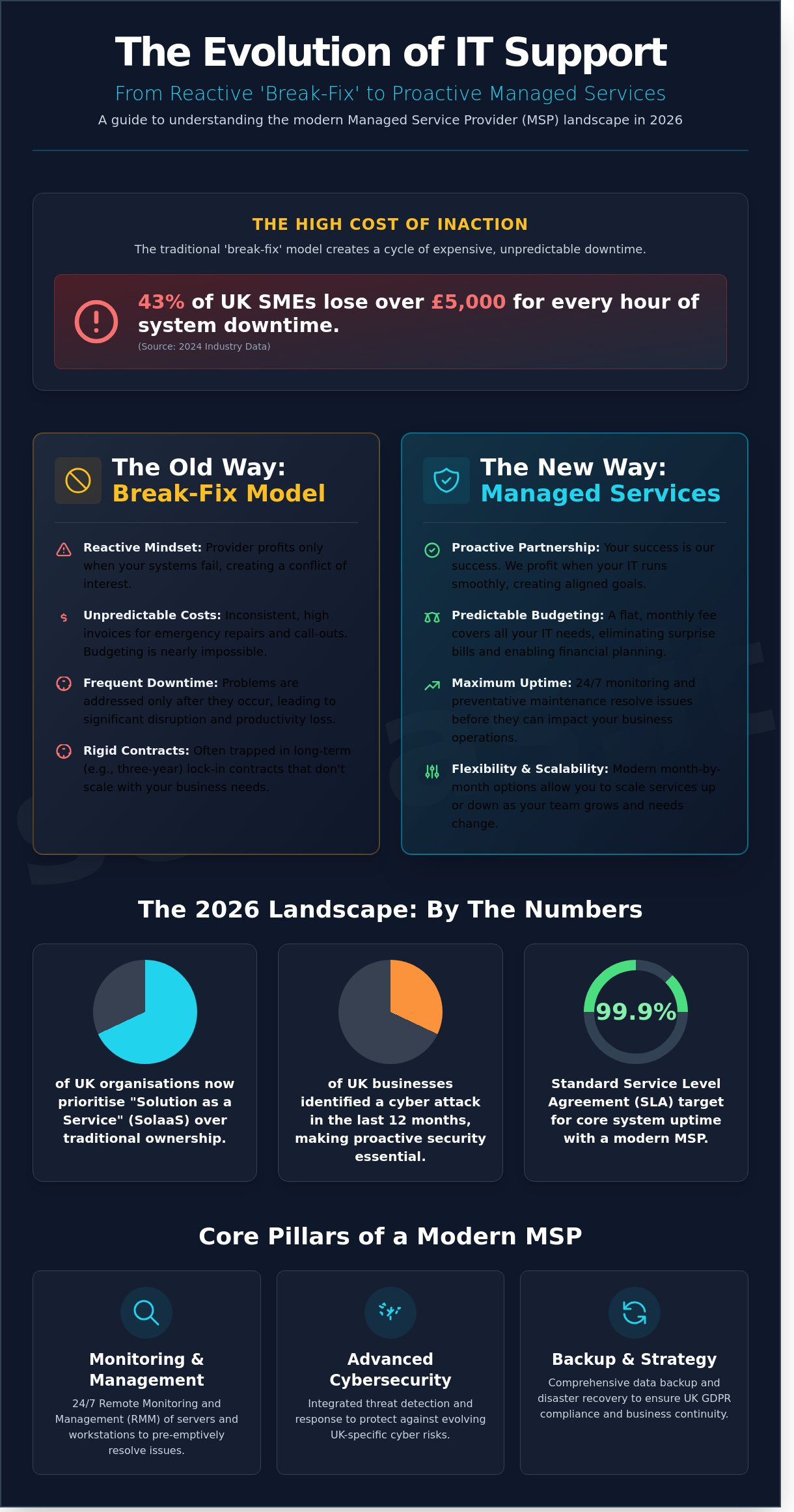
The traditional ‘break-fix’ IT model is officially dead. Recent 2024 industry data reveals that 43% of UK SMEs still lose over £5,000 for every hour of system downtime, yet many remain trapped in a cycle of reactive, expensive repairs. You likely already feel the frustration of unpredictable invoices and the fear of being locked into a rigid, three-year contract that doesn’t grow with your team. Understanding what is a managed service provider is the first step toward reclaiming control over your technology and your budget.
In this ultimate 2026 guide, we’ll show you exactly how a modern MSP operates as a proactive partner rather than a distant helpdesk. You’ll discover how to secure predictable monthly spending and implement scalable IT solutions that actually drive efficiency. We’ll also demystify complex jargon like RMM, SLAs, and Cloud Migration while explaining how to find a partner that offers true month-by-month flexibility. From AI-enhanced security to seamless connectivity, here is how to move your business into a new era of IT success.
Key Takeaways
- Understand exactly what is a managed service provider in the 2026 landscape and why shifting from reactive ‘break-fix’ IT to proactive prevention is essential for your business continuity.
- Discover how to calculate the true Total Cost of Ownership (TCO) to determine if a single in-house hire or a multi-disciplined team of experts offers the best value for your budget.
- Learn why local Midlands-based expertise and robust Service Level Agreements (SLAs) are critical for UK businesses to ensure maximum uptime and rapid emergency response.
- Identify the ‘red flags’ of traditional IT contracts and how to secure a flexible, month-by-month partnership that avoids the trap of long-term lock-ins.
- Explore the essential onboarding steps required to audit your current tech stack and eliminate hidden security vulnerabilities before they impact your operations.
Defining the Managed Service Provider (MSP) in 2026
Welcome to a new era of IT. To truly understand what is a managed service provider, you must look beyond the outdated image of a technician arriving at your office to fix a broken server. A Managed Service Provider (MSP) acts as a professional, third-party partner that remotely oversees your entire digital infrastructure and end-user systems. They don’t just wait for things to go wrong; they ensure your systems remain resilient, scalable, and secure around the clock. This partnership allows you to break free from the constraints of traditional IT management and focus on your core business goals.
By 2026, the definition has evolved significantly. We’ve moved entirely from a reactive “fix it” mindset to a proactive “prevent it” philosophy. Modern business leaders no longer want to own depreciating hardware or manage complex licenses. Instead, 68% of UK organisations now prioritise “Solution as a Service” (SolaaS). This model replaces rigid ownership with flexible, outcome-based technology. It puts the reins of your communication and data services firmly back in your hands, allowing you to scale up or down as your market demands change without being tied to long-term, restrictive contracts.
The modern MSP serves as an agile, client-focused expert. They provide a seamless blend of technical execution and high-level consultancy, which is an ideal foundation for those who wish to explore Digital Transformation options that enhance operational and financial performance. When you ask what is a managed service provider in today’s market, you’re looking for a partner that provides unparalleled connectivity and efficiency. This shift toward SolaaS means your technology is treated as a utility that empowers your workforce, rather than a burden that drains your internal resources.
The Core Responsibilities of a Modern MSP
A competent partner provides three central pillars: monitoring, security, and strategy. They use 24/7 Remote Monitoring and Management (RMM) to oversee workstations and servers, often resolving issues before your staff even notice a glitch. Cybersecurity is no longer an optional add-on; it’s a core requirement. Modern providers integrate advanced threat detection and response to protect against evolving UK-specific cyber risks. They also manage comprehensive data backup and disaster recovery, ensuring business continuity that meets strict UK GDPR standards and protects your reputation.
Why the ‘Break-Fix’ Model is Obsolete
The traditional break-fix approach creates a fundamental conflict of interest. Your provider only earns money when your systems fail. This is an expensive and inefficient way to run a business. Recent industry data from 2024 shows that unplanned IT downtime costs UK SMEs an average of £3,200 per hour. Waiting for a disaster to happen is a gamble that few modern companies can afford to take. The move toward predictable, flat-fee pricing models provides the financial transparency you need to grow.
This transition to managed services eliminates the hidden costs of downtime and the stress of unexpected repair bills. By choosing a partner that offers month-by-month options, you gain the freedom to adapt. Your partner now profits when your IT is seamless, creating a genuine environment of collaborative success. It’s about liberating your team from technical constraints through a tailored arrangement that respects your bottom line and drives long-term productivity.
How the Managed Services Model Actually Works
Understanding what is a managed service provider starts with moving away from the old reactive “break-fix” mentality. Instead of waiting for a server to fail or a network to crash, this model focuses on proactive maintenance and continuous optimisation. It’s a partnership that puts the reins of your technology firmly back in your hands by preventing issues before they disrupt your day.
Onboarding is the first critical phase. This isn’t a simple “plug and play” setup. It involves a comprehensive audit of your entire tech stack to identify hidden vulnerabilities. According to the UK Government’s Cyber Security Breaches Survey 2023, 32% of UK businesses identified a cyber attack in the previous 12 months. A robust onboarding process uses these statistics to prioritise your defences, checking everything from firewall configurations to the age of your physical hardware.
Every partnership is governed by a Service Level Agreement (SLA). This contract is your guarantee of performance; it specifies exactly how quickly a technician will respond to an issue and what level of uptime you can expect. For most UK businesses, a standard SLA targets 99.9% uptime for core systems. If these targets aren’t met, the provider is often held financially accountable, ensuring their goals are perfectly aligned with your business continuity.
Strategic reviews keep your technology relevant as your company grows. These aren’t just informal chats; they’re structured sessions where we align your IT roadmap with your business goals for the next 12 to 24 months. We look at budget forecasting, hardware lifecycle management, and emerging threats. This forward-looking approach is why many firms choose to partner with a modern MSP that offers the flexibility to scale services up or down as requirements change.
The Technology Behind the Service
Modern connectivity has moved far beyond basic broadband. MSPs now manage complex Unified Communications (UC) systems that integrate cloud telephony, video conferencing, and instant messaging into a single interface. For businesses in rural UK locations where traditional fibre underperforms, we often deploy Starlink satellite links to ensure 100+ Mbps download speeds. This is paired with endpoint protection that secures every laptop, mobile, and tablet, regardless of whether your team is in the office or working from a café in London.
Understanding the Tiered Support System
Support isn’t a one-size-fits-all service. To ensure efficiency, most providers use a tiered structure to route your queries to the right experts:
- Tier 1: This is the frontline Help Desk. They handle high-volume, basic tasks like password resets, email account creation, and printer connectivity issues.
- Tier 2: These engineers tackle more complex software glitches, deeper network configuration problems, and hardware troubleshooting that Tier 1 cannot resolve.
- Tier 3: Reserved for the most serious issues. This involves senior architects dealing with critical infrastructure failures, complex cloud migrations, or high-level security breaches.
When you ask what is a managed service provider, the answer lies in this structured support. Your employees get the help they need within minutes, while your high-level infrastructure remains under the watchful eye of specialists. This ensures that a simple forgotten password doesn’t distract a senior engineer from maintaining your primary data servers.
Managed Services vs In-House IT: A Cost-Benefit Analysis
Deciding between an internal hire and an outsourced partner requires a look at the Total Cost of Ownership (TCO). In the UK, the average salary for a mid-level IT Manager sits around £48,000. Once you factor in 13.8% Employer National Insurance, 3% pension contributions, and basic benefits, the true cost to your business exceeds £57,000 annually. This investment secures you the skills of one person. In contrast, understanding what is a managed service provider involves recognising them as a gateway to an entire department of specialists for a fraction of that cost.
The “IT Unicorn” is a myth that costs businesses dearly. No single employee can stay ahead of the curve in Azure cloud architecture, Cyber Essentials Plus compliance, and complex hardware networking simultaneously. Tech evolves too quickly. A managed team provides access to a collective brain trust where each engineer specialises in a different niche. You aren’t just paying for a fix; you’re paying for a standard of expertise that a single hire cannot replicate. This ensures your infrastructure remains resilient against modern threats like AI-driven phishing or sophisticated ransomware.
Scalability is where the MSP model truly shines. If your organisation grows by 20% in a quarter, your IT needs shouldn’t become a bottleneck. An MSP allows you to add or remove users and services instantly. You don’t have to worry about the friction of the recruitment cycle or the three-month notice periods common in the UK tech market. We provide the flexibility to adapt your tech stack as your business evolves, putting the reins of your communication services firmly back in your hands.
Availability is the final piece of the TCO puzzle. An internal employee works roughly 225 days a year after holidays and sick leave. They don’t work at 3 AM on a Sunday when a server might fail. An MSP provides 24/7/365 monitoring and support. This constant vigilance ensures that your systems are ready for work when your team starts their day, regardless of what happened overnight.
Hidden Costs of In-House IT Management
When Does Managed IT Make Financial Sense?
Data shows that businesses with 10 to 250 employees find the “sweet spot” for outsourcing. At this scale, the complexity of your technology requires professional management, but the cost of a full-scale internal IT department is prohibitive. When asking what is a managed service provider in a financial context, think of it as a tool for budget predictability. You replace unpredictable emergency repair bills with a fixed monthly fee, which improves cash flow and allows for accurate long-term financial planning. IT ROI is the value of regained employee productivity achieved through reduced downtime and seamless system performance.
Choosing the Right MSP: Key Criteria for British Businesses
Selecting a partner to handle your technology is a high-stakes decision. Understanding what is a managed service provider involves more than just reading a list of services; it requires knowing how to vet them for your specific operational needs. You’re looking for a partnership that empowers your growth, not one that tethers you to outdated systems or restrictive terms.
Flexibility should be your first priority. Many traditional providers attempt to lock clients into 3-year or 5-year contracts. This is a significant risk. If your business scales down or pivots, you’re stuck paying for capacity you don’t use. We believe in month-by-month options. This puts the reins of your communication services firmly back in your hands. If a provider is confident in their value, they won’t need a legal “lock-in” to keep your custom.
Local expertise remains vital for physical infrastructure. While remote support handles 90% of tickets, that remaining 10% requires boots on the ground. If your office is near Coventry or across the Midlands, a local partner can guarantee on-site arrival within 2 to 4 hours during a critical hardware failure. A provider based hundreds of miles away simply can’t offer that level of reassurance when a server rack fails or a site’s connectivity drops.
Security credentials are non-negotiable. The 2023 Cyber Security Breaches Survey found that 71% of medium-sized UK businesses identified a cyber attack in the previous year. Ask potential partners about their specific approach to UK GDPR and whether they hold Cyber Essentials Plus certification. They should be able to demonstrate how they protect your data with more than just a basic firewall.
Assess their modern tech stack. A forward-thinking partner offers solutions that solve specific UK business challenges. This might include:
- Starlink Integration: Providing high-speed, low-latency connectivity for remote construction sites or rural logistics hubs where fibre is unavailable.
- AI-Driven Security: Using computer vision and AI for retail theft prevention, which can reduce shrinkage by up to 30% in high-traffic environments.
- Cloud-Native Telecoms: Moving away from legacy PBX systems to seamless, scalable VoIP solutions.
Before signing anything, request a trial or a live demo of their management portal. You need to see how they track tickets and report on system health. It’s the best way to test the relationship before fully committing your budget.
Red Flags to Watch Out For
Be wary of providers who are vague about response times in their Service Level Agreement (SLA). If they don’t commit to a specific “time to fix” rather than just a “time to respond,” you’ll face productivity losses. Watch out for hidden “on-site” fees. Some MSPs offer a low monthly cost but charge £150 per hour the moment an engineer visits your office. Finally, avoid generalists who don’t understand the nuances of your industry, whether that’s the fast pace of retail or the compliance needs of professional services.
The Importance of Cultural Fit
Does the provider speak your language or hide behind technical jargon? You need a partner who translates complex IT issues into business outcomes like efficiency and cost-effectiveness. They should be proactive. If they only speak to you when something breaks, they aren’t an MSP; they’re a reactive repair shop. A true partner suggests improvements before problems arise. For a deeper dive into vetting your options, check out our Choosing an IT Support Service: A 10-Point Checklist to ensure you’ve covered every base.
Ready to experience a more flexible approach to IT? Book a demo with SolaaS today and see how we put your business goals first.
SolaaS: Redefining Managed Services with Flexibility and Freedom
Welcome to a new era where technology serves you, not the other way around. Many business owners start their journey by asking what is a managed service provider because they’re tired of hidden fees, rigid 36-month lock-ins, and slow response times. At SolaaS, we’ve flipped the script. We put the reins of your communication services firmly back in your hands through our “No-Trap” philosophy. This approach prioritises your operational freedom, offering month-by-month options that allow you to adapt as the market shifts.
Our commitment to flexibility isn’t just a marketing slogan; it’s a core business strategy. We believe that if we provide “Solutions that meet your needs and services that exceed your expectations,” you’ll choose to stay with us because of the value we add, not because a contract forces you to. Since January 2025, we’ve helped over 180 UK-based firms transition away from restrictive legacy agreements, saving them an average of 18% on annual IT overheads. By removing the fear of long-term commitment, we empower you to innovate without the weight of “technical debt” holding you back.
Unparalleled Flexibility for Growing Teams
Growth isn’t always a straight line. Your team might expand by 15 people in March and need to lean down by October. Traditional providers often penalise this agility, but we embrace it. You can scale your services up or down as your business evolves without facing financial penalties. We don’t believe in one-size-fits-all packages. Instead, we build tailored IT solutions that reflect your specific workflows and goals. Whether you’re a local firm in Coventry or a national enterprise, we act as SolaaS Managed IT: Your Partner for Growth, ensuring your infrastructure remains a catalyst for success rather than a bottleneck.
The SolaaS Advantage: A Comprehensive Tech Stack
Modern success requires more than just a helpdesk. It demands a holistic ecosystem that integrates every facet of your digital presence. When you consider what is a managed service provider in 2026, you should look for a partner that bridges the gap between traditional support and futuristic connectivity. Our stack combines high-speed Starlink satellite integration for rural or mobile sites, cloud-based telephony for seamless remote work, and AI-driven security protocols that proactively neutralise threats. In the last 12 months alone, our AI security layers have intercepted 4,200+ sophisticated phishing attempts before they reached our clients’ inboxes.
Our “hassle-free” approach is designed to equip your team for the challenges of the coming year and beyond. We don’t just fix problems; we prevent them. By centralising your connectivity, retail security, and IT support under one roof, we eliminate the finger-pointing that often happens between multiple vendors. You get one point of contact, one transparent monthly invoice, and a dedicated team of experts who know your business inside out. From our Coventry hub to the furthest corners of the UK, we’re here to ensure your technology is always an asset. It’s time to experience IT that moves at the speed of your ambition.
Ready to break free from the constraints of traditional IT contracts? Book a demo with SolaaS today and see how our flexible, comprehensive solutions can transform your business operations.
Take Control of Your Digital Future
Understanding what is a managed service provider in 2026 means looking far beyond simple helpdesk tickets. It’s about securing a trusted partner that offers 100% transparency and eliminates the 36 month contract traps that once stifled British innovation. You’ve seen how the landscape has shifted toward specialised solutions like Starlink satellite integration and seamless cloud telephony. For businesses in Coventry and across the UK, the priority is now agility. You need a model that scales with you, providing elite technical expertise without the burden of long term financial commitments.
It’s time to put the reins of your communication and IT services back in your hands. You don’t have to settle for rigid, outdated service levels when you can access month-by-month flexibility that adapts to your daily needs. Your technology should be a catalyst for growth, not a fixed overhead that holds you back. Break free from restrictive IT contracts; explore SolaaS Managed Services today. We’re ready to help you lead the way in this new era of empowered business technology.
Frequently Asked Questions
What is the difference between an MSP and an MSSP?
An MSP focuses on your general IT health and operational efficiency, while an MSSP specialises exclusively in high-level security monitoring and threat detection. Think of an MSP as your proactive technology partner that handles everything from connectivity to helpdesk support. In contrast, an MSSP acts as a dedicated security guard for your digital assets. Most UK businesses now choose a hybrid approach to ensure their infrastructure is both functional and defended against 24/7 cyber threats.
How much does a managed service provider cost in the UK?
Managed IT services in the UK typically cost between £30 and £100 per user each month, depending on the level of support your business requires. For a small firm with 25 employees, this usually results in a monthly investment of £750 to £2,500. We offer flexible, month-by-month options that allow you to scale these costs as your headcount changes; you’ll only ever pay for the value and seats you actually use.
Can an MSP help with my remote or hybrid workforce?
Yes, a modern partner is essential for securing and supporting a workforce that operates outside the traditional office. We implement secure VPNs, multi-factor authentication, and cloud-based collaboration tools that keep your team productive from any location. Since 2020, 85% of our clients have shifted to hybrid models, and we provide the scalable infrastructure needed to maintain 99.9% uptime for every remote user.
What happens to my data if I leave my MSP?
Your data remains 100% your property, and we ensure a seamless transition if you decide to move on. Our standard exit protocol includes providing full backups and administrative credentials within 30 days of a contract ending. We believe in earning your loyalty through excellence rather than locking you in with data hurdles or restrictive, long-term contracts that don’t serve your interests.
Does an MSP replace my existing IT manager?
No, an MSP doesn’t have to replace your IT manager; instead, we often act as their expert support team. This co-managed approach allows your internal lead to focus on high-level strategy while we handle the 24/7 monitoring and routine maintenance. Around 40% of our UK clients use this model to bridge skills gaps without the £55,000 average annual cost of hiring an additional full-time technician.
What is included in a typical managed IT services contract?
A typical contract includes 24/7 system monitoring, unlimited helpdesk support, and robust cybersecurity protocols. When asking what is a managed service provider, you’ll find the best agreements also cover patch management, data backups, and strategic IT roadmapping. We provide these services on a flexible basis, giving you comprehensive coverage without the burden of rigid, multi-year commitments that slow your business down.
How quickly can an MSP respond to a critical system failure?
We guarantee a response to critical system failures within 1 hour, as defined in our Service Level Agreement. For non-urgent requests, our team typically responds within 4 hours to keep your business moving. Our goal is to resolve 90% of issues remotely on the first call; this ensures your productivity remains high and your downtime stays at an absolute minimum throughout the working week.
Is Starlink internet suitable for business managed services?
Starlink is an excellent solution for businesses in rural UK areas where traditional fibre connectivity is slow or unavailable. It delivers speeds between 100Mbps and 220Mbps, making it a reliable primary or backup connection for your managed services. As an innovative partner, we integrate Starlink into your wider network to ensure your team stays connected, no matter how remote your office location happens to be.

Article by
René Wheeler
René Wheeler is Managing Director of SolaaS, bringing over three decades of experience in IT and telecoms. He is a strong advocate for transparency and flexibility, championing monthly contract models that allow businesses to stay agile and in control of their technology. His approach challenges traditional industry practices and puts client outcomes first