
UK Cloud Telephony Security: A 2026 Business Guide
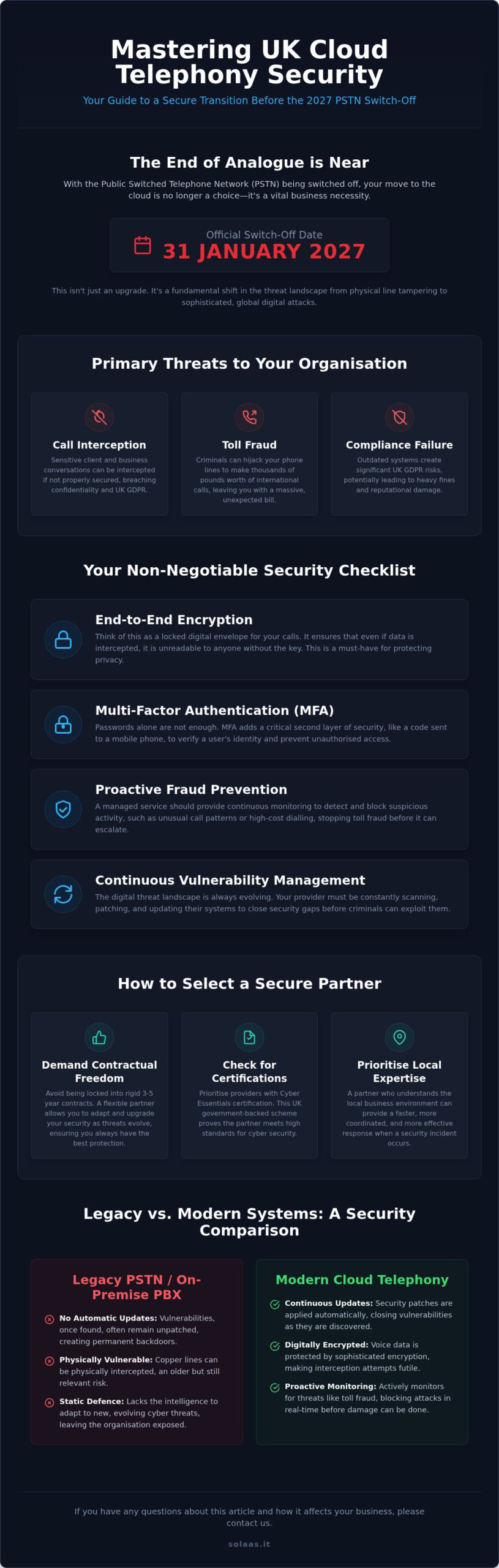
With the PSTN switch-off arriving on 31 January 2027, your move to the cloud is no longer a choice; it’s a vital business necessity. However, moving quickly shouldn’t mean leaving your digital front door unlocked for cyber criminals. You likely worry about sensitive client calls being intercepted or waking up to a massive bill caused by sophisticated toll fraud. It’s a valid concern in a landscape where remote working is standard and UK GDPR compliance is strictly non-negotiable.
This guide will show you how to master cloud telephony security uk to protect your business whilst maintaining the freedom and flexibility that modern communication offers. We’ll explore the implications of the 2026 Telecommunications Security Code of Practice, provide a clear security checklist for evaluating providers, and explain how to stay compliant without being tied down by rigid, outdated contracts that hinder your growth.
Key Takeaways
- Understand why the 2027 PSTN switch-off necessitates an immediate focus on cloud telephony security uk to prevent interception and unexpected toll fraud costs.
- Identify the core technical safeguards, including end-to-end encryption and multi-factor authentication, that ensure your communications remain private and accessible only to authorised users.
- Learn how to evaluate potential partners using a clear security checklist and the importance of Cyber Essentials certification for maintaining UK GDPR compliance.
- Discover how a flexible, partnership-focused approach with no long-term commitment empowers your business to adapt quickly as modern cyber threats evolve.
Understanding the Security Landscape of UK Cloud Telephony
At its core, cloud telephony security uk refers to the comprehensive protection of your voice data as it travels across the internet. It’s no longer just about a clear line; it’s about ensuring your private business discussions remain private. By leveraging advanced Voice over IP (VoIP) security protocols, modern systems encrypt audio packets to prevent unauthorised interception. With the UK PSTN switch-off confirmed for 31 January 2027 and the revised Telecommunications Security Code of Practice now in effect as of mid-2026, this transition to digital isn’t just an upgrade. It’s a fundamental change in how your business connects with the world.
You’ll often hear about “built-in” security, which includes standard features like basic encryption. However, for true peace of mind, a managed approach to cloud telephony security uk involves continuous monitoring for suspicious behaviour, such as toll fraud or unusual call volumes. Whilst built-in tools provide the foundation, a managed service ensures your communication infrastructure adapts to new threats as they emerge, providing a level of oversight that a “set and forget” system can’t match. This proactive stance is what separates a standard phone line from a resilient business asset.
Why Traditional Systems are a Risk to Your Organisation
Legacy hardware is a significant liability because it lacks the capacity for continuous, automatic security updates. Once a vulnerability is discovered in an old on-premise PBX, it often remains unpatched, leaving a permanent back door for hackers. Physical copper lines are also vulnerable to old-fashioned interception, whereas digital streams can be obscured through sophisticated encryption methods. The end of analogue support has shifted the threat landscape for UK SMEs, moving the primary risk from physical line tampering to global, automated digital attacks.
Protecting Your Business: Key Security Features to Demand
When you evaluate a system, the technical specifications can often feel overwhelming. Focusing on a few non-negotiable features will significantly bolster your cloud telephony security uk. The first priority is end-to-end encryption. Think of it as a locked digital envelope. Your voice travels securely inside this envelope, and only the recipient has the “key” to open it. This ensures that even if a hacker intercepts the data stream, they’ll find nothing but unreadable code.
Another critical safeguard is toll fraud prevention. Criminals frequently target business lines to route thousands of pounds in international calls through your account, often whilst your office is closed. Proactive monitoring stops this by identifying unusual call patterns and blocking them instantly. By integrating these tools into your cloud telephony solutions without being tied to a long-term commitment, you gain a system that defends itself whilst you stay agile.
Encryption and Access Control Made Simple
Passwords are no longer a sufficient shield on their own. In 2026, automated attacks can bypass simple login credentials with ease. Multi-Factor Authentication (MFA) is essential; it requires a second form of ID, like a code sent to a mobile device, before granting access to your communication portal. Alongside this, your provider must stay on top of vulnerability management. This involves constant scanning and patching of the software to close security gaps before they can be exploited. This background work ensures your cloud telephony security uk remains a fortress, protecting your client data and your reputation without adding complexity to your daily routine.
Choosing a Secure Cloud Partner in the UK
Selecting the right partner is the final piece of the puzzle. Local expertise in areas like Coventry and Leicester isn’t just about a friendly face; it’s about speed. When a security incident occurs, having a partner who understands the local business environment ensures a faster, more coordinated response. You should also prioritise providers with Cyber Essentials certification. This government-backed scheme proves that a provider has implemented the essential technical controls to shield against common internet-based threats. It’s a hallmark of reliability that ensures your cloud telephony security uk meets the highest standards.
Contractual freedom is another often overlooked security feature. Many providers lock you into three or five-year deals. If their technology becomes outdated or a new security vulnerability emerges that they can’t patch, you’re stuck. By choosing a partner that offers flexibility without long-term commitment, you retain the power to adapt your security posture as your team grows. You can upgrade or pivot your services the moment a better, more secure solution becomes available, keeping your cloud telephony security uk at the cutting edge.
The SolaaS Limited Approach to Secure Communications
We believe that high-performance telephony and managed cybersecurity must work in tandem. Our bespoke solutions for various sectors are designed from the ground up to ensure strict compliance with UK GDPR. We focus on providing a hassle-free transition to the cloud, removing the technical hurdles that often leave businesses exposed. You deserve a modern partner that prioritises your safety over rigid, insecure contracts. If you have any questions about this article and how it affects your business, please contact us.
Future-Proofing Your Business Communications
The 2027 PSTN switch-off is a major milestone, but it doesn’t have to be a security risk. By prioritising end-to-end encryption and multi-factor authentication, you can protect your organisation from modern threats like toll fraud. Investing in cloud telephony security uk is about more than just technology; it’s about finding a partner that offers the agility you need to grow without being held back by outdated systems.
As a Cyber Essentials certified provider, we focus on delivering secure, bespoke solutions with no long-term commitment. Our local experts across the West Midlands are here to ensure your transition is seamless and your data remains protected. You now have the tools to evaluate providers and demand the high standards your business deserves.
If you have any questions about this article and how it affects your business, please contact us.
Frequently Asked Questions
Is cloud telephony more secure than a traditional landline?
Cloud telephony is significantly more secure than traditional landlines because it uses advanced encryption to protect your data. Traditional copper lines are vulnerable to physical tampering and haven’t received meaningful security updates in years. Modern systems allow for continuous monitoring and automated patching, ensuring your cloud telephony security uk remains robust against the latest digital threats from cyber criminals.
How does cloud telephony help with UK GDPR compliance?
Modern cloud systems simplify UK GDPR compliance by offering robust encryption and granular access controls. You can easily manage who has access to call recordings and ensure sensitive data is stored securely. Choosing a partner that holds Cyber Essentials certification guarantees that your communication platform meets the technical standards expected by UK data protection regulators.
What is toll fraud and can it happen to my UK business?
Toll fraud is a type of cyber attack where criminals hijack your phone system to route expensive international calls through your account. It can happen to any UK business using an insecure system. Proactive managed services monitor your lines for unusual spikes in activity, blocking fraudulent calls instantly to save you from potentially devastating financial costs.
Do I need special hardware to ensure my cloud calls are secure?
Special hardware isn’t a requirement, but using modern, supported devices is essential for maintaining security. Most security features are integrated into the software and network layers. As long as your handsets or computer apps are kept updated with the latest firmware, they’ll support the encryption needed to keep your cloud telephony security uk at the highest possible standard.
If you have any questions about this article and how it affects your business, please contact us.

Article by
René Wheeler
René Wheeler is Managing Director of SolaaS, bringing over three decades of experience in IT and telecoms. He is a strong advocate for transparency and flexibility, championing monthly contract models that allow businesses to stay agile and in control of their technology. His approach challenges traditional industry practices and puts client outcomes first