
Small Business IT Support: The 2026 Guide to Costs, Models, and UK Providers
That sinking feeling when your systems go down is bad enough. It’s made worse when you’re stuck waiting for a slow response, worrying about hidden costs for ‘out-of-scope’ work, and trapped in a rigid, long-term contract. For ambitious UK companies, choosing the right small business it support isn’t just a technical decision-it’s a strategic one that directly impacts your budget, productivity, and potential for growth. The landscape can be confusing, and the wrong choice can lock you into a service that no longer fits your needs.
Welcome to your 2026 guide. We’re cutting through the jargon to give you a clear, comprehensive overview of the costs, models, and top providers across the UK. In this article, you will discover how to secure predictable monthly IT spending, find a responsive partner who knows your name, and build a secure, scalable infrastructure for the future. Most importantly, you’ll learn how to achieve all this without being tied down by restrictive contracts, putting the control of your business technology firmly back in your hands.
Key Takeaways
- Understand the crucial difference between reactive break-fix support and proactive Managed IT Services to prevent costly downtime.
- Get a clear picture of UK IT support costs, including typical 2026 price tiers and the key factors that determine your monthly investment.
- Learn how to properly vet a small business it support provider by checking for essential UK certifications and evaluating their Service Level Agreement (SLA).
- Discover how modern, flexible models are replacing restrictive long-term contracts, giving you the power to scale your support as your business grows.
What is Small Business IT Support in 2026?
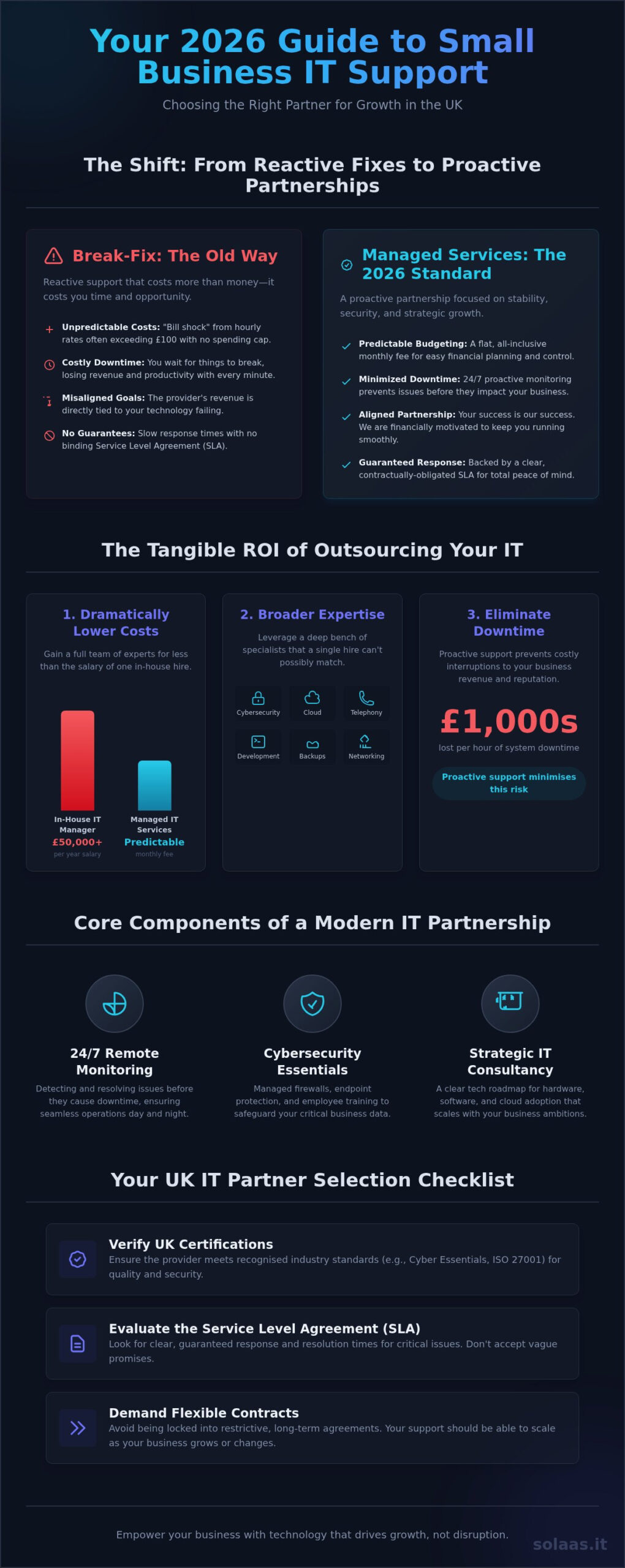
The days of waiting for a computer to fail before calling for help are over. The traditional ‘break-fix’ model-the reactive call-out when something goes wrong-is no longer a viable solution for the demands of the modern workplace. While the foundational definition of what is IT support? remains rooted in resolving technical issues, its application has evolved dramatically. In 2026, the landscape is defined by proactive management, where technology drives growth, not disruption. With the rise of integrated AI tools, the permanence of remote work, and the complexity of hybrid cloud infrastructures, UK businesses need more than just a repair service.
Modern small business it support is a strategic partnership designed to enhance productivity, secure assets, and drive competitive advantage.
The Core Components of Modern IT Support
A comprehensive IT solution moves far beyond simple troubleshooting. It provides a tailored, multi-layered service focused on business continuity and strategic growth. The essential pillars include:
- 24/7 Remote Monitoring: Your systems are watched around the clock by sophisticated tools that detect and resolve potential issues before they can cause downtime. This proactive approach ensures your operations run seamlessly, day and night.
- Cybersecurity Essentials: With ransomware attacks on UK businesses becoming more frequent and sophisticated, a robust defence is non-negotiable. This includes managed firewalls, endpoint protection, and employee training to safeguard your critical data.
- Strategic IT Consultancy: Your IT partner should help you plan for the future. This means creating a clear hardware and software roadmap, advising on cloud adoption, and ensuring your technology stack scales with your ambitions.
Why Small Businesses Outsource IT
For a growing business, outsourcing IT is not just about fixing problems; it’s a strategic decision that delivers tangible business outcomes. The key drivers are clear:
- Cost Efficiency: Hiring a single, full-time IT manager in the UK can cost over £50,000 per year in salary alone. Outsourcing provides access to an entire team of experts for a predictable, flexible monthly fee, delivering a far greater return on investment.
- Access to a Wider Pool of Skills: A managed services provider offers a deep bench of specialists in areas like telephony, cloud architecture, and advanced cybersecurity-expertise that is impossible to find in a single in-house hire.
- Reducing Downtime: Every hour your system is offline costs money. For a typical UK small business, a single hour of downtime can easily result in thousands of pounds in lost revenue, productivity, and reputational damage. Proactive support minimises this risk.
Comparing IT Support Models: Which Fits Your Business?
Selecting the right small business it support isn’t just about fixing computers; it’s a strategic decision that impacts your budget, productivity, and growth. The model you choose determines whether your IT partner is a reactive cost centre or a proactive engine for efficiency. Understanding the core differences is the first step toward making a confident choice.
From traditional pay-as-you-go fixes to modern, flexible partnerships, each model offers a distinct approach to managing your technology.
Break-Fix vs. Managed Services: Reactive vs. Proactive
The oldest model is “break-fix,” where you call for help only when something breaks. While it seems cheaper upfront, the true costs quickly accumulate through downtime and unpredictable “bill shock” from hourly rates that can exceed £100. The fundamental issue is a conflict of interest: this provider only earns when your technology fails. In contrast, a Managed Services Provider (MSP) operates on a fixed monthly fee, creating a partnership where success is shared.
- Predictability: Managed services offer a flat, predictable monthly cost, while break-fix leads to volatile, reactive spending.
- Response Times: MSPs provide Service Level Agreements (SLAs) guaranteeing a response, whereas break-fix offers no such assurance.
- Alignment: Your MSP is motivated to keep your systems running flawlessly to protect their own margins, ensuring they are proactively preventing issues before they disrupt your business.
Is Co-Managed IT Right for You?
For businesses with an in-house IT manager or a small tech team, a co-managed model provides the best of both worlds. It bridges the gap by empowering your internal expert with enterprise-grade tools and specialist support. Your external partner handles the time-consuming maintenance-like patching, backups, and 24/7 monitoring-freeing your team to focus on strategic projects that drive innovation. This shared responsibility is especially critical for security, helping you implement a robust defence that aligns with best practices like the SBA cybersecurity guidelines by leveraging external expertise.
Ultimately, the goal of modern small business it support is to provide proactive, scalable solutions. While MSPs set the standard, the most forward-thinking models now offer this high-end support without locking you into rigid 36-month contracts, giving you the flexibility and control your business deserves.
The True Cost of Small Business IT Support in the UK
Understanding the investment in small business it support goes beyond a simple monthly fee. To make a strategic decision, you need clarity on pricing structures, potential hidden charges, and the ultimate return on your investment. Many providers hide costs for on-site travel, emergency call-outs, or initial “onboarding,” turning a seemingly affordable contract into a significant expense. A transparent partner will provide a clear, predictable cost structure tailored to your specific needs.
In 2026, UK market rates vary based on the depth of service. Expect to see tiers ranging from basic remote helpdesk support to comprehensive, full-stack management that includes proactive cybersecurity and strategic planning. The primary factors driving these costs are:
- User & Device Count: The number of employees and endpoints (laptops, servers, mobiles) that need support.
- Service Complexity: The level of support required, from simple troubleshooting to managing complex cloud infrastructure.
- Compliance Needs: Businesses in regulated sectors like finance or healthcare require specialised, and therefore more costly, security and data management.
UK Pricing Models Breakdown
The most common model for UK small businesses is Per-User Pricing, which typically ranges from £40 to £150 per user per month. In the Midlands, 2026 rates align with this, with basic packages at the lower end and all-inclusive, security-focused plans at the premium end. A Per-Device model can be more cost-effective for businesses with more hardware than staff, like manufacturing. However, the gold standard for predictable budgeting is a Flat-Fee / All-Inclusive plan, which bundles all services into one fixed monthly cost, eliminating surprise bills and empowering you to control your finances.
Calculating Your ROI
A proactive IT support contract is an investment, not just an expense. Consider this: the average cost of a single major data breach for a UK small business can run into tens of thousands of pounds in fines, recovery, and reputational damage. This figure dwarfs the annual cost of a comprehensive support plan. Furthermore, a skilled IT partner enhances productivity by ensuring seamless connectivity-whether through robust leased lines or innovative Starlink solutions-minimising downtime and empowering your team to perform at its best. By evaluating The True Cost of Small Business IT Support in the UK, you can see how a strategic partnership delivers tangible value far beyond just fixing problems.
How to Choose an IT Partner: A UK Selection Checklist
Selecting the right IT partner is a strategic decision that directly impacts your business’s efficiency, security, and growth. To make an informed choice, you need a structured approach that goes beyond a simple price comparison. This checklist is designed to help UK businesses evaluate potential providers and find a partner truly aligned with their goals.
First, verify UK-specific credentials. A provider must demonstrate full GDPR compliance to protect your data and your reputation. Furthermore, look for certifications like Cyber Essentials, a government-backed scheme that proves they take cybersecurity seriously. When evaluating small business IT support, these credentials are non-negotiable.
Next, scrutinise the Service Level Agreement (SLA). This document is your guarantee of service. It should clearly define response and resolution times for critical issues, outlining exactly what happens when things go wrong. Don’t settle for vague promises; demand a contract that protects your operational uptime.
For firms in the Midlands, the “local vs. national” debate is crucial. While national providers have scale, a Coventry-based partner offers unparalleled advantages, including faster on-site response times and a deeper understanding of the regional business landscape. Finally, assess scalability. Your IT support should be a catalyst for growth, not a bottleneck. Can they seamlessly manage a cloud migration or equip a new office? A forward-thinking partner will have a clear strategy for supporting your ambitions.
Essential Questions for Your Potential Provider
- What is your average response time for a P1 (critical) ticket? This reveals their commitment to handling business-stopping emergencies.
- Do you offer month-by-month options or just long-term contracts? Flexibility is key for modern businesses; a partner offering flexible IT solutions puts control back in your hands.
- How do you handle remote workers and mobile device security? Their answer demonstrates if they are equipped for the demands of today’s hybrid work environments.
Red Flags to Avoid
- Proprietary lock-ins: Avoid providers who insist on “owning” your domain name, website hosting, or admin passwords. You should always retain ultimate control of your digital assets.
- Lack of transparency: Vague invoices with ambiguous “miscellaneous” or “admin” charges are a sign of a provider that isn’t being upfront about their costs.
- Outdated tech stack: If a provider seems unfamiliar with or unsupportive of modern solutions like Starlink connectivity or AI-driven security, they may not be equipped to future-proof your business.
SolaaS: Empowering Small Businesses with Flexible IT
Welcome to a new era of IT and Telecoms. For too long, small businesses have been locked into rigid, long-term contracts that don’t adapt to their changing needs. At SolaaS LTD, we believe in a different approach. We put the control firmly back in your hands with a flexible, month-by-month model. Our philosophy is simple: we earn your business every 30 days by delivering unparalleled service and tangible results. This is small business it support designed for the agility and ambition of today’s entrepreneurs.
We go beyond simple break-fix solutions by offering a fully integrated technology ecosystem. We combine our expert IT support with cutting-edge services to create a seamless, powerful, and secure operational backbone for your company. This comprehensive approach includes:
- Resilient Connectivity: Leveraging Starlink for high-speed internet, even in the most challenging UK locations.
- Cloud Telephony: Modern, scalable communication systems that connect your team anywhere.
- AI-Powered Security: Proactive, intelligent cybersecurity that defends against threats before they impact your business.
The SolaaS LTD Difference
We don’t offer generic packages; we build tailored solutions. As your trusted partner, our goal is to align our services directly with your business objectives, ensuring we grow together. For instance, we helped a local Coventry logistics firm scale their tech infrastructure to support a 200% increase in operations, providing the flexibility they needed at every stage without the constraints of a long-term commitment. This is the partnership and expertise we bring to every client.
Get Started Today
Transitioning from your current provider is a seamless and stress-free process managed entirely by our expert team, guaranteeing no downtime for your business. The first step is to understand your unique environment. We offer a complimentary, no-obligation IT audit to identify opportunities for improvement and create a strategy that fits your budget and goals. Ready to discover a better standard of small business it support? Take control of your technology today.
Book a demo or request a tailored IT quote
Empower Your Business with Agile IT Support
Navigating the future of small business it support means moving beyond outdated, rigid contracts. As we’ve seen, success in 2026 and beyond will depend on choosing a flexible, scalable model that aligns with your true operational needs and budget, empowering your UK business to adapt and thrive.
This is where a modern approach makes all the difference. At SolaaS, our Coventry-based team of experts delivers precisely that with unparalleled month-by-month flexibility. We specialise in forward-thinking solutions, from robust AI Security to cutting-edge Starlink connectivity, ensuring you’re always ahead of the curve. Break free from long-term contracts-Get flexible IT support from SolaaS today.
Take control of your technology and position your business for sustained success. Your journey to smarter, more efficient IT starts now.
Frequently Asked Questions
How much does IT support cost per employee in the UK?
In the UK, IT support costs typically range from £25 to £75 per user, per month. The exact price depends on the level of service required. A basic plan might cover remote helpdesk support, while a comprehensive package will include advanced cybersecurity, on-site visits, and proactive network monitoring. The most effective solutions are scalable, allowing you to tailor the investment to your precise business needs and ensure cost-effectiveness as you grow.
Do small businesses really need managed IT services?
Absolutely. Modern small businesses depend on technology for efficiency and growth. Managed IT services move beyond reactive fixes to provide proactive maintenance, robust cybersecurity, and strategic guidance. This approach minimises downtime, protects critical data, and provides access to expert knowledge without the high cost of an in-house team. Effective small business it support is a strategic investment that enhances productivity and secures your competitive edge in the market.
What is the difference between IT support and an IT consultancy?
IT support focuses on the day-to-day operational health of your technology. This includes troubleshooting issues, managing systems, and ensuring everything runs smoothly. An IT consultancy, on the other hand, is strategic. Consultants assess your business goals and help you create a long-term technology roadmap, advising on major investments like cloud migration or infrastructure upgrades. A great partner provides both, ensuring your current needs are met while planning for future success.
Can I switch IT providers if I am currently in a long-term contract?
Yes, switching providers is often possible even when you’re in a long-term contract, but you must review your agreement’s termination clause for specific terms and potential fees. Many businesses feel constrained by rigid, multi-year contracts. That’s why forward-thinking providers offer flexible, month-by-month options, putting the control firmly back in your hands and allowing you to partner with a provider that truly meets your evolving business needs.
Does IT support include cybersecurity and data backup?
A comprehensive IT support plan should always include cybersecurity and data backup as fundamental components. These services are critical for business continuity. This typically involves managing firewalls, deploying antivirus solutions, monitoring for threats, and implementing automated, secure data backups. When choosing a provider, always clarify that these non-negotiable protections are included to ensure your business is resilient against data loss and cyber threats.
What happens if my internet goes down? Does IT support help with connectivity?
Your IT support partner should be your first call. They will quickly diagnose the problem to determine if it’s an issue with your internal network or your Internet Service Provider (ISP). A quality provider will then manage the issue for you, liaising directly with the ISP to resolve the outage. This saves you valuable time and frustration, ensuring your connectivity is restored as quickly as possible with minimal disruption to your operations.
How does remote IT support work for small businesses?
Remote IT support uses secure software that allows certified technicians to access your computers and systems from their location. This enables them to troubleshoot problems, install updates, and resolve most issues in real-time without needing to be physically on-site. For a small business, this means faster response times, reduced downtime, and a highly cost-effective way to get expert help. This seamless model ensures your team stays productive with minimal interruption.

Article by
René Wheeler
René Wheeler is Managing Director of SolaaS, bringing over three decades of experience in IT and telecoms. He is a strong advocate for transparency and flexibility, championing monthly contract models that allow businesses to stay agile and in control of their technology. His approach challenges traditional industry practices and puts client outcomes first