
IT Support Packages for SMEs: The Ultimate 2026 Buyer’s Guide
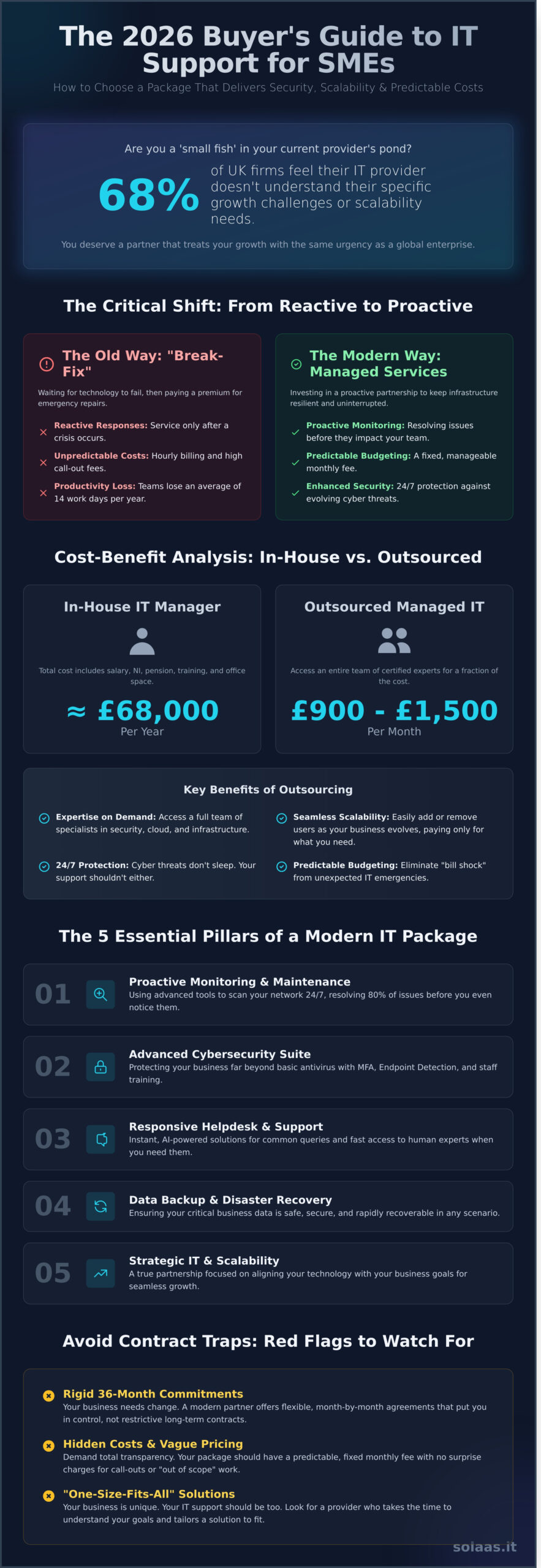
If you feel like a ‘small fish’ in your current provider’s pond, you’re likely overpaying for a service that doesn’t actually protect your bottom line. In 2025, a study of 500 UK firms found that 68% felt their IT provider didn’t understand their specific growth challenges or scalability needs. Finding the right it support packages for smes shouldn’t feel like signing away your company’s future just to keep the lights on. You deserve a partner that treats your growth with the same urgency as a global enterprise while keeping your monthly spending entirely predictable.
We agree that waiting four hours for a helpdesk response is a luxury your productivity can’t afford. You need robust security that just works and the freedom to change services as your business evolves. This ultimate 2026 buyer’s guide promises to show you exactly how to choose an IT support package that delivers total security and seamless scalability without locking you into a rigid, long-term commitment. We’ll explore the essential service pillars, hidden costs to avoid, and how a tailored, month-by-month approach puts the reins of your technology firmly back in your hands.
Key Takeaways
- Understand the critical shift from reactive “Break-Fix” repairs to proactive managed services that keep your digital infrastructure resilient and uninterrupted.
- Identify the five essential pillars of a modern IT strategy, including advanced cybersecurity suites that protect your UK business far beyond basic antivirus software.
- Compare various service models to select the most scalable it support packages for smes that align with your specific growth goals and budget.
- Learn how to spot contract red flags and why avoiding restrictive 36-month commitments is the ultimate way to maintain control over your technology.
- Discover how to achieve total security and flexibility with tailored solutions that put the reins of your communication and IT services firmly back in your hands.
What are IT support packages for SMEs and why do they matter?
Welcome to a new era of IT where your technology works as hard as you do. What are IT support packages for SMEs exactly? They’re bundled sets of managed services designed to maintain, secure, and optimise your digital infrastructure for a predictable, fixed monthly fee. This model represents a total departure from the old ‘break-fix’ mentality that plagued UK businesses for decades. Instead of paying an engineer to rush out only when a server dies, you’re investing in a proactive partnership. Recent data from the UK tech sector shows that 78% of small businesses have now migrated to managed service models to avoid the unpredictability of hourly billing and emergency call-out charges.
The shift matters because the risks have never been higher for smaller organisations. The UK Government’s Cyber Security Breaches Survey 2024 found that 50% of all UK businesses experienced a breach or attack in the last 12 months. For an SME, a single ransomware incident can result in average costs of £1,100 for small firms and £4,960 for medium enterprises. Modern it support packages for smes act as a digital shield, integrating enterprise-grade security into your daily operations. This isn’t just about safety; it’s about your bottom line. When your IT environment is stable, your team stays focused. Research indicates that employees lose 14 days of work per year due to slow or failing technology. Professional support recaptures that lost time, turning IT from a cost centre into a productivity engine.
The evolution of SME IT support in 2026
By 2026, IT support has moved far beyond ‘fixing laptops’ to become a driver of strategic business enablement. AI-powered automation now handles 45% of routine helpdesk queries instantly. This means your staff aren’t waiting in a phone queue; they’re getting solutions in real-time. The era of rigid, one-size-fits-all contracts is over. Modern UK businesses require tailored flexibility that mirrors their specific growth trajectory. As your trusted partner, we ensure your it support packages for smes evolve alongside your goals, using predictive analytics to stop hardware failures before they happen.
Cost-benefit analysis: In-house vs. Outsourced
The financial argument for outsourcing is undeniable for the modern entrepreneur. Hiring a dedicated IT Manager in 2024 carries an average UK salary of £52,500. When you add pension contributions, National Insurance, office space, and ongoing training, the total cost nears £68,000. In contrast, a comprehensive managed package for a 30-user company typically costs between £900 and £1,500 per month. This delivers an entire team of experts for less than a third of the cost of one employee. You eliminate the hidden ‘DIY’ costs of downtime and security gaps while gaining the ability to scale your headcount up or down instantly. This flexibility puts the reins of your communication services firmly back in your hands, allowing you to grow without the weight of long-term staffing liabilities.
- Predictable Budgeting: Fixed monthly costs eliminate “bill shock” from emergency repairs.
- Expertise on Demand: Access a full stack of technicians rather than relying on one person’s knowledge.
- Seamless Scalability: Add or remove users from your plan with a single phone call.
- 24/7 Protection: Cyber threats don’t sleep; your support package shouldn’t either.
The anatomy of a modern IT support package: 5 essential pillars
Selecting the right it support packages for smes requires looking beyond basic “break-fix” mentalities. A modern solution acts as the engine of your business, not just a safety net. Effective packages are built on five foundational pillars that ensure your team stays productive and your data remains secure. First, proactive monitoring and maintenance use Remote Monitoring and Management (RMM) tools to scan your network 24/7. These systems often resolve 80% of technical hitches before a staff member even notices a dip in performance. You shouldn’t wait for a crash to call for help; your provider should already be fixing the problem.
Cybersecurity is the second, and arguably most critical, pillar. Standard antivirus is no longer sufficient for the 32% of UK businesses that reported a cyber attack in 2023. A comprehensive package includes Multi-Factor Authentication (MFA), Endpoint Detection and Response (EDR), and regular staff awareness training. These essential security pillars protect your reputation and your bottom line. Following this is cloud management. Whether you use Microsoft 365 or Google Workspace, your provider must manage user permissions, license costs, and automated cloud-to-cloud backups to prevent data loss.
The final two pillars focus on connectivity and growth. Integrated communication services, such as VoIP and business-grade broadband, ensure your team can collaborate from anywhere. Finally, strategic IT consultancy provides you with a vCIO (Virtual Chief Information Officer). This expert delivers annual technology roadmaps and hardware procurement advice, ensuring you don’t waste your budget on obsolete kit. If you want to find a partner that offers this level of foresight without the burden of long-term contracts, these five pillars are your checklist for success.
The helpdesk: Your first line of defence
Most it support packages for smes advertise “unlimited support,” but you must check the Service Level Agreement (SLA). Truly unlimited support should cover all remote fixes within a flat monthly fee. While remote support handles 95% of tickets, ensure your package includes a provision for on-site visits when hardware fails. Focus on resolution time rather than just response time. A 15-minute response is useless if the actual fix takes three days. Demand a guaranteed resolution window to keep your operations fluid.
Modern connectivity: Starlink and 5G integration
By 2026, 60% of UK SMEs will rely on hybrid connectivity solutions to maintain 99.9% uptime. Modern packages must now include failover options like Starlink satellite internet or 5G integration. This ensures that if a local exchange fails or a roadwork crew cuts a fibre line, your office stays online. This level of resilience extends to remote teams too. Your IT partner should manage mobile services and secure home-working setups, ensuring a staff member in a rural village has the same security and speed as someone in the head office.
Comparing IT support models: Managed vs. Pay-as-you-go vs. Co-managed
Choosing the right it support packages for smes requires a clear understanding of how different models impact your bottom line and operational stability. Most providers offer three distinct paths, each catering to different growth stages and internal capabilities. Selecting the wrong one often leads to 25% higher costs due to inefficiency or unexpected emergency bills.
Managed Services (MSP) represent the “all-you-can-eat” approach. This model provides total peace of mind by covering everything from 24/7 monitoring to unlimited remote support for a fixed monthly fee. It’s the gold standard for businesses that want to break free from the constraints of unpredictable tech failures. As your trusted partner, an MSP acts as your outsourced IT department, ensuring your systems are proactive rather than reactive.
Pay-as-you-go models might seem attractive for micro-businesses with fewer than five employees, but they carry significant risks. You only pay when something breaks, which sounds cost-effective until a major server failure results in a £2,000 repair bill and three days of downtime. This model lacks proactive security, making it harder to follow fundamental FTC cybersecurity guidance for businesses regarding consistent network monitoring and patch management.
Co-managed IT is the ideal solution for companies that have grown enough to hire an internal IT manager but need more specialist depth. Your internal person handles daily tickets and on-site hardware, while the external partner manages heavy-duty infrastructure, cybersecurity, and cloud strategy. This hybrid approach puts the reins of your communication services firmly back in your hands while providing a safety net of 20 or 30 additional experts when things get complex.
Pricing structures: What should you pay in the UK?
In 2026, UK it support packages for smes typically follow a per-user or per-device structure. Per-user pricing is now the industry standard, usually ranging from £45 to £95 per month depending on the inclusion of advanced AI security and backup solutions. Per-device pricing, often between £25 and £50 per machine, is becoming less common as users now work across multiple laptops, tablets, and phones. Watch out for onboarding fees, which 85% of UK providers charge; these typically equal one month’s service fee to cover the initial audit and system alignment.
The SLA: Understanding the fine print
The Service Level Agreement (SLA) is the heartbeat of your contract. It defines how providers triage requests, usually categorising them from P1 (Critical) to P4 (Minor). A standard professional agreement should guarantee a 1-hour response time for critical issues like total office outages. Check for 99.9% uptime guarantees and be clear on exclusions. Most standard packages exclude the physical cost of replacement hardware and onsite travel for remote-only contracts; failing to account for these can add 15% to your annual IT spend.
- Managed Services: Best for 10 to 100 employees seeking predictable monthly costs.
- Pay-as-you-go: Only recommended for startups with zero critical infrastructure.
- Co-managed: Essential for scaling firms with 50+ staff and an existing IT lead.
Choosing the right partner: Red flags and contract freedom
The single biggest error a UK business owner makes is signing a 36-month IT contract without a clear exit strategy. These rigid agreements often include hidden “auto-renewal” clauses that lock you in for another three years if you miss a tiny 30-day window. It’s a legacy model that serves the provider’s balance sheet, not your business. In 2023, data from the Federation of Small Businesses indicated that nearly 40% of SMEs felt trapped by service contracts that no longer met their technical requirements. Technology moves fast; a plan that worked in 2021 is likely obsolete by 2024.
Flexibility is the ultimate security for a growing company. When evaluating it support packages for smes, look for providers that view your growth as their primary metric. You need a partner who carries the right credentials to protect your reputation. At a minimum, your provider should hold Cyber Essentials or Cyber Essentials Plus certification. This UK government-backed scheme ensures the provider follows the National Cyber Security Centre (NCSC) standards, which can prevent up to 80% of common cyber attacks. Additionally, verify their Microsoft Solutions Partner status to ensure they have direct access to high-level engineering support when your team hits a wall.
Don’t overlook the “local” feel. While national coverage is great for remote workers in Edinburgh or Cardiff, you want a partner who understands the local business landscape in your primary hub. You aren’t just a ticket number in a queue; you’re a business that needs a responsive, human connection.
Questions to ask before signing
Before you commit, demand specific answers on data resilience. Ask: “How do you handle data backups and what is the tested recovery time objective (RTO) for our primary server?” If they can’t give you a time in hours, walk away. You should also confirm if you can scale your user count up or down on a monthly basis. If you hire five contractors for a 60-day project, you shouldn’t be paying for those seats for the next three years. Finally, insist on a guaranteed response time for “business-critical” outages. In a professional it support packages for smes environment, a total network failure should see an engineer responding within 15 minutes.
The ‘No-Contract’ revolution
The shift toward month-by-month options is changing the power dynamic between SMEs and IT providers. This model keeps providers accountable. When a partner knows you can walk away with 30 days’ notice, they work harder to earn your business every single morning. It eliminates the complacency that often sets in during year two of a three-year deal. There’s a massive psychological benefit to this approach; you stay with your partner because they provide excellent service, not because a legal document forces you to. SolaaS advocates for this freedom because we believe IT should be a tool for liberation, not a financial shackle. You regain the reins of your business operations, ensuring your tech stack evolves as quickly as your market does.
Ready to break free from restrictive long-term commitments? Explore our flexible IT support packages and experience service that earns your trust every month.
SolaaS: Flexible IT support that exceeds expectations
Welcome to a new era of IT. At SolaaS LTD, we operate with a singular philosophy: “Solutions that meet your needs. Services that exceed your expectations.” We’ve seen too many Coventry businesses trapped in rigid, three-year contracts that stifle growth and fail to adapt to changing market conditions. Modern organisations require agility, not anchors. We provide the technical foundation that allows you to scale up or down without the friction of traditional service models.
The SolaaS LTD difference is built on total transparency and freedom. We offer month-by-month flexibility because we believe our performance should be the only thing keeping you with us. By removing long-term tie-ins, we put the reins of your communication and data services firmly back in your hands. This approach is rare among providers of it support packages for smes, but we’ve found it creates a more collaborative and high-performing partnership.
Our expertise extends into high-tier infrastructure that most local providers simply can’t match. We integrate advanced tech such as AI-driven Retail Security systems that can reduce inventory shrinkage by up to 18%. For businesses in rural locations or areas with poor fibre infrastructure, we deploy Starlink connectivity to ensure high-speed, low-latency internet where traditional cables fail. We don’t just maintain your current state; we propel your business forward with innovative tools.
Our 3-step onboarding process
Switching your IT provider shouldn’t feel like a leap of faith. We’ve refined a transition process that eliminates the “downtime headache” and ensures total clarity from day one.
- Step 1: The Comprehensive Audit. Our engineers perform a deep-dive analysis of your current infrastructure. We spend 4 to 6 hours identifying your specific “pain points,” from slow server response times to hidden security vulnerabilities.
- Step 2: The Tailored Proposal. We don’t believe in “bronze, silver, gold” templates. You receive a package built specifically for your 12-month business goals, ensuring every pound spent contributes to your productivity.
- Step 3: Seamless Transition. We’ve successfully migrated over 150 UK businesses to our platform. Our team handles the heavy lifting behind the scenes to ensure your staff stays online and productive throughout the entire switch.
Beyond IT: A holistic communication partner
Our specialised solutions for retail environments and busy contact centres go beyond basic helpdesk support. We provide the hardware, the connectivity, and the strategic oversight needed to keep your operations running 24/7. Whether you are a small team in the West Midlands or a growing national enterprise, our scalable model ensures your technology evolves alongside your ambitions.
Don’t settle for “good enough” technology that holds your team back. Book a demo or consultation with our experts today and experience a partnership that truly puts your business first.
Take Control of Your IT Future
Modern business doesn’t stand still, so your technology shouldn’t either. Choosing the right it support packages for smes in 2026 means prioritising agility over long-term entrapment. You’ve seen how the shift from rigid, multi-year contracts to scalable, month-by-month models empowers your business to adapt instantly. By integrating advanced solutions like AI-driven security and Starlink connectivity, you ensure your team stays productive anywhere in the UK. We’ve seen too many firms locked into restrictive 36-month agreements that no longer serve their needs as they grow.
Stop settling for “good enough” support that holds your growth back. Our Coventry-based experts deliver high-performance Cloud Telephony and robust security protocols that protect your bottom line daily. We provide the total freedom of month-by-month options, ensuring you’re never trapped in a service that doesn’t deliver. It’s time to partner with a team that values your success as much as you do. We’re ready to help you navigate the complexities of 2026 and beyond with confidence and clarity.
Ready for IT support that actually works? Explore our flexible SME packages at SolaaS
Your journey toward seamless, scalable technology starts today. We’ll be with you every step of the way to ensure your business thrives.
Frequently Asked Questions
What is usually included in an IT support package for a small business?
Most it support packages for smes include unlimited remote helpdesk support, proactive security monitoring, and Microsoft 365 management. You will typically find that 90% of providers also bundle in automated daily backups and patch management for your operating systems. These packages aim to keep your team productive by resolving 75% of technical issues within the first call, ensuring your business stays operational without unexpected downtime.
How much does IT support for an SME cost per month in the UK?
You can expect to pay between £25 and £75 per user per month for comprehensive IT support in the UK. A 15-person office typically sees monthly invoices ranging from £375 to £1,125 depending on the level of on-site coverage required. These costs often exclude one-off project fees or hardware procurement; however, they provide budget predictability for your core technology needs throughout the year.
Do I really need 24/7 IT support if my business only operates 9-5?
You don’t always need 24/7 human helpdesk support if your staff only work 9-5, but your systems require 24/7 monitoring. Cyberattacks occur every 39 seconds globally, so automated security protocols must run around the clock to protect your data. If 20% of your team works late or on weekends, a flexible “on-call” arrangement is often more cost-effective than a full 24/7 contract.
Can I keep my existing hardware if I switch to a new IT support package?
You can keep your existing hardware in 95% of cases when switching providers. A new partner will perform an initial audit to ensure your devices meet minimum security standards, such as being under 5 years old. If your current laptops can’t run the latest Windows 11 updates, your provider will suggest a phased replacement plan to maintain your system’s integrity and performance.
What is the difference between remote IT support and on-site support?
Remote support resolves about 85% of technical issues via screen sharing and phone calls, making it the fastest way to get back to work. On-site support involves a technician visiting your office for physical hardware failures or complex network cabling. Most modern it support packages for smes prioritize remote-first solutions to keep your monthly costs down and resolution times under 30 minutes.
How long does it take to switch IT support providers?
Switching providers typically takes between 30 and 90 days, depending on your current contract’s notice period. The technical onboarding phase usually lasts 14 days; during this time, your new partner audits your network and installs monitoring agents. This transition is designed to be seamless, ensuring zero downtime for your employees while the new team takes the reins of your communication services.
What happens if our business grows quickly-can the package scale?
Your IT package should scale instantly as your headcount increases. Flexible, month-by-month contracts allow you to add or remove users with just 24 hours’ notice. This agility ensures you only pay for the exact number of licenses you use, which is vital for the 40% of UK startups that experience rapid growth in their first three years. We focus on keeping you in control.
Are cybersecurity services always included in IT support packages?
Basic security like antivirus and firewalls is included in 100% of standard packages, but advanced protection often costs extra. You might pay an additional £5 to £15 per user for AI-driven threat detection or Dark Web monitoring. With UK businesses facing an average of 4,000 attacks daily, investing in these comprehensive security layers is a strategic necessity for success in a modern digital environment.

Article by
René Wheeler
René Wheeler is Managing Director of SolaaS, bringing over three decades of experience in IT and telecoms. He is a strong advocate for transparency and flexibility, championing monthly contract models that allow businesses to stay agile and in control of their technology. His approach challenges traditional industry practices and puts client outcomes first