
Cloud Phone System for Remote Teams: A 2026 Guide for UK Businesses
What if the technology you rely on to reach your customers simply vanished in January 2027? It’s a daunting thought, especially when you’re already managing a distributed workforce across Coventry, Leicester, or even abroad. You’re likely tired of the high costs of traditional landlines and the mess of staff using personal mobiles to reach clients. Implementing a cloud phone system for remote teams is no longer just an upgrade; it’s a vital step to ensure your business remains connected and professional during the digital migration.
We agree that navigating technical shifts should feel like a liberation, not a chore. This guide is here to show you how to unite your staff under one professional identity whilst significantly lowering your monthly bills. We’ll walk you through a jargon-free path to total flexibility, ensuring your business remains agile long after the old copper wires go cold. Discover how to take full control of your communications and empower your team to work from anywhere with absolute confidence.
If you have any questions about this article and how it affects your business, please contact us at https://www.solaas.it/contact-us/.
Key Takeaways
- Prepare your business for the January 2027 PSTN switch-off by understanding why traditional landlines are being retired across the UK.
- Discover how a cloud phone system for remote teams allows your staff to maintain a single professional identity, whether they are working from home or on the move.
- Explore essential collaboration features like presence status that help you stay connected with colleagues in Leamington or Warwick as if they were in the same room.
- Learn how to audit your existing numbers and internet connectivity to ensure a smooth transition to the cloud without any service downtime.
- Identify ways to reduce overheads and monthly costs whilst empowering your distributed workforce with total flexibility and modern tools.
What is a Cloud Phone System and Why Does Your Remote Team Need One Now?
At its simplest, a cloud phone system is a business communication tool that routes your voice calls over the internet instead of through old-fashioned copper wires. Unlike the heavy hardware of the past, this technology relies on Cloud communications to connect your team. For many UK businesses, choosing a cloud phone system for remote teams has become the final step in breaking free from the physical office. It’s simple. It’s fast. It works.
The End of the Copper Era: The 2027 Switch-Off Explained
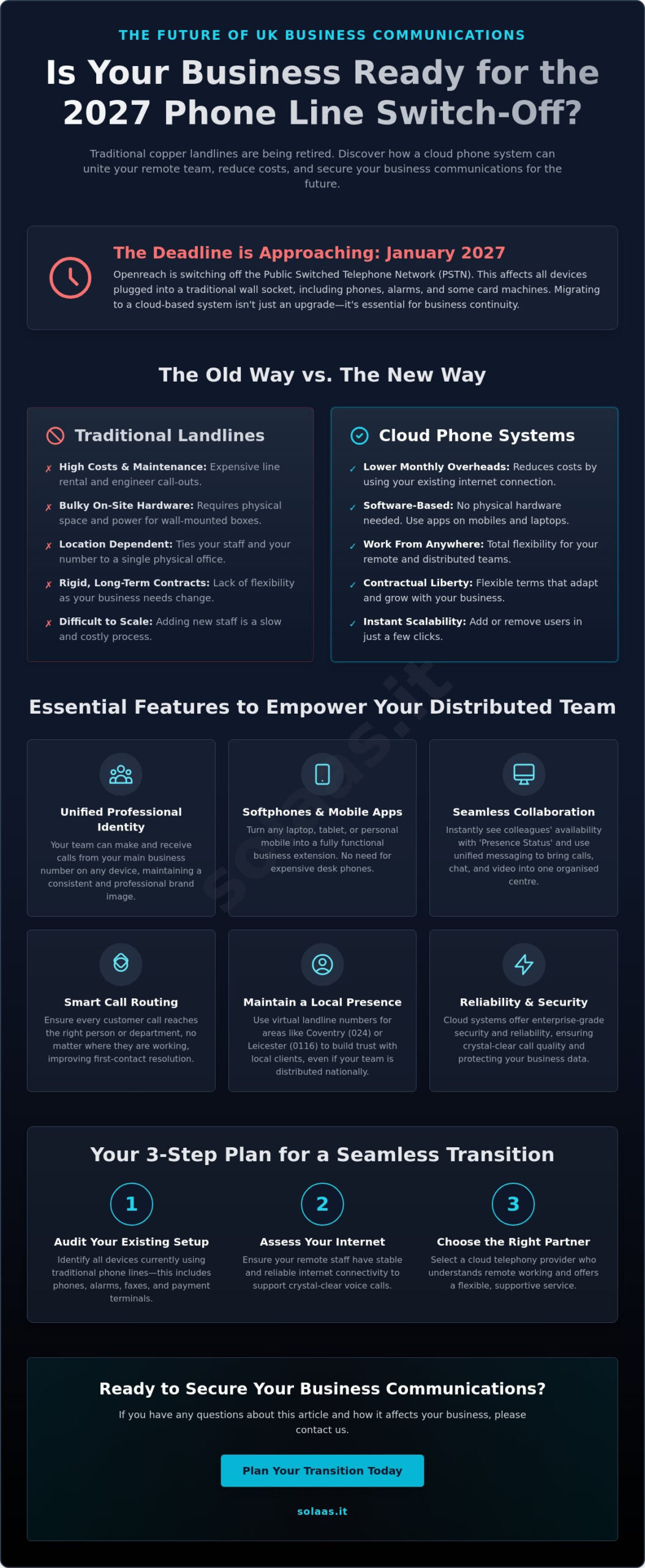
Openreach is currently retiring the Public Switched Telephone Network (PSTN), with a final switch-off date set for January 2027. This change affects every device plugged into a traditional wall socket, including phones, alarms, and even some lift sensors. Remote teams are actually in a fantastic position for this migration. Since your staff already rely on home broadband or mobile data, moving their voice services to the cloud is a natural and straightforward transition. You’re already halfway there; you just need the right platform to unite everyone.
Cloud vs. Traditional Systems: A Jargon-Free Comparison
Traditional systems often involve bulky boxes mounted on walls and expensive maintenance visits. Cloud telephony removes these barriers entirely. There are no “black boxes” to fix and no need for onsite engineers to pull cables through your ceiling. We believe in providing “Contractual Liberty,” which means you aren’t trapped in long-term, rigid agreements that no longer suit your needs. It is about giving you the control to adapt your communications as your business grows, rather than being held back by outdated infrastructure and restrictive terms.
If you have any questions about this article and how it affects your business, please contact us at https://www.solaas.it/contact-us/.
Essential Features to Help Your Distributed Team Organise and Collaborate
Managing a distributed workforce requires more than just a dial tone. A modern cloud phone system for remote teams acts as the digital glue that holds your operations together. By using softphones and mobile apps, your staff can turn their personal mobiles or laptops into fully functional business extensions. This means they can make and receive calls using your company’s official number, keeping personal data private whilst maintaining a cohesive brand identity across the board.
Visibility is often the biggest hurdle for remote managers. Presence status solves this instantly. You can see if a colleague in Leamington is “available,” “busy,” or “on a call” without sending a single message. When combined with unified messaging, which brings voicemail, chat, and video into one single, easy-to-use centre, your team spends less time hunting for information and more time delivering results. Smart call routing then ensures that when a client rings, the call finds the right person, even if they’ve popped out to a meeting in Warwick.
Maintaining a Professional Image from Anywhere
Your location shouldn’t dictate your professional standing. Virtual landlines allow you to keep a local Coventry (024) or Leicester (0116) identity regardless of where your staff actually sit. This builds trust with local clients who prefer a familiar area code. By integrating these tools with your existing CRM, you create a seamless workflow that captures every interaction automatically. Explore our Cloud Telephony Solutions to see how these features can be tailored to your specific team structure.
Security and Reliability for Remote Working
Reliability is the foundation of any successful remote strategy. It’s vital that call quality remains crystal clear, as dropped calls or lag can damage your reputation. The shift towards mobility is a key driver for modern growth, making cloud-based communications for flexible work an essential investment for staying competitive. To achieve this, we recommend reviewing your Business Internet Connectivity to ensure your remote staff have the stability they need to represent your business effectively.
If you have any questions about this article and how it affects your business, please contact us at https://www.solaas.it/contact-us/.
Implementing Your Cloud System: A Seamless Transition for Midlands Businesses
Moving your communications to the cloud doesn’t have to be a headache. The secret to a successful migration lies in the preparation. Transitioning to a cloud phone system for remote teams should feel like a step toward freedom, not a technical hurdle. By following a structured approach, you can ensure your staff stay connected without missing a single client call during the process.
- Step 1: Audit and Port. Start by listing every number your business currently uses. We ensure these are ported to the cloud platform seamlessly, meaning you keep your established identity without any downtime.
- Step 2: Connectivity Check. A cloud system is only as good as your internet. For remote staff in rural areas near Warwick or Leamington, we assess local connection speeds to guarantee call quality.
- Step 3: Find a Flexible Partner. Avoid rigid, long-term contracts. Look for a partner who prioritises “hassle-free” setup and gives you the autonomy to adjust your service as your team grows.
- Step 4: Workflow Training. Once the system is live, show your team how to use their new tools. Simple training on mobile app features ensures they can manage their professional presence effectively from day one.
Why Local Support Matters for Remote Teams
Faceless global providers often overlook the “human” element of technical support. Having a partner based in the Midlands means you’re working with people who understand the local business landscape and the specific challenges of regional connectivity. Integrating your telephony into a broader Managed IT Support Services strategy ensures that your communication tools and cybersecurity measures work in perfect harmony.
Calculating the ROI of Your Move to the Cloud
The financial benefits of switching are immediate and clear. You can stop paying for multiple physical line rentals and expensive maintenance visits, replacing them with a predictable, monthly per-user fee. In terms of business performance, ROI is the direct financial gain achieved by eliminating physical line maintenance and office-bound hardware costs whilst significantly reducing travel requirements. It’s a leaner, smarter way to operate.
If you have any questions about this article and how it affects your business, please contact us at https://www.solaas.it/contact-us/.
Securing Your Business Communication for the Digital Future
The January 2027 PSTN switch-off is a fixed milestone, but it doesn’t have to be a source of stress. By adopting a cloud phone system for remote teams, you’re doing more than just meeting a regulatory deadline. You’re giving your staff the tools they need to collaborate without boundaries whilst maintaining a rock-solid professional image. We’ve seen how easy it is to port your existing numbers and scale your services without the burden of heavy hardware or disruptive maintenance visits.
We provide a 99.999% Uptime SLA for remote teams, ensuring your connection remains stable when it matters most. You’ll benefit from expert local support across Coventry, Leicester, and Warwick, all without the frustration of long-term contract lock-ins. It’s about giving you the contractual liberty and technical reliability you deserve to grow your business with absolute confidence.
If you have any questions about this article and how it affects your business, please contact us.
Frequently Asked Questions
What is the best cloud phone system for remote employees in the UK?
The best system is one that provides total flexibility and high-performance features without locking you into rigid, long-term contracts. Platforms like Wildix and Xbees are excellent choices for UK businesses because they offer seamless mobile apps and browser-based calling. These tools allow your staff to work from any location whilst maintaining a single professional identity and accessing advanced collaboration features.
Can I keep my existing business number when moving to a cloud system?
Yes, you can keep your existing business numbers through a process called porting. We manage the transition of your Coventry, Leicester, or national numbers to the cloud so there is no downtime for your customers. This ensures your established brand identity remains intact whilst you upgrade to a modern cloud phone system for remote teams.
Do my remote staff need special handsets to use a cloud phone system?
No, your remote staff don’t necessarily need physical handsets to stay connected. Most modern systems work through softphones installed on laptops or mobile apps on personal phones. However, if a team member prefers a traditional desk phone, you can provide pre-configured handsets that simply plug into their home internet router to work instantly without any complex setup.
How does the 2027 PSTN switch-off affect my business if we already work remotely?
The January 2027 switch-off still affects you if your main business number or office-based systems are currently tied to traditional copper lines. Moving to a cloud phone system for remote teams now ensures that your primary point of contact remains active when the old network closes. It also provides a chance to audit other legacy services, such as older security alarms, that might still rely on the retiring network.
If you have any questions about this article and how it affects your business, please contact us at https://www.solaas.it/contact-us/.

Article by
René Wheeler
René Wheeler is Managing Director of SolaaS, bringing over three decades of experience in IT and telecoms. He is a strong advocate for transparency and flexibility, championing monthly contract models that allow businesses to stay agile and in control of their technology. His approach challenges traditional industry practices and puts client outcomes first.