
UK GDPR Explained: A Complete Guide for UK Businesses
The threat of multi-million-pound fines. The maze of complex legal terminology. The lingering question of what’s changed since Brexit. For many UK businesses, navigating the landscape of the UK GDPR can feel like a daunting, high-stakes challenge. The fear of non-compliance is real, but achieving it doesn’t have to be a source of constant anxiety. In fact, mastering data protection can become a powerful tool for building unparalleled customer trust and driving business efficiency.
Welcome to your complete, jargon-free guide. We’ve designed this resource to be your trusted partner in data compliance, breaking down your complex obligations into a series of simple, actionable steps. We will provide a clear roadmap that demystifies the regulations, outlines your key responsibilities, and gives you the practical tools needed to protect customer data effectively. Gain the confidence to handle data legally and ethically, securing your business and its reputation for the future.
Key Takeaways
- Master the seven core principles of data protection to build a robust and trustworthy compliance framework for your business.
- Discover your essential legal responsibilities and use our actionable checklist to ensure you meet your obligations.
- Prepare your business to efficiently handle the eight individual rights guaranteed under UK GDPR, strengthening customer trust.
- Learn how to implement a data breach response plan to protect your business and avoid significant regulatory fines.
What is UK GDPR? From EU Law to UK Standard
In the digital-first landscape, understanding data protection isn’t just a compliance task-it’s a cornerstone of building customer trust. The UK General Data Protection Regulation, or UK GDPR, is the definitive data privacy law governing the United Kingdom. Its core purpose is both simple and powerful: to give individuals control over how their personal data is used, ensuring it is handled securely, transparently, and with respect.
For small and medium-sized enterprises (SMEs), navigating this regulation is essential. If your business processes the personal data of UK residents-whether they are customers, employees, or website visitors-you are required to comply, regardless of where your company is based. The good news is that it retains the key principles, rights, and obligations of its European predecessor, providing a familiar framework for responsible data management.
The Post-Brexit Transition: Key Changes
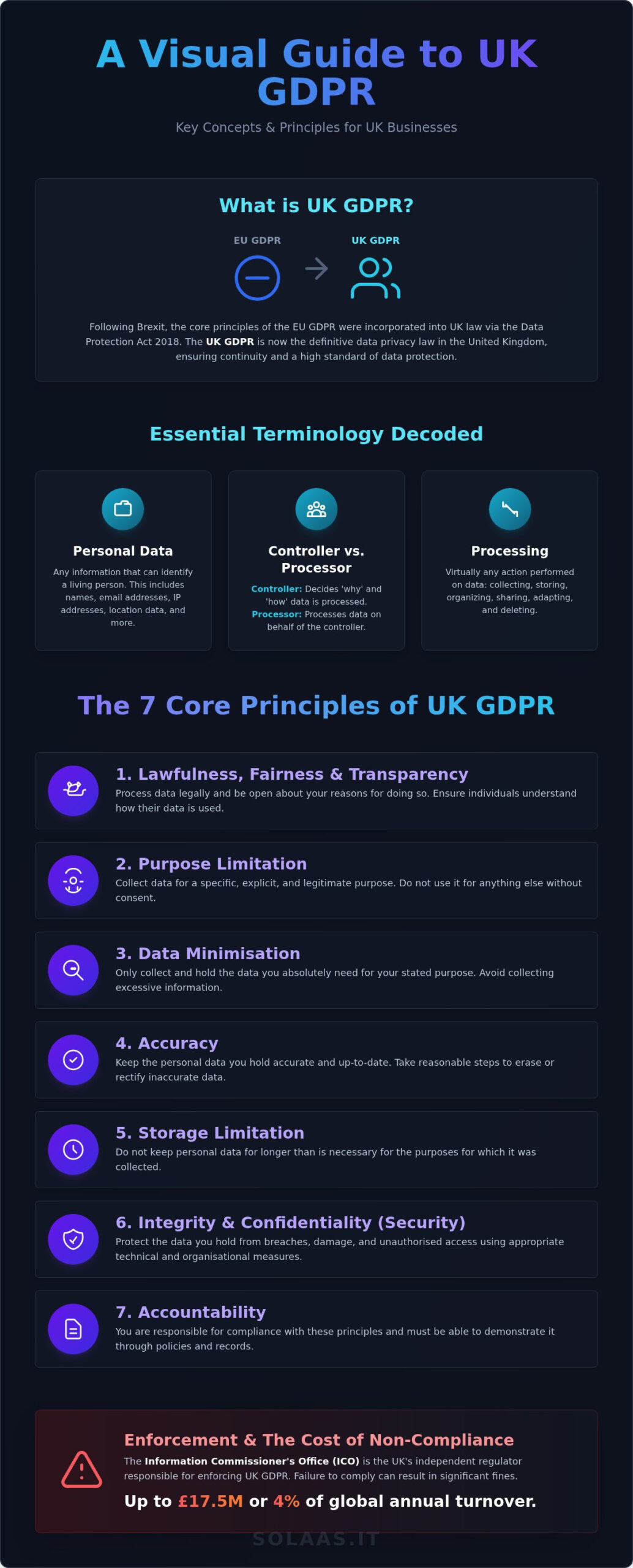
The transition from EU to UK law was designed for continuity. The principles of the EU’s landmark General Data Protection Regulation (GDPR) were incorporated directly into UK law through the Data Protection Act 2018. This established the UK’s independent data protection regime, tailored to our national context. The key enforcement body in the UK is the Information Commissioner’s Office (ICO), which acts as the independent regulator, providing guidance and enforcing the rules to protect information rights.
Essential Terminology Decoded
To confidently manage compliance, it’s crucial to understand the language of the uk gdpr. Here are the foundational terms every SME should know:
- Personal Data: This is any information that can be used to identify a living person. It includes obvious details like names, email addresses, and phone numbers, but also extends to less direct identifiers like IP addresses, location data, and customer account numbers.
- Data Controller vs. Data Processor: The Controller is the organisation that determines the purposes and means of processing personal data (e.g., your business deciding to collect customer details for a newsletter). The Processor is an organisation that processes data on behalf of the controller (e.g., the third-party email marketing service you use).
- Processing: A broad term that covers virtually any action performed on personal data. This includes everything from collecting, recording, and organising data to storing, adapting, sharing, and ultimately, deleting it.
The 7 Core Principles of UK GDPR for Businesses
At the heart of the uk gdpr are seven core principles that act as the foundation for the entire regulation. Think of them not as a restrictive list of rules, but as a robust framework for building customer trust and implementing good data governance. Compliance with these principles is mandatory and demonstrates your commitment to handling personal information responsibly. For a complete breakdown, the Information Commissioner’s Office (ICO) provides the definitive ICO’s Guide to the GDPR, but here is a practical overview for your business.
| Principle | What it Means for Your Business |
|---|---|
| Lawfulness, fairness and transparency | You must process data legally and be open about why you’re doing it. |
| Purpose limitation | Collect data for a specific, stated purpose and nothing else. |
| Data minimisation | Only collect and hold the data you absolutely need. |
| Accuracy | Keep the personal data you hold accurate and up-to-date. |
| Storage limitation | Don’t keep data for longer than necessary. |
| Integrity and confidentiality (Security) | You must protect the data you hold from breaches and unauthorised access. |
| Accountability | You are responsible for compliance and must be able to prove it. |
Principles 1-3: Lawfulness, Purpose, and Minimisation
These first three principles govern how you collect data. You must have a valid, lawful reason for processing personal information, such as consent or contractual necessity. You must be clear about why you are collecting the data (purpose limitation) and only gather what is strictly required for that purpose (data minimisation). Avoid collecting extra details ‘just in case’-this is a common compliance pitfall.
Principles 4-5: Accuracy and Storage Limitation
Once you have the data, you must manage it correctly. The accuracy principle requires you to take reasonable steps to keep information correct and current. The storage limitation principle means you cannot hold onto data indefinitely. Implementing a data retention policy is key. For example, your policy might state that customer contact details are deleted one year after their last purchase, while financial records are kept for six years to meet legal obligations.
Principles 6-7: Integrity, Confidentiality, and Accountability
Protecting data is non-negotiable. The integrity and confidentiality principle mandates that you secure personal data against breaches, damage, or loss. This is where robust IT security becomes critical. The final principle, accountability, places the responsibility squarely on your shoulders. You must not only comply with the uk gdpr but also be able to demonstrate that compliance through clear policies, procedures, and records. To ensure your security solutions are fit for purpose, it’s often best to get expert help.
Your Key Responsibilities: A Compliance Action Plan
Understanding the principles of data protection is the first step. Now, let’s translate that knowledge into a practical, actionable checklist. Think of these responsibilities not as a one-time project, but as an ongoing commitment to safeguarding data and building customer trust. Documenting every decision and process is crucial; it’s your evidence of accountability and the foundation of a robust uk gdpr compliance strategy.
Lawful Basis for Processing
Before you process a single piece of personal data, you must identify your legal reason for doing so. The UK GDPR outlines six lawful bases, but for most SMEs, two are particularly relevant:
- Consent: You have been given clear, specific permission to process data for a defined purpose. Example: A customer actively ticks a box to subscribe to your marketing newsletter.
- Legitimate Interest: Processing is necessary for your legitimate business interests, provided it doesn’t override the individual’s rights. Example: Using a client’s address to send them an invoice for services rendered.
Choosing the correct basis is fundamental. For a complete overview, the Information Commissioner’s Office provides the definitive ICO’s Guide to UK GDPR, which is an essential resource for any business.
Data Protection Impact Assessments (DPIAs)
A DPIA is a risk assessment process required when you plan to undertake data processing that is likely to result in a high risk to individuals’ rights and freedoms. It helps you identify and minimise data protection risks before a project begins. You must conduct a DPIA when implementing new technologies or systems, such as a new company-wide CRM platform, or installing CCTV surveillance systems that monitor staff or the public.
Appointing a Data Protection Officer (DPO)
Not every SME is legally required to appoint a DPO. The obligation applies if you are a public authority, or if your core activities involve large-scale, regular monitoring of individuals or processing of special category data. However, even if not mandatory, appointing someone to oversee data protection is best practice. For many SMEs, a full-time DPO isn’t feasible. Outsourced DPO services offer a flexible and cost-effective solution, providing expert guidance tailored to your specific needs.
Understanding Individual Rights: Responding to Customer Requests
Under the uk gdpr, individuals are granted eight fundamental rights over their personal data, empowering them to control how businesses use their information. For an SME, this isn’t just a compliance checkbox; it’s a matter of customer trust. You must have clear, efficient procedures to handle these requests, typically within one calendar month. Failure to manage these requests properly is a leading cause of complaints to the Information Commissioner’s Office (ICO), making this a critical area for your business to master.
The Right to Access (Subject Access Requests – SARs)
A Subject Access Request (SAR) is when an individual asks for a copy of the personal data you hold on them. You must provide this information, along with details on why you have it and who it has been shared with. The process is straightforward: verify the requester’s identity to prevent a data breach, locate the relevant information, and provide it securely. In most circumstances, you cannot charge a fee for handling a SAR.
The Right to Erasure and Rectification
Often called the ‘right to be forgotten’, the right to erasure allows individuals to request the deletion of their personal data when it’s no longer necessary for the purpose you collected it. Similarly, the right to rectification gives them the power to have inaccurate data corrected. These rights highlight the importance of organised, modern data systems. Without a clear view of where customer data resides, fulfilling these requests can become a significant technical and administrative challenge.
Rights Related to Processing and Marketing
Individuals also have the right to object to or restrict the processing of their data. This is most relevant for direct marketing. If a customer objects to their data being used for marketing, you must stop immediately-there are no grounds to refuse. This is why every marketing email must include a clear, simple unsubscribe link. Honouring these preferences is a non-negotiable part of modern, respectful customer communication and a core requirement of the uk gdpr.
Ensuring your systems and processes can handle these rights efficiently is key to compliance and customer confidence. For tailored IT solutions that give you control over your data, explore how SolaaS can be your trusted partner.
Managing Data Breaches Under UK GDPR
Even with the most robust protections, the risk of a data breach can never be completely eliminated. Under the uk gdpr, a personal data breach is a security incident leading to the accidental or unlawful destruction, loss, alteration, unauthorised disclosure of, or access to, personal data. How you respond is just as critical as your preventative measures.
Having a documented and rehearsed breach response plan is not just good practice; it’s a fundamental part of compliance. This underscores the direct link between proactive cybersecurity and data protection. A solid, well-managed IT infrastructure is your first and most effective line of defence, transforming your response from reactive panic into a controlled, efficient process.
When to Report a Breach to the ICO
You are legally required to report a personal data breach to the Information Commissioner’s Office (ICO) if it is likely to result in a risk to people’s rights and freedoms. This notification must be made within 72 hours of becoming aware of the breach. Your report should include:
- The nature of the breach, including the categories and approximate number of individuals and records concerned.
- Contact details for your Data Protection Officer or another point of contact.
- A description of the likely consequences of the breach.
- A description of the measures taken or proposed to address the breach.
When to Inform Individuals
The threshold for informing individuals is higher. You must notify the affected people directly and ‘without undue delay’ if a breach is likely to result in a high risk to their rights and freedoms. For example, a breach exposing encrypted internal project data may not require notification, but one leaking customer names, addresses, and credit card details almost certainly would. Your communication must clearly describe the nature of the breach and advise them on steps to protect themselves.
Creating a Breach Response Plan
A comprehensive response plan empowers your team to act decisively. It should cover four key stages: Containment (stopping the breach), Assessment (understanding the scope and risk), Notification (informing the ICO and individuals where necessary), and Review (learning lessons to improve future security). A critical, often overlooked, element is staff training. Your employees are your first alert system; ensuring they can identify and report a potential incident internally is vital for a swift response.
Don’t wait for an incident to test your defences. Take control of your security posture with a forward-thinking strategy. Protect your data with SolaaS’s managed cybersecurity services.
Mastering UK GDPR: Your Path to Lasting Compliance
Navigating the landscape of data protection is a critical task for every UK business. The key takeaways are clear: understanding the seven core principles, establishing a proactive compliance plan, and respecting individual rights are the cornerstones of building customer trust and avoiding significant penalties. Mastering the principles of uk gdpr isn’t just about avoiding fines; it’s about demonstrating a powerful commitment to data integrity and security.
While the path to compliance is straightforward, implementing the robust technical and organisational measures required can be complex. This is where expert guidance becomes invaluable. As your trusted partner in IT and cybersecurity, SolaaS provides tailored solutions for UK businesses, turning regulatory requirements into a competitive advantage with expert guidance on data protection and compliance.
Don’t leave your compliance to chance. Ensure your business is protected and compliant. Talk to a SolaaS IT expert today and take confident control of your data strategy.
Frequently Asked Questions
Does UK GDPR apply to my small business?
Yes, if your business processes personal data from anyone in the UK-including customers, employees, or even website visitors-the regulations apply. Compliance is not determined by the size of your company but by the act of handling personal information. Embracing UK GDPR is a fundamental step in building customer trust and creating a secure, scalable foundation for your business’s success and reputation.
What are the fines for not complying with UK GDPR?
The potential fines for non-compliance are significant and designed to be a serious deterrent. The Information Commissioner’s Office (ICO) can issue penalties up to a maximum of £17.5 million or 4% of your company’s annual global turnover, whichever is higher. Investing in a robust, tailored data protection strategy is the most cost-effective solution to safeguard your business from these substantial financial and reputational risks.
Do I need to appoint a Data Protection Officer (DPO)?
Most SMEs are not required to appoint a formal DPO. This is typically mandatory only for public authorities or organisations whose core activities involve large-scale, systematic monitoring or processing of sensitive data. However, every business must assign someone the responsibility for data protection compliance. A tailored approach ensures you meet your obligations efficiently without incurring unnecessary costs.
How does UK GDPR affect my company’s marketing emails?
UK GDPR requires you to have clear and affirmative consent (an ‘opt-in’) before sending marketing emails to new contacts; pre-ticked boxes are not compliant. For existing customers, a ‘soft opt-in’ may apply if you’re marketing similar products. In all communications, you must provide a simple and obvious way for recipients to unsubscribe. This empowers your audience and helps build a more engaged customer base.
What is the difference between a data controller and a data processor?
The Data Controller is the decision-maker-it’s the organisation (likely your SME) that determines the purposes and means of processing personal data. The Data Processor is a separate organisation that processes data on the controller’s behalf, such as a cloud hosting provider or a payroll company. Clearly defining these roles in your contracts is crucial for establishing accountability and ensuring seamless compliance across your operations.
How long can I legally keep customer data for?
There is no single fixed time limit. The ‘storage limitation’ principle requires you to keep personal data for no longer than is necessary for the specific purpose for which it was collected. This period will vary; for instance, you may need to keep financial records for six years for tax purposes, while marketing data should be reviewed more frequently. A clear data retention policy is a key component of an effective compliance framework.

Article by
René Wheeler
René Wheeler is Managing Director of SolaaS, bringing over three decades of experience in IT and telecoms. He is a strong advocate for transparency and flexibility, championing monthly contract models that allow businesses to stay agile and in control of their technology. His approach challenges traditional industry practices and puts client outcomes first