
Cybersecurity for SMBs in the UK: The 2026 Strategy Guide
In 2024, the UK government’s Cyber Security Breaches Survey revealed that 50% of small businesses fell victim to an attack. By 2026, as AI-driven threats evolve, the cost of a single data breach for a British firm is expected to exceed £4,000 on average. You likely feel that managing cybersecurity for smbs uk is an uphill struggle against confusing jargon and the high costs of hiring full-time IT staff. It’s exhausting to balance growth with the constant fear that one weak password could ruin your hard-earned reputation.
We believe you deserve a better way to protect your business. This guide provides a clear, jargon-free framework to master UK GDPR and Cyber Essentials compliance. We’ll show you how to secure your hybrid team using flexible solutions that scale with you, rather than locking you into rigid, long-term contracts. From immediate technical wins to long-term strategic planning, this is your roadmap to becoming a resilient, modern enterprise with the help of a trusted partner who handles the complexity for you.
Key Takeaways
- Understand the evolving 2026 threat landscape, where AI-driven social engineering and supply chain attacks make robust protection more critical than ever.
- Learn how to implement the NCSC-backed Cyber Essentials framework to establish a gold-standard foundation for cybersecurity for smbs uk.
- Discover how to foster a proactive security-first culture that transforms your team into a “human firewall” against common digital breaches.
- Gain actionable strategies for securing a hybrid workforce across various locations, from home offices to remote sites using public Wi-Fi or Starlink.
- Explore how flexible, month-by-month managed security solutions can provide expert-led protection while freeing your business from restrictive long-term contracts.
The UK SMB Threat Landscape: Why 2026 is Different
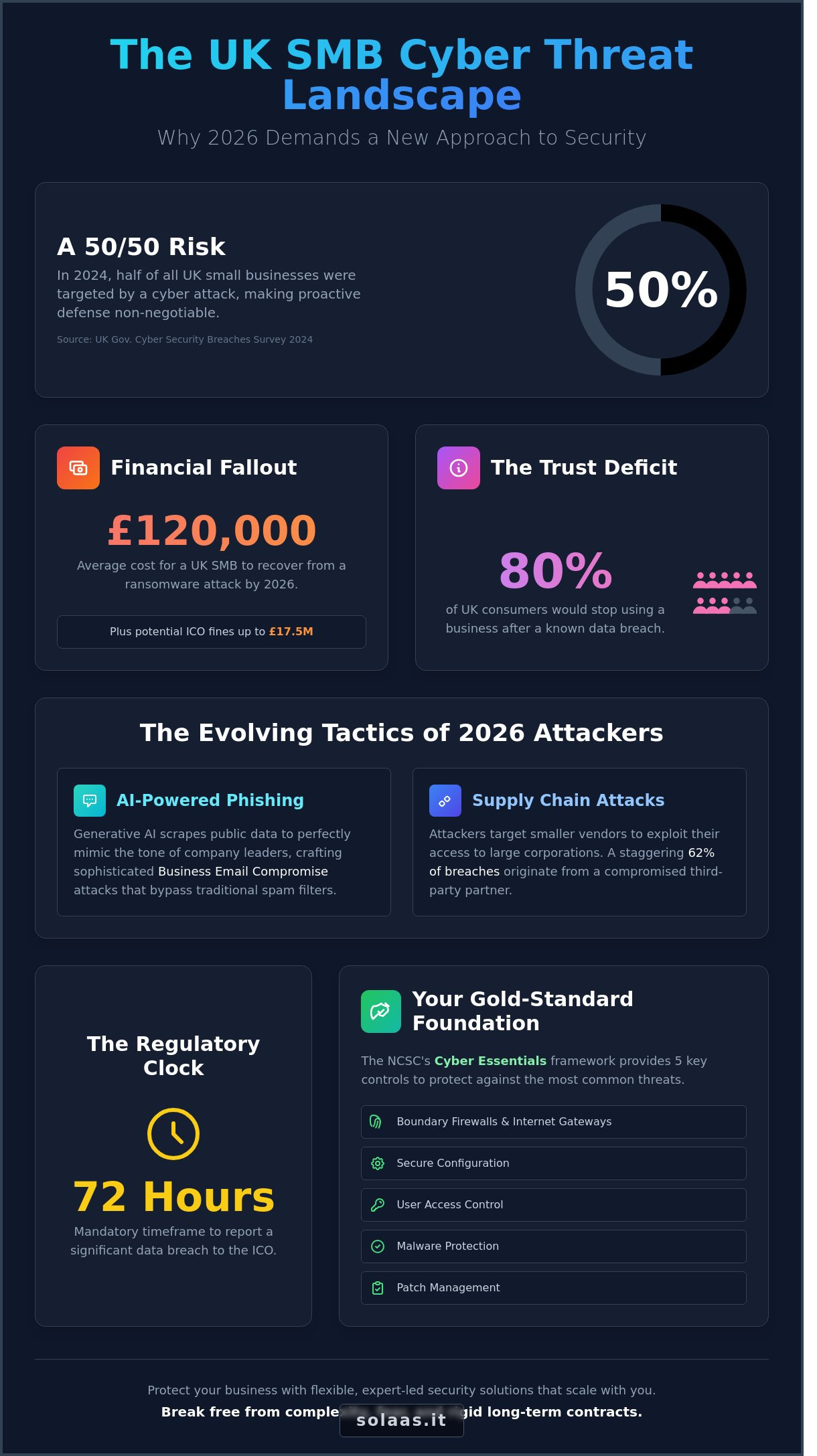
The UK business environment has changed. By 2026, the digital risks facing small and medium enterprises have evolved beyond simple viruses or generic spam. Cybersecurity for SMBs UK is no longer a luxury; it’s a foundation for survival. Statistics from the Department for Science, Innovation and Technology (DSIT) indicate that 50% of UK businesses experienced a cyber attack in 2024, a figure that has climbed steadily as we enter 2026. Attackers have moved away from “spray and pray” tactics. They now use surgical precision to exploit the specific vulnerabilities of smaller firms.
This is especially true for the new wave of online entrepreneurs, many of whom are building businesses from the ground up with digital products. Resources like Living the Hustle showcase the immense opportunity in this space, making it all the more crucial to protect these new ventures from day one.
The Rise of AI-Powered Phishing
Generative AI has weaponised communication. In 2026, hackers use Large Language Models (LLMs) to scrape LinkedIn profiles and public filings, allowing them to mimic the exact tone and syntax of a UK Managing Director. These messages bypass traditional filters because they contain no malicious links or obvious linguistic errors. Business Email Compromise occurs when a criminal impersonates a trusted contact to trick a UK firm into redirecting a legitimate invoice payment to a fraudulent bank account. This isn’t just a tech issue; it’s a sophisticated psychological trap that exploits your team’s desire to be helpful.
Supply Chain Vulnerabilities
Your size doesn’t protect you. In fact, it makes you a target. Large corporations have hardened their perimeters, so attackers look for the weakest link in the chain. If you provide services to a FTSE 100 firm, you’re a valuable entry point. A 2025 report indicated that 62% of breaches originated through a third-party vendor. Demonstrating your commitment through the Cyber Essentials scheme is now a prerequisite for most government and high-value private sector tenders. The myth that “we’re too small to be noticed” died in 2023 when automated bots began scanning every IP address in the UK for vulnerabilities. You’re not just protecting your data; you’re protecting your right to win contracts.
This is particularly critical in the fintech sector, where businesses often rely on third-party APIs to handle sensitive financial data. Choosing a provider with a strong security posture, such as the banking aggregation API from Wealthreader, becomes a fundamental part of a company’s own cybersecurity strategy.
The same principle applies to industrial sectors, where the integrity of manufacturing and construction data is paramount. For example, managing welding documentation digitally requires robust systems to ensure project specifications and safety records are secure. To see how specialized software is addressing this, you can read more.
A breach costs more than just a fine from the Information Commissioner’s Office (ICO). While penalties can reach £17.5 million or 4% of global turnover, the average cost for a UK SMB to recover from a ransomware attack in 2026 is £120,000. This figure includes lost productivity, forensic fees, and the devastating loss of client trust. Once a client feels their data is unsafe with you, they’ll move to a competitor who prioritises cybersecurity for SMBs UK. We’re your trusted partner in managing these risks, helping you break free from the fear of non-compliance and reputational damage.
Beyond the technical recovery, managing the public perception of the breach is crucial. In these situations, professional executive reputation management services become vital for restoring trust with clients and stakeholders, protecting the personal reputation of company leaders as well as the brand itself.
Under the 2026 regulatory framework, SMBs face stricter reporting timelines. You must notify the ICO of a significant breach within 72 hours, or risk severe public censure and increased financial penalties. This modern era of IT demands a proactive approach. By choosing flexible, month-by-month security solutions, you put the reins of your business safety firmly back in your hands. We provide the expertise to ensure your data protection responsibilities are met without the constraints of long-term, rigid contracts.
- AI Mimicry: Attackers use voice and text synthesis to impersonate UK directors.
- Regulatory Pressure: The 2026 Data Protection and Digital Information Bill mandates stricter oversight for SMBs.
- Financial Impact: Recovery costs often exceed the direct cost of any ransom paid.
- Trust Deficit: 80% of UK consumers state they would stop using a business following a known data breach.
Welcome to a new era of IT where security is synonymous with growth. As your modern partner, we focus on delivering comprehensive protection that exceeds your expectations, allowing you to focus on what you do best: running your business.
The Cyber Essentials Framework: Your Foundation for Success
Cyber Essentials is the UK gold standard for digital protection. This NCSC-backed scheme provides a clear roadmap for cybersecurity for smbs uk, focusing on five technical controls that prevent the vast majority of commodity attacks. By achieving this certification, your business demonstrates a commitment to security that resonates with 74% of consumers who prioritise data safety when choosing a provider. It’s a signal to the market that you’re a competent, modern partner capable of handling sensitive information responsibly.
The framework covers five core areas that every business should implement immediately:
- Boundary firewalls and internet gateways: Establishing a digital fence to protect your internal network.
- Secure configuration: Ensuring systems are set up specifically for your needs, removing unnecessary functions.
- User access control: Limiting access to data and services to only those who strictly need it.
- Malware protection: Deploying robust software to defend against viruses and ransomware.
- Patch management: Keeping all software and apps updated to close security loopholes.
Certification offers tangible commercial advantages. Many UK government contracts now require Cyber Essentials as a prerequisite for bidding. Beyond tendering, insurers often reduce premiums for certified firms. For instance, some providers offer a 15% discount on cyber liability cover once you prove these controls are active. While the standard Cyber Essentials is a verified self-assessment, Cyber Essentials Plus requires a hands-on technical audit by an external assessor. This higher tier provides an unparalleled level of assurance for your partners and clients. You can find detailed implementation steps in the NCSC’s Small Business Guide, which serves as an excellent starting point for any growing firm.
Boundary Firewalls and Internet Gateways
Your firewall acts as the first line of defence, creating a secure perimeter around your office network. Many UK startups rely on the default settings of their ISP-provided routers, which is a significant security hole. These devices often ship with “admin” as the default password and open ports that invite intrusion. Organising your network traffic requires closing unnecessary ports and ensuring every gateway into your business is strictly monitored. This simple step blocks unauthorised access before it ever reaches your sensitive data. It puts the reins of your connectivity firmly back in your hands.
Secure Configuration and Patch Management
Clicking “remind me tomorrow” on a software update is a gamble with your company’s future. The NCSC reports that 14 days is the critical window; if you haven’t patched a known vulnerability within a fortnight, you’re a prime target for automated attacks. A regular schedule for device and application patching ensures that your software remains resilient against the latest exploits. Our team at SolaaS LTD manages these updates seamlessly behind the scenes, so your staff stay productive while your systems stay locked down. We take the weight of IT maintenance off your shoulders, allowing you to focus on growth without the constant worry of manual updates. This proactive approach ensures your cybersecurity for smbs uk strategy remains robust and adaptable to new threats.
Human Behaviour: Turning Your Team into a Human Firewall
Technology alone won’t protect your business if your team isn’t aligned with your security goals. Data from the Information Commissioner’s Office (ICO) reveals that over 90% of UK data breaches are triggered by human error rather than technical flaws. This statistic highlights a critical vulnerability in cybersecurity for smbs uk; your staff are often the primary target for criminals looking for a way into your network. Instead of viewing employees as a weakness, you should empower them to become your strongest line of defence. This transformation requires a shift in how your business approaches mistakes and daily digital habits.
Moving away from a blame culture is the first step toward a resilient organisation. If an employee feels they’ll be sacked for clicking a suspicious link, they’ll likely hide the mistake, giving an attacker more time to move through your systems unnoticed. A proactive, security-first mindset encourages transparency. When your team feels confident reporting potential issues immediately, your response time drops from days to minutes. For those starting their journey, the NCSC Small Business Guide provides an excellent framework for establishing these initial human-centric defences and building a culture of shared responsibility.
Traditional annual security briefings are largely ineffective because the threat landscape moves too fast. A “tick-box” exercise once a year doesn’t change long-term behaviour. You’ll find much better results by implementing regular, bite-sized training sessions that take five or ten minutes each month. These micro-learning moments keep threats top-of-mind without disrupting productivity. By focusing on real-world scenarios that affect cybersecurity for smbs uk, such as invoice fraud or social engineering, you turn abstract risks into practical knowledge that staff can apply every time they open their inbox.
Security often feels like a hurdle to efficiency, leading staff to find “workarounds” that put your data at risk. Using personal WhatsApp groups for business or storing passwords in unprotected spreadsheets are common examples of convenience winning over safety. Your role as a leader is to provide tools that make the secure way the easiest way. When security is baked into the daily workflow through seamless logins and clear protocols, the temptation to bypass controls disappears. This balance ensures your business stays agile while remaining protected against evolving digital threats.
Password Management and MFA
The era of the “complex” password filled with symbols and numbers is over. Modern standards for 2026 favour passphrases; three random, unrelated words that are easy for humans to remember but nearly impossible for machines to crack. Pair this with Multi-Factor Authentication (MFA) to create a formidable barrier. MFA is the single most effective tool available, stopping the vast majority of identity-based attacks. We recommend using a dedicated password manager to securely organise team credentials, ensuring no one ever has to reuse a password across different services.
Identifying Phishing in the Wild
Modern phishing attempts have evolved far beyond poorly written emails from distant princes. Today’s attackers use sophisticated branding and “tells” like slightly altered domain names or unusual requests for urgent payments. Attackers craft messages that exploit high-pressure emotional triggers like fear, urgency, or curiosity to bypass a person’s logical thinking and provoke an immediate, unthinking reaction. Implement a “Report, Don’t Delete” policy. Internal reporting allows your IT team to block the threat for everyone else, turning one person’s vigilance into a company-wide shield.
Securing the Hybrid UK Workforce
Hybrid working is the operational reality for 44% of the UK workforce as of May 2023. This flexibility allows your team to work from a garden office in Surrey or a train to Edinburgh, but it creates a sprawling attack surface. Effective cybersecurity for smbs uk requires moving beyond the traditional office firewall. When staff connect from coffee shops or home routers, they bypass the robust protections of your primary site. This makes every remote device a potential gateway for intruders.
Public Wi-Fi remains a significant threat. Cybercriminals often set up “evil twin” hotspots in high-traffic areas like London St Pancras to intercept unencrypted data. If your staff use these connections without protection, your sensitive business credentials are at risk. Similarly, the rise of Starlink for rural UK businesses in Cornwall or the Scottish Highlands introduces new hardware into your ecosystem. These satellite connections are excellent for productivity, yet they require enterprise-grade encryption and bespoke configuration to ensure they don’t become a weak link in your chain.
Your communication platforms are equally vulnerable. Modern contact centres and cloud telephony systems are targets for eavesdropping if not properly configured. Hackers can intercept VoIP traffic to gather intelligence or commit toll fraud. We ensure your voice data is encrypted using Secure Real-time Transport Protocol (SRTP), keeping your private conversations private. It’s about putting the reins of your communication services firmly back in your hands, ensuring every call is as secure as an in-person meeting.
Mobile Device Management (MDM) is no longer a luxury for the enterprise; it’s a fundamental requirement for the modern SMB. With 67% of employees using personal devices for work, the line between personal and professional data has blurred. MDM allows you to enforce security policies, push updates, and maintain visibility across your entire fleet of laptops, tablets, and smartphones. It provides the confidence you need to empower your team, regardless of where they choose to work.
Remote Connectivity and VPNs
A Virtual Private Network (VPN) creates a secure, encrypted tunnel for your data, making it unreadable to anyone on the outside. This is vital for staff using Starlink or public hotspots. However, a VPN only works if staff use it. Shadow IT remains a persistent threat, with 80% of workers admitting to using unapproved SaaS apps for work tasks. We help you identify these gaps and provide official, secure alternatives that don’t hinder productivity.
Mobile Device Security
If a company phone is left in a taxi, the risk isn’t just the hardware cost of £800; it’s the access to your corporate network. We implement remote wipe capabilities that allow you to erase sensitive data within seconds of a reported loss. By using containerisation, we separate business emails and files from personal photos on employee-owned devices. This protects your intellectual property without infringing on your staff’s privacy, creating a seamless and secure user experience.
Ready to empower your team with a secure, flexible infrastructure that grows with your business?
SolaaS: Managed Security Without the Constraints
Hiring a full-time cybersecurity specialist in the UK isn’t just difficult; it’s a significant financial burden for a growing business. According to 2024 data from Glassdoor, the average base salary for a Cybersecurity Analyst in London exceeds £52,000. When you factor in National Insurance, pension contributions, and ongoing training, that cost easily climbs above £65,000 per year. SolaaS provides a modern alternative. We deliver expert-level cybersecurity for smbs uk at a fraction of the cost of a single in-house hire, giving you access to a full team of specialists rather than one person’s limited perspective.
The SolaaS difference lies in our refusal to follow the industry standard of 36-month lock-in contracts. We believe your IT provider should earn your trust every month. Our month-by-month flexibility means you’re never stuck with services you no longer need or technology that has become obsolete. This approach puts the reins of your business infrastructure firmly back in your hands. It’s about freedom, control, and ensuring your budget is always working as hard as possible for your bottom line. Welcome to a new era of IT where your success is our only metric for retention.
Flexible Protection That Scales
Our month-by-month options are designed for the reality of the UK market. Small businesses make up 99% of the UK private sector, and these organisations need the ability to pivot quickly. If your business scales from 5 to 50 employees over a single quarter, your security needs to move at the same pace. SolaaS allows you to scale your protection up or down instantly. This agility ensures you aren’t paying for 50 licences when you only have 10, yet you’re never left vulnerable when a growth spurt occurs. Flexibility is the foundation of modern business resilience; it allows you to stay lean while remaining completely secure against evolving threats.
A Holistic View of Security
We don’t view your business in silos. A truly secure organisation connects the dots between its digital assets and its physical presence. Effective cybersecurity for smbs uk must now account for every entry point. We integrate your cloud phone systems directly with your data firewalls to stop social engineering attacks before they reach your team. This joined-up thinking extends to your physical premises too.
With the Office for National Statistics reporting a 37% surge in shoplifting across England and Wales in 2024, physical security is more critical than ever. We provide AI-powered retail theft prevention that uses intelligent analytics to protect your stock and your staff. By linking these AI insights with your wider digital network, we create a comprehensive shield for your business. This holistic approach is why SolaaS is the partner of choice for companies looking toward 2026 and beyond. We provide solutions that meet your needs and services that exceed your expectations.
Your business deserves protection that is as ambitious as your growth plans. Don’t let rigid contracts or expensive overheads hold you back from securing your digital future. Book a demo with SolaaS today and discover how our tailored, flexible security solutions can empower your business to thrive in a digital-first world.
Secure Your Business for the 2026 Landscape
The UK threat landscape is evolving rapidly. By 2026, simple antivirus software won’t be enough to protect your company’s turnover. You need a strategy built on NCSC-aligned frameworks like Cyber Essentials to stop 80% of common cyber attacks before they reach your network. Your team is your first line of defence. Turning them into a resilient human firewall is essential for securing a hybrid workforce that operates across various home networks and personal devices.
Managing these risks doesn’t have to be a burden on your internal resources or your budget. SolaaS provides the flexibility your business needs to grow without being tied down. We offer expert UK-based support and comprehensive protection with absolutely no long-term contracts. It’s time to take the reins of your digital safety and ensure your cybersecurity for smbs uk strategy is robust enough for the years ahead.
Ready to move into a new era of IT? Book your free 2026 Cybersecurity Audit with SolaaS today. Let’s build your future success together.
Frequently Asked Questions
Is cybersecurity for small businesses really necessary in the UK?
Yes, it’s vital for survival. The 2024 Cyber Security Breaches Survey found that 50% of UK businesses faced an attack last year. Small firms are often seen as easier targets with fewer defences. Implementing robust cybersecurity for smbs uk protects your reputation and prevents the average £1,200 cost of a single breach for small organisations.
What is the most common cyber attack on UK SMBs in 2026?
AI-powered phishing is the most prevalent threat in 2026, making up 84% of successful breaches. These attacks use generative AI to create perfect, error-free emails that bypass traditional filters. You can’t rely on spotting spelling mistakes anymore. We provide advanced threat detection that identifies these sophisticated attempts before they reach your inbox.
How much does a basic cybersecurity setup cost for a small business?
You can expect to pay between £500 and £2,500 for a foundational security overhaul, followed by monthly costs of roughly £30 per user. These figures vary based on your specific hardware and cloud requirements. SolaaS offers these essential services on flexible, month-by-month terms. This ensures you get high-level protection without being trapped in expensive, multi-year commitments.
Do I need Cyber Essentials certification to win government contracts?
You definitely need Cyber Essentials to bid for government contracts involving sensitive data or personal information. This has been a mandatory requirement for all central government suppliers since 2014. It demonstrates that your business has the five basic technical controls in place. These controls are proven to stop roughly 80% of the most common internet-borne cyber attacks.
Can SolaaS help with UK GDPR compliance?
SolaaS helps you meet UK GDPR obligations by deploying the technical safeguards required under the Data Protection Act 2018. We set up encrypted storage and multi-factor authentication to keep your data secure. This proactive stance helps you avoid the ICO’s heavy penalties, which can reach £17.5 million or 4% of your annual turnover for serious failures.
What should I do immediately if I think my business has been breached?
Isolate any compromised devices from your network immediately to stop the infection from spreading further. You must then change your passwords and contact your security partner to investigate the source. If the breach involves personal data, you’re legally required to notify the ICO within 72 hours. Fast action is the only way to minimise damage and maintain client trust.
How does SolaaS differ from traditional IT support providers?
SolaaS differs by offering total flexibility and freedom from the long-term contracts that traditional providers demand. We believe in being your trusted partner, providing scalable solutions that meet your needs exactly. Our team focuses on your business success rather than just technical tickets. We put the reins of your IT services firmly back in your hands with month-by-month options.
Does SolaaS offer cybersecurity for remote workers using Starlink?
We offer tailored security solutions for remote workers using Starlink or any other high-speed satellite connection. Our team implements hardware-based firewalls and secure VPN tunnels to protect your data across every link. This means your team can work from anywhere in the UK while staying fully integrated into your secure business environment. It’s a modern solution for a flexible workforce.

Article by
René Wheeler
René Wheeler is Managing Director of SolaaS, bringing over three decades of experience in IT and telecoms. He is a strong advocate for transparency and flexibility, championing monthly contract models that allow businesses to stay agile and in control of their technology. His approach challenges traditional industry practices and puts client outcomes first