
Ransomware Attacks: A Small Business Survival Guide
The screen freezes. A menacing pop-up appears demanding payment, and your heart sinks. Suddenly, every client file, invoice, and critical piece of your business data is held hostage. This is the stark reality of a modern ransomware attack, a threat that can cost UK small businesses thousands of pounds in downtime and cause irreparable damage to their hard-earned reputation. In those first few minutes, the feeling of helplessness can be overwhelming.
But panic is not a strategy, and you are not powerless. This survival guide is designed to be your trusted partner in a crisis, putting control firmly back in your hands. We will provide a clear, step-by-step checklist of what to do the moment you suspect an attack, a practical roadmap for recovering your data, and the essential, affordable solutions to prevent it from ever happening again. It’s time to build your business’s cyber resilience.
Key Takeaways
- When under attack, your immediate actions are critical. Follow a clear, step-by-step plan to contain the threat and minimise operational damage.
- A solid recovery strategy is your key to restoring data and resuming business operations—often without paying the cybercriminals’ ransom.
- Proactive prevention is your strongest defence. Discover the essential security layers that make your business a difficult target for a ransomware attack.
- Partnering with a managed IT expert provides your business with a dedicated security team, ensuring comprehensive protection against evolving threats.
What is a Ransomware Attack and Why is it a Threat to Your Business?
Imagine arriving at your office one morning to find every critical file—client data, financial records, and operational documents—locked and inaccessible. This is the reality of a ransomware attack: a digital kidnapping of your business’s most valuable asset, its data. Cybercriminals use malicious software to encrypt your files, holding them hostage and grinding your operations to a halt.
The attacker’s goal is straightforward but devastating. By scrambling your data, they make it completely unusable. Their sole objective is to demand a payment, or ransom, typically in cryptocurrency, in exchange for the decryption key that will supposedly unlock your files. A successful ransomware attack can jeopardise the very survival of a small business, leading to catastrophic downtime, severe financial loss, and long-term damage to your hard-earned reputation.
How Ransomware Gets In: The Common Culprits
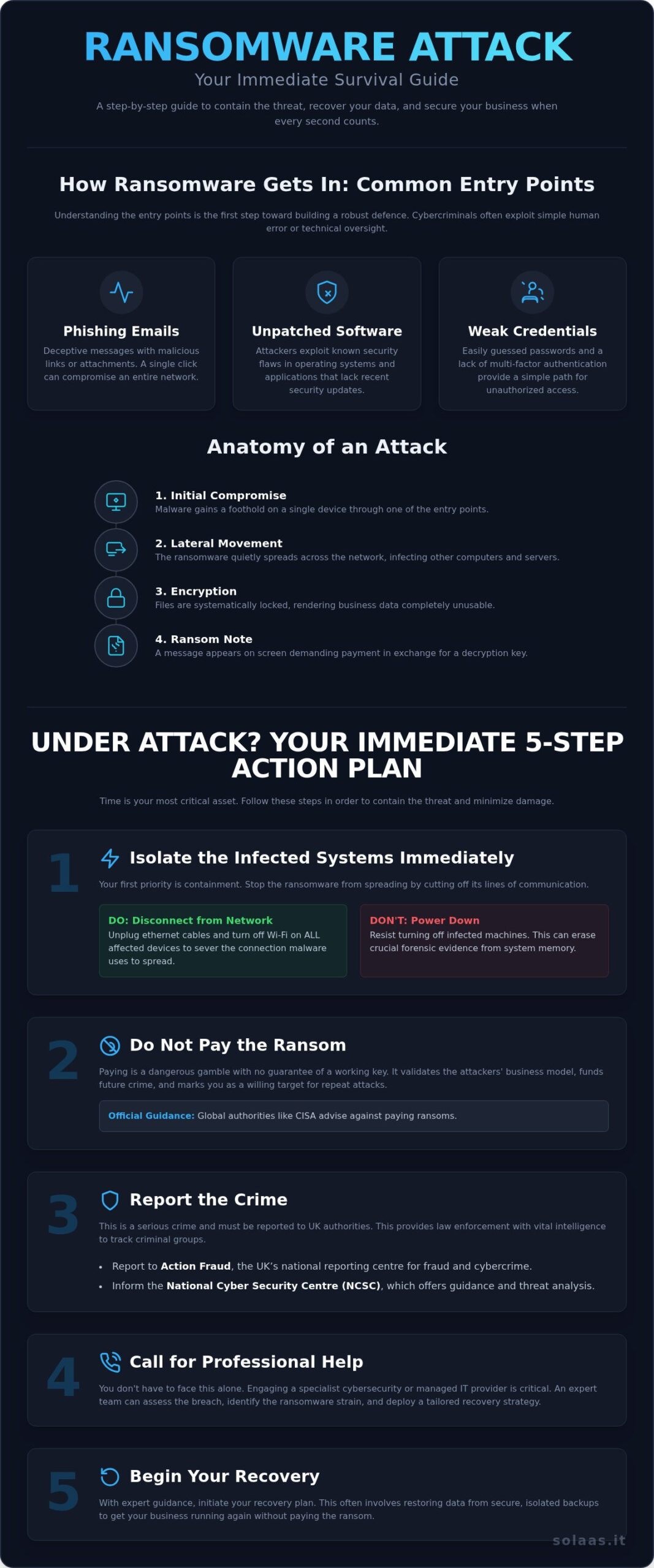
Understanding the entry points is the first step toward building a robust defence. The doors cybercriminals use are often unlocked by simple human error or technical oversight:
- Phishing Emails: Deceptive messages disguised as legitimate communications from banks, suppliers, or even colleagues. A single click on a malicious link or attachment by an unsuspecting employee can be enough to compromise your entire network.
- Unpatched Software: Cybercriminals actively seek out and exploit known security vulnerabilities in operating systems and applications. Failing to apply regular security updates leaves your systems exposed and is an open invitation for an attack.
- Weak Credentials: Easily guessable passwords, reused credentials across multiple services, and a lack of multi-factor authentication (MFA) provide a simple path for attackers to gain unauthorised access.
The Anatomy of an Attack: From Infection to Ransom Note
A ransomware attack unfolds in distinct, calculated stages. It begins with the initial compromise, where the malware gains a foothold on a single device. From there, it performs lateral movement, quietly spreading across your network to infect other computers and servers to maximise its impact. Once it has established a wide reach, the encryption phase begins, systematically locking files and rendering them useless. The final, chilling step is the appearance of the ransom note—a message on your screen detailing the attacker’s demands, the payment amount, and a deadline to create a sense of urgency and pressure.
Under Attack? Your Immediate 5-Step Action Plan
If you suspect a ransomware attack, time is your most critical asset. This emergency checklist is designed to help you contain the threat and minimise damage. Follow these steps in order before you do anything else—uninformed decisions can make a bad situation worse. Your measured response sets the stage for a successful recovery.
Step 1: Isolate the Infected Systems Immediately
Your first priority is containment. Stop the ransomware from spreading across your entire network by cutting off its lines of communication.
- Disconnect from the network: Unplug ethernet cables and turn off Wi-Fi on all affected devices immediately. This severs the connection the malware uses to spread.
- Do not power down: Resist turning off infected machines unless instructed by an IT professional. Doing so can erase crucial forensic evidence stored in system memory that experts need for analysis.
Step 2: Do Not Pay the Ransom
It may feel like the quickest way out, but paying the ransom is a dangerous gamble. There is no guarantee cybercriminals will provide a working decryption key. Paying only validates their business model, funds future crime, and marks your business as a willing target for repeat attacks. This advice is echoed by global authorities; the official CISA #StopRansomware Guide provides detailed reasons why paying is not a viable solution.
Step 3: Report the Crime
A ransomware attack is a serious crime and must be reported to UK authorities. This provides law enforcement with vital intelligence to track criminal groups and help protect other businesses from the same fate.
- Report to Action Fraud, the UK’s national reporting centre for fraud and cybercrime.
- Inform the National Cyber Security Centre (NCSC), which offers guidance and helps analyse threats.
Step 4: Call for Professional Help
You don’t have to face this alone. Engaging a specialist cybersecurity or managed IT provider is critical for recovery. An expert team can assess the breach, identify the ransomware strain, and deploy a tailored recovery strategy to get you back online safely. The sooner you get professional help, the better the outcome. Our experts are on standby to provide urgent support. Contact SolaaS for emergency IT support.
Step 5: Begin Your Recovery Plan
With your IT partner engaged, the structured recovery process can begin. This is a meticulous operation to ensure the threat is completely eradicated. It involves identifying the entry point, wiping affected systems, and restoring data from clean, verified backups. Attempting this without expert oversight can lead to reinfection or permanent data loss. A trusted partner ensures your systems are not just restored, but fortified.
The Road to Recovery: How to Get Your Business Running Again
A ransomware attack can feel like a knockout blow, but it doesn’t have to be the end of the story. With a solid, pre-planned strategy, recovery is not only possible—it’s achievable without paying a single penny of ransom. This phase is a meticulous process of eradicating the threat, restoring your critical data, and fortifying your defences. Executing these steps with precision is your key to getting back to business safely and preventing a costly repeat incident.
Leveraging Your Backups: The #1 Recovery Tool
Your backup strategy is the single most important factor in a successful recovery. The first step is to identify your most recent, clean backup that predates the infection. This is where offline or “air-gapped” backups prove invaluable; because they aren’t connected to your network, they remain immune to the attack. A regularly tested backup solution is the difference between days of operational paralysis and a seamless restoration that minimises financial and reputational damage.
The System Wipe and Restore Process
You cannot simply remove the malware; you must assume every infected device is compromised. The only secure path forward involves completely erasing and rebuilding affected systems from a known good state, such as a fresh operating system installation. Once your systems are clean, you can restore your data from your verified backup. As detailed in resources like the official CISA’s #StopRansomware Guide, it is crucial to scan all restored data to ensure no remnants of the malware are reintroduced into your clean environment.
Identifying and Closing the Security Gap
Once your operations are restored, the work isn’t over. A thorough post-mortem is essential to understand precisely how the attackers gained entry. Was it a phishing email, an unpatched vulnerability, or a compromised password? Answering this question allows you to implement targeted, effective changes—such as enhanced email filtering, multi-factor authentication, or a robust patch management policy. This crucial final step transforms a devastating ransomware attack from a disaster into a powerful security lesson that strengthens your business for the future.
Proactive Prevention: How to Make Your Business a Hard Target
In the world of cybersecurity, the best defence is a strong offence. While having a recovery plan is essential, the most effective way to survive a ransomware attack is to prevent it from ever succeeding. This doesn’t require a limitless budget; it requires a strategic, multi-layered approach to security. Many of the most robust defences are built on smart processes and an empowered team, making your business a far less attractive target for cybercriminals.
Build a Human Firewall: Employee Security Training
Your team is your first and most important line of defence. Technology can only do so much, which is why empowering your staff with security awareness is critical. Regular, practical training helps them confidently spot and report suspicious phishing emails—the number one entry point for ransomware. Enforce a policy of strong, unique passwords for all accounts and implement Multi-Factor Authentication (MFA) wherever possible. This creates a culture where security is everyone’s responsibility.
Implement the 3-2-1 Backup Rule
A resilient backup strategy is your ultimate safety net, ensuring you can restore operations without paying a ransom. The industry-standard 3-2-1 rule provides a simple yet powerful framework for data protection:
- 3 Copies: Keep at least three copies of your critical data.
- 2 Media Types: Store your copies on two different types of media (e.g., a local network drive and an external hard drive).
- 1 Off-site Copy: Maintain one copy securely off-site, either physically or in the cloud, isolating it from any potential local network breach.
Maintain Your Systems: Patching and Updates
Cybercriminals thrive on exploiting known vulnerabilities in outdated software. A consistent patching and update routine is one of the most cost-effective ways to slam the door on these easy entry points. Ensure all operating systems, applications, and security software are updated regularly. Where feasible, automate this process to close security holes the moment a fix is released. Diligent system maintenance denies attackers the low-hanging fruit they depend on for a successful ransomware attack.
Putting these proactive measures in place transforms your security from a reactive scramble to a confident strategy. For expert guidance on implementing a tailored security solution, explore how SolaaS can be your trusted partner.
How a Managed IT Partner Shields You From Ransomware
Defending your business against sophisticated cyber threats is a full-time job that demands constant vigilance and deep expertise. For most small businesses, dedicating the necessary resources is simply not feasible. This is where a managed IT services provider (MSP)—such as the specialists at Aspire Computing—becomes your most valuable ally, acting as your dedicated, expert security team.
Instead of reacting to problems, we implement and manage the proactive, layered defences your business needs to stay ahead of threats. With a trusted partner monitoring your systems 24/7, you gain the peace of mind to focus on what you do best: running your business.
Proactive Monitoring and Threat Detection
We deploy advanced, enterprise-grade security tools to continuously monitor your network for suspicious activity. This constant watchfulness is your first line of defence, allowing our team to detect the early warning signs of a potential ransomware attack and neutralise the threat before it can lock down your systems or cause significant damage. We deliver a tailored security solution that fits a small business budget.
Managed Backups and Disaster Recovery
A backup is only useful if it works when you need it most. We don’t just set up your backups; we actively manage, test, and verify them to ensure their integrity. In the event of an emergency, our team leads a rapid and efficient recovery process, minimising downtime and ensuring your most critical business asset—your data—is always safe, secure, and restorable.
Your Trusted Partner in Cybersecurity
As your trusted partner, we handle the complex and time-consuming realities of modern cybersecurity. This includes:
- Systematic Patch Management: We ensure all your software and systems are consistently updated to close security vulnerabilities that criminals exploit.
- Expert Guidance: Our team provides ongoing security awareness training and practical advice to empower your staff to spot and avoid phishing and other common attack vectors.
Don’t leave your business exposed to a devastating ransomware attack. It’s time to put an expert team in your corner. Let’s build your defence strategy. Discover SolaaS Managed IT Services.
Your Proactive Defence Against Ransomware
The threat of a ransomware attack is significant, but it doesn’t have to be inevitable. As this guide has shown, the most powerful strategy is moving from a reactive stance to one of proactive, intelligent defence. Understanding the threat, preparing an incident response plan, and building a resilient infrastructure are the keys to ensuring your business not only survives, but thrives.
You don’t have to build this fortress alone. At SolaaS, we act as your trusted partner, delivering tailored solutions for small and medium businesses across the UK. With our expert, UK-based support team and 24/7 proactive network monitoring, we provide the vigilance and expertise needed to shield your operations from threats before they can cause damage.
Take control of your company’s security. Secure your business with a free cybersecurity consultation and welcome a new era of IT confidence and peace of mind.
Frequently Asked Questions About Ransomware
Should my business ever pay the ransom?
Official guidance from the UK’s National Cyber Security Centre (NCSC) strongly advises against paying. There is no guarantee you will get your data back, and paying marks your business as a willing target for future attacks. Instead of funding criminal enterprises, your resources are better invested in a robust recovery plan. A trusted IT partner can help you focus on restoring operations from clean backups, which is the only reliable solution to a ransomware incident.
How can I tell if a ransomware attack is happening?
The signs of an active ransomware attack are usually sudden and disruptive. You may find you are unable to open files, which now have strange, unrecognisable file extensions. A ransom note will often appear on screen, demanding payment in cryptocurrency for a decryption key. You might also notice your systems running extremely slowly as the malware works to encrypt your data in the background. Immediate action is critical if you spot these indicators.
Can antivirus software alone stop ransomware?
While essential, traditional antivirus software is not a complete solution. It serves as a crucial first line of defence, but sophisticated ransomware variants are often designed to evade it. A comprehensive, layered security strategy is required for effective protection. This includes advanced endpoint protection, regular employee training on phishing, secure data backups, and proactive network monitoring. Relying on a single tool leaves your business vulnerable to modern threats.
Are cloud services like Microsoft 365 or Google Drive safe from ransomware?
Cloud services are targets. While providers like Microsoft and Google have excellent infrastructure security, your data can still be compromised. If a local, synced device is infected, ransomware can encrypt files that are then synced to the cloud, overwriting clean versions. A compromised user account can also give an attacker direct access. Therefore, a separate, dedicated cloud-to-cloud backup solution is a vital component of a modern data protection strategy.
How long does it typically take to recover from a ransomware attack?
Recovery time varies significantly and is rarely quick, often taking days or even weeks. The duration depends on the scope of the damage, the quality and accessibility of your backups, and the efficiency of your incident response plan. Every hour of downtime impacts revenue and reputation, with costs potentially running into thousands of pounds. A well-rehearsed recovery plan is the key to minimising this disruption and restoring business operations as swiftly as possible.
We are a very small business. Are we really a target for ransomware?
Yes, absolutely. The belief that small businesses are “too small to target” is a dangerous myth. Cybercriminals often use automated tools to scan for vulnerabilities, making businesses of all sizes potential victims. In fact, they frequently target SMEs, assuming they have fewer security resources. Protecting your data and your clients’ information is essential, regardless of your company’s size. A scalable, tailored security solution ensures you have the right level of protection.

Article by
René Wheeler
René Wheeler is Managing Director of SolaaS, bringing over three decades of experience in IT and telecoms. He is a strong advocate for transparency and flexibility, championing monthly contract models that allow businesses to stay agile and in control of their technology. His approach challenges traditional industry practices and puts client outcomes first