
Outsourced IT Support: Is It Right For Your Business?
Is your IT to-do list growing faster than your team can handle? For many UK businesses, the cycle of firefighting system glitches, worrying about ever-present cyber threats, and facing the high cost of hiring specialist talent can feel overwhelming. These distractions pull focus from your core business goals, hindering growth and efficiency. This is where the strategic question of in-house versus outsourced IT support comes into sharp focus-a critical decision that can define your company’s agility, security, and future success.
Making the right choice requires more than a simple cost comparison; it’s about finding a scalable solution that puts the reins of your technology firmly back in your hands. In this comprehensive guide, we break down the pros and cons of both models. We’ll provide a clear, balanced comparison to help you confidently decide which approach will best control your spending, improve your operational efficiency, and drive your business forward with a modern, tailored IT strategy.
Key Takeaways
- Understand the critical business factors, such as company size and compliance needs, that make an in-house IT team the superior choice.
- Discover how strategic outsourced IT support can enhance your cybersecurity, provide access to specialist expertise, and drive business efficiency.
- Use our actionable framework to assess your unique operational needs and confidently decide if outsourcing is the right path for your company’s growth.
- Learn to identify the qualities of a true technology partner, not just a provider, to ensure your IT investment delivers long-term strategic value.
What Exactly Is Outsourced IT Support?
At its core, outsourced IT support involves partnering with a third-party team of experts to manage your entire technology infrastructure. It represents a fundamental shift from the outdated, reactive ‘break-fix’ model, where you only call for help when a crisis strikes. Instead of waiting for problems, this modern approach-typically delivered by a Managed Service Provider (MSP)-focuses on proactive management to keep your business running seamlessly. The broader business practice of outsourcing allows companies to leverage specialised skills, and in the world of IT, it translates into a strategic partnership designed to drive efficiency, security, and growth.
The Spectrum of Outsourcing: Fully-Managed vs. Co-Managed IT
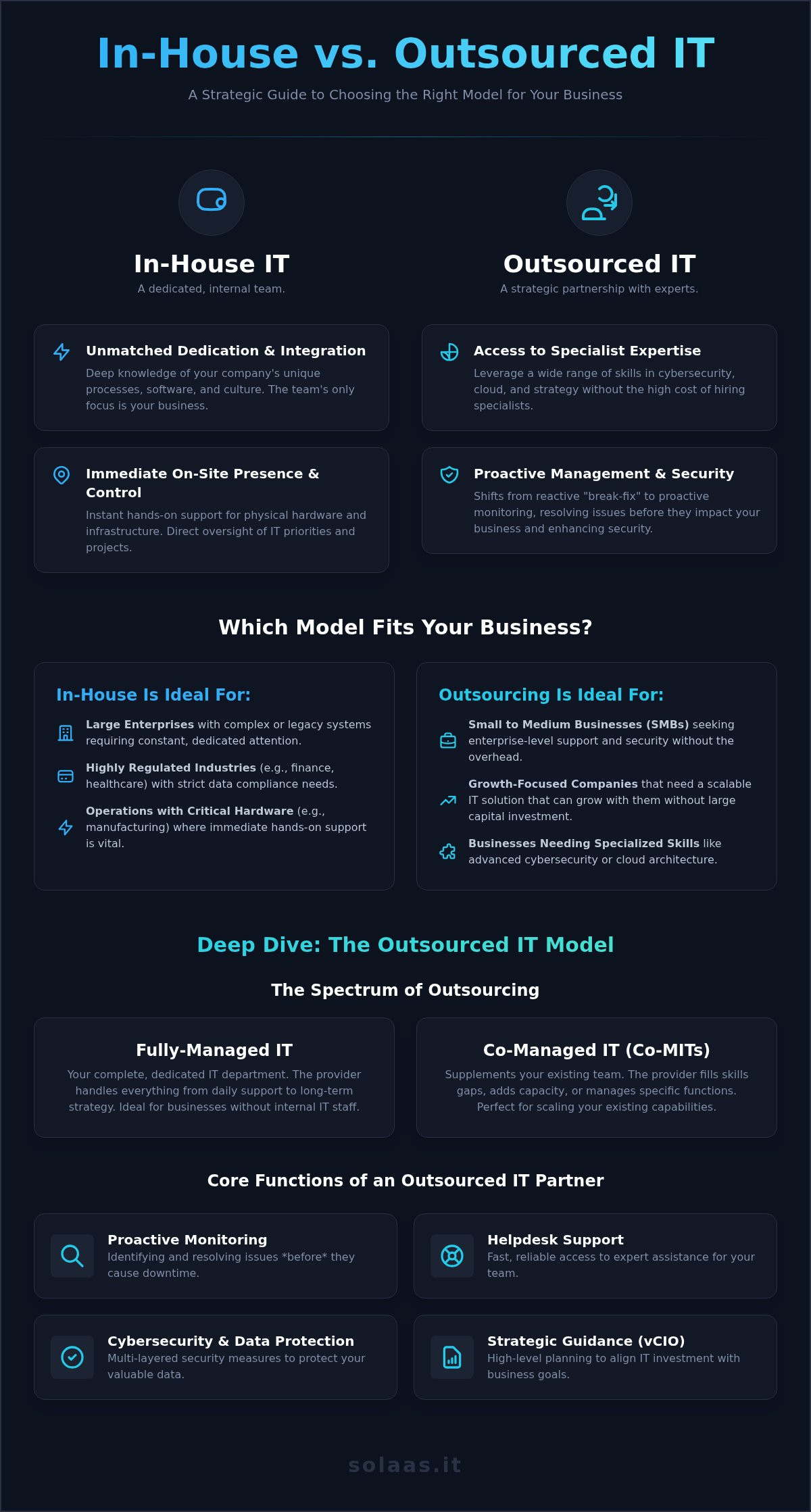
Your partnership can be tailored to your exact needs, falling somewhere on a spectrum. Fully-Managed IT is like hiring a complete, dedicated IT department; your provider handles everything from daily support to long-term strategy. In contrast, Co-Managed IT (Co-MITs) supplements your existing in-house team, filling skills gaps or adding capacity. A fully-managed model is ideal for businesses without internal IT staff, while co-managed is perfect for companies looking to scale their existing capabilities. Think of it like this: a fully-managed partner is your project’s general contractor, while a co-managed partner is the specialist plumber you bring in for their specific expertise.
Core Functions of an Outsourced IT Partner
A true IT partner delivers far more than troubleshooting. This isn’t a simple helpline; it’s a comprehensive technology engine designed to empower your business. A proactive provider will manage these core functions:
- Proactive Monitoring & Maintenance: Identifying and resolving potential issues before they can disrupt your operations, ensuring maximum uptime and productivity.
- Helpdesk Support: Providing your team with fast, reliable access to expert assistance for any day-to-day technical challenges, keeping them focused on their roles.
- Cybersecurity & Data Protection: Implementing and managing robust, multi-layered security measures to protect your valuable data from evolving threats in the UK and beyond.
- Strategic Guidance (vCIO): Offering high-level technology planning and consultancy to ensure your IT investment aligns perfectly with your business goals for a competitive edge.
The Case for In-House IT: When to Keep it Internal
To make an informed decision about your technology strategy, it’s essential to understand both sides of the coin. While outsourced IT support delivers unparalleled flexibility and access to a broad range of expertise, it isn’t the universal solution for every organisation. For some businesses, particularly those with highly specific operational demands, maintaining an in-house IT team is the most effective and strategic choice.
The decision to keep IT internal is not about resisting change; it’s about aligning your support model with your core business objectives. Let’s explore the powerful advantages that a dedicated, internal team can provide.
Unmatched Dedication and Business Integration
An in-house IT team has only one client: your business. This singular focus allows them to develop a deep, institutional knowledge of your unique processes, proprietary software, and company culture. They don’t just fix problems; they understand the context behind them, leading to more tailored and proactive solutions. This complete alignment ensures your IT function evolves in lockstep with your business goals.
Immediate On-Site Presence and Control
For businesses with significant physical infrastructure, nothing beats having an expert on-site. An internal team provides an immediate physical presence for hands-on tasks like server maintenance, network cabling, or urgent hardware replacements. This model also offers direct management oversight, giving you complete control over IT priorities, projects, and personnel, ensuring tasks are executed exactly to your specifications.
An internal team often excels in specific scenarios where control and deep integration are paramount. This model is typically the right fit for:
- Large Enterprises: Companies with complex, legacy, or bespoke systems that require constant, dedicated management and specialised internal knowledge.
- Highly Regulated Industries: Organisations in sectors like finance or healthcare where strict data sovereignty and compliance regulations in the UK may necessitate a fully controlled, on-site team.
- Operations with Critical Hardware: Businesses such as manufacturing plants or logistics centres where immediate, hands-on hardware support is crucial to prevent costly downtime.
For these organisations, the benefits of a deeply integrated team can be the deciding factor, making it a more suitable choice than even the most comprehensive outsourced IT support package.
The Strategic Advantages of Outsourcing Your IT
Moving beyond the traditional break-fix model, modern businesses view IT not as a cost centre, but as a strategic driver for growth and efficiency. Choosing outsourced IT support is a deliberate decision to gain a competitive edge. It’s about reallocating your internal resources to core business activities while placing your technology in the hands of a dedicated, expert partner focused on delivering tangible outcomes.
Access a Breadth of Specialist Expertise
A small in-house team, no matter how talented, cannot master every facet of today’s complex technology landscape. Outsourcing instantly embeds a full team of specialists into your business. Instead of relying on a single generalist, you gain immediate access to a collective of experts in crucial, distinct areas:
- Cybersecurity Specialists: To defend your data and infrastructure against ever-evolving digital threats.
- Cloud Architects: To design and optimise your cloud environment for maximum performance and cost-effectiveness.
- Network Engineers: To ensure your team enjoys seamless, secure, and reliable connectivity.
- VoIP and Communications Experts: To modernise and streamline how your business communicates.
This model eliminates the need for constant and costly training, ensuring your business is always leveraging the most effective solutions.
Significant Cost Savings and Predictable Budgeting
When you calculate the true cost of an in-house IT employee-including salary, National Insurance, pension contributions, benefits, and recruitment fees-the financial case for outsourcing becomes compelling. A Managed Service Provider (MSP) replaces these variable costs with a single, predictable monthly fee, transforming your IT from a volatile capital expense (CapEx) into a stable operational expense (OpEx) that you can budget for with confidence.
Enhanced Scalability and Proactive Support
Your business is dynamic, and your IT support must be agile enough to keep pace. Outsourced IT support provides unparalleled flexibility, allowing you to scale services up or down seamlessly as your team grows or your operational needs change. Most importantly, it shifts your IT management from a reactive ‘firefighting’ model to a proactive, strategic one. With 24/7/365 monitoring, potential issues are identified and resolved before they cause costly downtime, ensuring your team remains productive and your operations run smoothly.
Decision Framework: Is Outsourcing Right for YOUR Business?
The theory is clear, but how does it apply to your unique business? This practical framework is designed to help you move from abstract concepts to a concrete decision. By honestly assessing your current situation, you can determine if an outsourced IT support model is the right strategic move to unlock efficiency and growth.
What is your true total cost of IT?
Before comparing quotes, you need a clear picture of your current investment, which extends far beyond a salary. Consider the full financial picture, including:
- Direct Costs: Salaries, National Insurance contributions, pensions, recruitment fees, and ongoing training.
- Technology Costs: Investment in software licences, hardware procurement, and infrastructure maintenance.
- Opportunity Costs: The true cost in lost productivity and revenue when systems go down or staff are diverted to fix IT issues.
Calculate this total and compare it to a fixed, predictable monthly fee. You may find a tailored plan offers significant savings and budget clarity.
How complex are your technology needs?
Modern business technology is a complex web of cloud platforms, remote access tools, and specialised applications. Are you navigating strict compliance requirements like UK GDPR? An honest assessment of your in-house team’s capacity to manage this complexity is crucial. If they are stretched thin or lack specialist knowledge, critical systems can be left vulnerable or under-optimised.
Does your IT support your business growth?
Is your technology an enabler or a bottleneck? A reactive, “fire-fighting” IT department can hold your business back. A strategic partner provides a forward-looking technology roadmap. Many providers offer a virtual Chief Information Officer (vCIO) service, giving you board-level insight to ensure your IT infrastructure scales seamlessly with your ambitions, turning it into a genuine asset for growth.
How robust is your cybersecurity posture?
The threat landscape is relentless. Can your current setup effectively defend against sophisticated threats like ransomware and phishing attacks? A specialist partner brings enterprise-grade security tools and expertise, implementing robust data backup, disaster recovery plans, and proactive monitoring that are often financially out of reach for a single business.
Answering these questions provides a data-driven foundation for your decision. If you’ve identified gaps in cost-efficiency, expertise, or security, it may be time to explore how a flexible, expert partner can transform your technology. Discover tailored solutions at solaas.it.
Choosing a Partner, Not Just a Provider
You’ve explored the benefits and determined that outsourcing is a viable path for your business. The critical next step is shifting your focus from if you should outsource to how you choose the right partner. The most effective outsourced IT support isn’t a faceless service; it’s a strategic relationship built on trust, shared goals, and a deep understanding of your operational needs.
Look for Flexibility Over Rigid Contracts
The era of being locked into long, inflexible IT contracts is over. Many traditional providers rely on restrictive multi-year agreements that don’t account for the dynamic nature of a modern UK business. A forward-thinking partner puts control back in your hands, offering adaptable solutions like month-to-month options. Your IT agreement should be a living arrangement that scales and pivots with you, not an anchor holding your business back.
Prioritise a Strategic Partnership Approach
True value extends far beyond simply fixing technical issues as they arise. While rapid response is crucial, a genuine partner is proactively invested in your long-term success. They move from a reactive “break-fix” model to a strategic one, acting as a virtual CIO who understands your commercial objectives.
This means finding a provider who:
- Takes the time to understand your unique business processes and goals.
- Offers proactive advice on leveraging technology for greater efficiency and growth.
- Helps you build a technology roadmap that aligns with your future ambitions.
- Acts as a trusted partner, not just another name on an invoice.
This level of engagement transforms your IT support from a simple cost centre into a powerful driver of business innovation and productivity.
When your technology partner is fully aligned with your vision, the potential for growth is limitless. See how a flexible partnership can transform your IT.
The Right IT Partnership: Your Competitive Edge
The decision between in-house and outsourced IT is more than an operational choice-it’s a strategic move that defines your business’s agility, security, and capacity for growth. The ultimate takeaway is that there is no single right answer, only the right answer for you. The key is to move beyond viewing IT as a cost centre and instead see it as a strategic asset, powered by a partner who truly understands your vision.
At SolaaS LTD, we believe that modern businesses deserve a modern approach. The right outsourced it support should empower you, not restrict you with long-term contracts. As your trusted partner for business growth, our Coventry-based team of certified experts delivers tailored solutions built on flexible, month-to-month options. We provide the enterprise-level expertise and stability you need, with the freedom your business deserves to thrive.
Ready to unlock your business’s full potential and build a more resilient future? Discover how a flexible IT partnership can empower your business.
Frequently Asked Questions About Outsourced IT Support
What is the difference between outsourced IT support and managed IT services?
Outsourced IT support traditionally focuses on a reactive, break-fix model where you call for help when something goes wrong. Managed IT services, a modern evolution of this, represent a proactive partnership. A Managed Service Provider (MSP) continuously monitors, manages, and optimises your IT infrastructure to prevent issues before they impact your business. This strategic approach focuses on long-term stability, security, and efficiency, rather than just solving immediate problems. For a practical look at what this entails, this guide to managed IT services Toronto offers a comprehensive overview with principles that apply globally.
Will I lose control of my business-critical systems if I outsource IT?
On the contrary, the right IT partner puts the reins of your technology firmly back in your hands. Instead of losing control, you gain strategic oversight without the day-to-day technical burden. A professional provider offers complete transparency through clear reporting and regular strategy meetings. This collaborative approach ensures your IT systems are perfectly aligned with your business goals, giving you more control over your direction, not less.
How much does outsourced IT support cost for a small business in the UK?
For a small business in the UK, the cost of outsourced IT support typically ranges from £25 to £60 per user, per month. The final price depends on the complexity of your systems and the level of service required, from a basic helpdesk to comprehensive, proactive management. Many modern providers offer flexible, scalable packages, ensuring you only pay for the tailored support your business actually needs to thrive and grow.
Is it more secure to keep IT in-house or to outsource it?
While it may seem counterintuitive, outsourcing to a specialist IT provider is often far more secure. A dedicated provider invests in enterprise-grade security tools and has a team of experts focused solely on cyber threats-resources most small businesses cannot afford in-house. They provide proactive 24/7 monitoring, threat intelligence, and rapid incident response, offering a level of protection and expertise that significantly surpasses a typical internal setup.
How can I ensure a smooth transition when switching IT providers?
A seamless transition is achieved through a structured and collaborative onboarding process, led by your new IT partner. Key steps include a comprehensive audit of your current systems, clear documentation of all assets and credentials, and a phased handover plan communicated to your team. A competent provider will manage this entire process meticulously, ensuring zero downtime and minimal disruption, allowing you to focus on your business while they handle the technical details.
What is a Service Level Agreement (SLA) and why is it important?
A Service Level Agreement (SLA) is a critical component of your contract that formally defines the level of service you can expect. It outlines specific, measurable metrics such as guaranteed response times for issues, system uptime percentages, and provider responsibilities. The SLA provides clarity and accountability, ensuring your IT partner is committed to delivering the performance and reliability your business needs. It’s the foundation of a transparent and trustworthy relationship.

Article by
René Wheeler
René Wheeler is Managing Director of SolaaS, bringing over three decades of experience in IT and telecoms. He is a strong advocate for transparency and flexibility, championing monthly contract models that allow businesses to stay agile and in control of their technology. His approach challenges traditional industry practices and puts client outcomes first